29, January 2019
Cameroon: Political crisis deepens as Prof. Kamto gets arrested 0
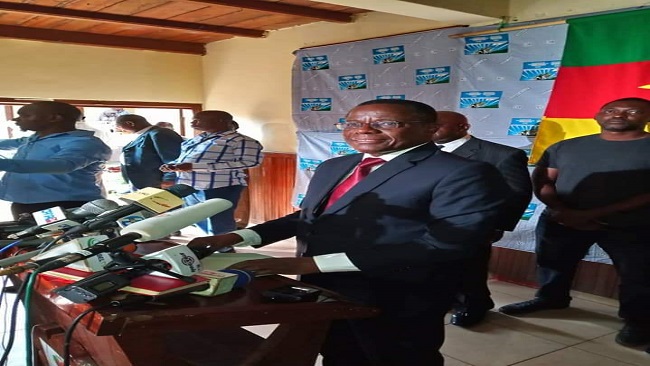
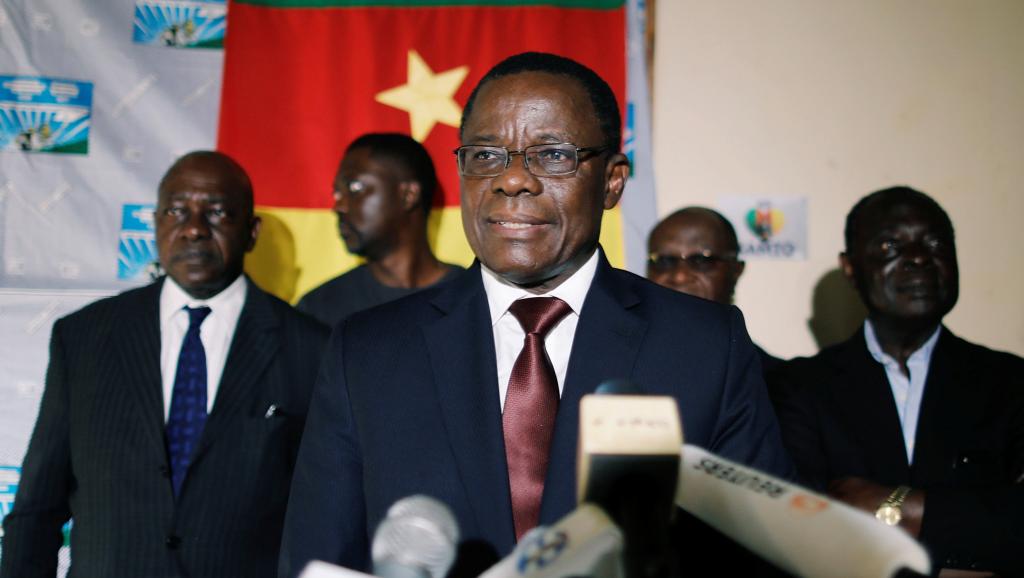
Cameroon’s political crisis has taken a turn for the worse as government forces have arrested the winner of last year’s presidential election, Professor Maurice Kamto, a prominent law professor who has vowed that the people’s victory must be returned, or the country will be made ungovernable.
Arrested along with Prof. Kamto was Mr. Albert Dzongang who was with Mr. Kamto at the time the police arrived. Mr. Kamto was at Mr. Dzongang’s home where they were strategizing on the next move in their bid to reclaim their stolen victory.
But the arrest of the learned lawyer was not that easy. As the police arrived Mr. Dzongang’s home, the population came out to ensure their leaders were not arrested. With the crowd increasing, the security forces decided that it was better to negotiate, but when the population was adamant, the forces decided to use tear gas and fired at the crowd, wounding several supporters of Maurice Kamto. Mr. Kamto and several of his supporters have been taken to Yaounde where they will be charged with all the crimes and sins in the world.
In a related story, another senior opposition politician, Celestin Djamen, was picked up from his hospital bed and taken to an unknown destination. Mr. Djamen had been shot on Saturday, January 26, 2019, within the framework of the demonstrations organized by Mr. Kamto and his MRC party. Mr. Djamen was whisked off to an unknown destination with five other persons who had been shot by the police on Saturday.
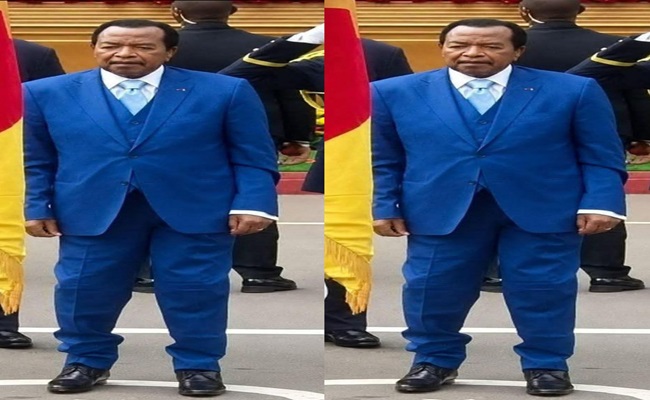
Prof. Kamto’s arrest only deepens the country’s political crisis that has brought its economy to its knees. Under Mr. Paul Biya, the country’s president, Cameroon has witnessed serious and several political and economic crises and this has fragilized the entire sub-region.
Mr. Biya’s rulership which is predicated upon corruption and nepotism has created huge divisions within the country, with many Cameroonians holding that merit has no place in the country. With Mr. Kamto’s arrest, the government has opened another front in its struggle to stay in power. Cameroon has been dealing with many military challenges in recent times. In the north, it is facing a tough Boko Haram insurgency that has resulted in the deaths of thousands of civilians.
In a bid to turn tables on Boko Haram, government forces have been committing violent crimes in the north, making it hard to win hearts and minds in the region. On many occasions, government troops have been caught on video in flagrant acts of human rights violation. The shooting of a woman and her daughter as well as the killing of some young unarmed boys in a village in the north were the incidents that shocked the world the most.
To hide its crimes, the government alleged that the heartless killing of a lady and her children occurred in Mali, a situation that prompted Amnesty International and the International Crisis Group to investigate and the investigations revealed that the incidents actually occurred in the northern part of Cameroon.
In the East, armed groups from the Central African Republic (CAR) remain a dangerous menace to the local population and the military. The armed groups have been carrying out incursions on towns and villages in Cameroon’s eastern region.
But it is the Southern Cameroons crisis that has become a millstone around the government’s neck. A crisis that started as a simple strike by teachers and lawyers in October 2016 is gradually making the independence of the two English-speaking regions of Cameroon a certainty, especially as there are targeted killings and huge refugee movements in and out of the country.
Ever since the crisis started, the country’s president also known as the “monarch”, has refused to listen to many respectable people across the world. The Pope has had an opportunity to talk to Mr. Biya. Leaders of Western Countries have advised him to pursue dialogue as a sure means out of the impasse. But all the advice has fallen on deaf ears.
Cameroon, a once peaceful nation, has been gripped by the ‘dictator’s disease’; a disease that attacks African countries that have been ruled by sit-tight dictators. The Democratic Republic of Congo, the Central African Republic and Somalia are some of the African countries that have been victims of this devastating disease.
Many African dictators always bequeath civil wars and political chaos to future generations when they leave power. In many cases, they leave power forcefully or through a civil war. Cameroon is on its way to joining this unfortunate club as Mr. Biya and his collaborators hold that the best way to address political issues is to unleash a reign of terror on the people they are supposed to govern and protect.
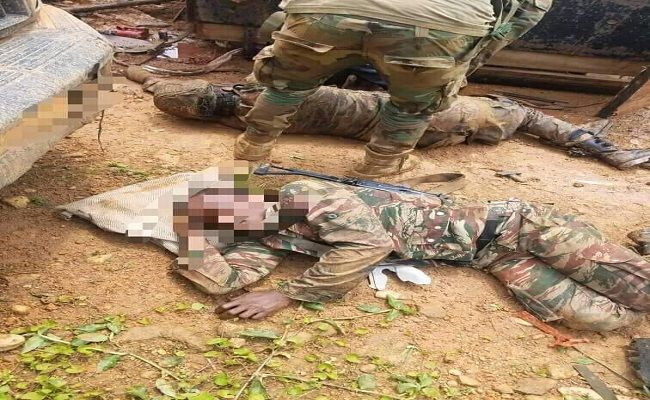
The Southern Cameroons crisis which could have been addressed through an inclusive dialogue has today become a civil war wherein government soldiers are shooting and killing many innocent civilians, as they cannot fully engage the Southern Cameroons fighters who are lurking in the jungles. The fighters, for their part, are using rudimentary weapons to protect themselves and this is adding to the chaos that has made life unbearable in the English-speaking regions.
The fighting is unfortunately consuming many young soldiers who have been pushed by the government to go and kill Southern Cameroonians whose initial objective was to put their grievances to the government. The government’s violent response caused the demands of Southern Cameroonians to mutate and, today, almost all Southern Cameroonians, even those in government, are in support of secession.
In many towns and villages in the two English-speaking regions, corpses of young innocent civilians are being discovered at roadsides and the government seems to be padding itself on the back for accomplishing such a feat. It is a really tough to know that government officials of Beti extraction are really celebrating when their fellow compatriots are being shot down point blank. It is even more baffling to know that the same authorities have kept on talking about one and indivisible Cameroon when their brutality is slowly dividing the country.
To defend themselves, many young Southern Cameroonians have taken to the jungle and many are now using whatever means that are available to them to fight a government they believe is intent on killing all the young men in the region. The fighting clearly indicates that Cameroon will never be the same again. Holding a country together clearly goes beyond political sloganeering and brinkmanship.
From every indication, the crisis has entered a very critical stage with the government holding that the more people it kills, the greater its chances of keeping the country one and indivisible. The government is gradually losing Southern Cameroons. Its high-handedness is dividing the country. In a bid to keep the country one and indivisible through force, it is only succeeding to tear it apart.
Time is gradually running out. It is time to make necessary changes. The government has to abandon its legendary high-handedness if it wants to keep Cameroon one and indivisible. Terrorizing its people and intimidating political opponents will not keep Cameroon one and indivisible. The government must seek to meet Southern Cameroonians halfway if it really wants to keep the country united. The ball is in its court. The world is watching. The country’s president has refused all useful advice and this will surely turn out to be his Achilles heels. Arresting Prof. Kamto might be that mistake the government might regret for a long time.
By Chi Prudence Asong on special assignment in Yaounde











29, January 2019
Corruption seen rising in Trump’s US 0
The United States last year slid down the rankings of a global corruption index as America’s system of checks and balances faced growing threats on Donald Trump’s watch, Transparency International said Tuesday.
The US lost four points to score 71 out of 100 on the watchdog’s 2018 Corruption Perceptions Index, sending the country tumbling out of the top 20 for the first time since 2011.
“The low score comes at a time when the US is experiencing threats to its system of checks and balances as well as an erosion of ethical norms at the highest levels of power,” TI said in its annual report.
The second year of Trump’s presidency was a turbulent one, ranging from damaging revelations in an investigation probing links between Trump’s 2016 campaign team and Russia, to his controversial backing for a Supreme Court nominee accused of sexual assault.
The US leader, who frequently rails against the media for writing “fake news”, was also dogged by accusations of nepotism and conflicts of interest. Last month, Trump agreed to close his personal charity after the New York attorney general said it had acted “as little more than a checkbook to serve Mr. Trump’s business and political interests”.
Transparency International’s closely-watched index ranks 180 nations according to their perceived level of public sector corruption, where a score of zero means very corrupt and 100 signifies very clean.
“The Trump presidency has illuminated the cracks in the US system for ensuring a government that is accountable to the public interest,” TI’s Zoe Reiter, acting representative to the US, told AFP.
“But President Trump is a symptom rather than a cause; the issues were there before he took office. For example, the Office of Government Ethics simply doesn’t have the teeth to control for conflicts of interest at the highest levels,” she said.
– Rise of autocrats –
As in previous years, New Zealand and Nordic countries were among the best in class with Denmark narrowly beating New Zealand to the top spot at 88 and 87 points respectively.
Strife-torn Somalia was once again the worst performer, below Yemen, South Sudan and Syria which all scored in the low teens.
The Berlin-based watchdog also singled out Turkey and Hungary for falling down the rankings, blaming “the deterioration of rule of law and democratic institutions, as well as a rapidly shrinking space for civil society and independent media”.
“With many democratic institutions under threat across the globe ?- often by leaders with authoritarian or populist tendencies -? we need to do more to strengthen checks and balances and protect citizens’ rights,” TI’s managing director Patricia Moreira said.
As part of its recommendations, the group urged governments to stand up for a free press and support civil society organisations that encourage public oversight over government spending.
The index is compiled based on data from 12 international organisations including the World Bank, African Development Bank and the World Economic Forum.
AFP