
22, April 2025
Cardinal Kevin Farrell will be the next Pope 0
When the world learned of Pope Francis’ death on Monday morning, an Irish-American cardinal, little known in the wider world, was the one to break the news.
After announcing that the pope had “returned to the home of the Father”, Irish-American Cardinal Kevin Farrell took on one of his biggest roles yet: the “camerlengo”, or the person who runs the Vatican after the death or resignation of a pope.
Pope Francis nominated the cardinal for the role in 2019. The cardinal will remain in the position during the “Apostolica Sedes Vacans”, the period between the death or resignation of a pope until the election of the next pontiff.
He also will play an important role in the centuries-old ceremonies to mourn Pope Francis.
Born in 1947 in Dublin, Farrell attended the University of Salamanca in Spain and the Pontifical Gregorian University in Rome, according to the Vatican.
He held roles in churches around the world, serving as a chaplain at the University of Monterrey in Mexico as well as at a parish in Bethesda, Maryland.
All told, the 77-year-old spent more than 30 years working for churches in the US.
Farrell was appointed Bishop of Dallas in 2007 until Pope Francis asked him in 2016 to serve as the leader of the Vatican’s new department responsible for the pastoral care of families, raising him to the rank of cardinal.
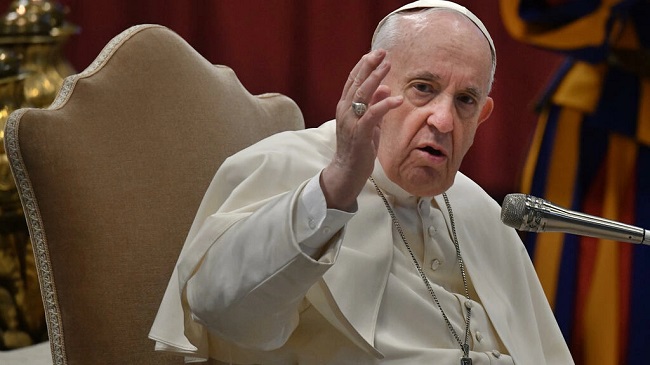
Cardinal Kevin Farrell and other Vatican officials announce the death of Pope Francis in a video statement from the Vatican on 21 April.
Years after naming him as camerlengo, in 2023, Francis chose Farrell as president of the Supreme Court of Vatican City State. He was also named president of the Commission for Confidential Matters.
How the next Pope is chosen
As camerlengo, Cardinal Farrell will be tasked with making arrangements for the conclave, the process through which the next pontiff is selected.
Technically, a camerlengo can become pope, as has happened twice in history: Gioacchino Pecci (Pope Leo XIII) in 1878 and Eugenio Pacelli (Pope Pius XII) in 1939.
The cardinal also will preside over the certification of Francis’s death, laying his body into the coffin. After that, the cardinal is expected to lead a procession moving the pope’s body from the chapel of the Domus Santa Marta to St Peter’s Basilica.
The ceremony could take place as soon as Wednesday morning, according to the Vatican.
Source: BBC















22, April 2025
Over half of World Bank projects in Cameroon now flagged as high risk 0
More than half of the World Bank–funded projects in Cameroon are now considered “at risk” due to poor execution, slow disbursements, and looming deadlines, government officials said during a recent review of the country’s World Bank portfolio.
Out of 17 national projects backed by the World Bank, 9 have fallen behind schedule, according to Cameroon’s Ministry of Economy, Planning and Regional Development (Minepat), which oversees coordination with the Bank. These include efforts to expand rural electricity, improve secondary education, support digital transformation, and respond to food insecurity.
Among the most critical cases is the country’s digital acceleration project, known as PATNUC, which has only used 15.4% of its CFA55 billion budget, even though it launched in 2023. “We have completed the midterm review and found good solutions to speed up delivery,” said Guy Ronel Guemaleu, deputy director of multilateral cooperation at Minepat.
Other struggling projects include the CFA87 billion rural electrification project (PERACE), which is nearing its deadline in just two months with only 45% of funds disbursed. The education-focused PADESCE project, worth CFA73 billion, is also behind, with just 42% of funds used and a closing date in December.
Cameroon’s emergency response to food insecurity (PULCCA), under the Ministry of Livestock and Fisheries, is moving slightly faster, at 53% disbursement, but it too is set to close later this year. Another major program, PROLOG, aimed at boosting local governance and resilience, was approved in 2023 with a CFA172 billion budget but was recently rated “moderately unsatisfactory.”
Despite these setbacks, a few projects are showing strong performance. These include initiatives focused on transport development, education reform, adaptive social protection, and regional economic development (PIDREC), Guemaleu noted.
Still, the broader picture is worrying. Many of these World Bank projects target essential sectors such as infrastructure, education, health, and agriculture. Delays and poor execution risk limiting their long-term impact.
Guemaleu explained that the main issues include unrealistic planning, late approval of work plans and budgets, a poor grasp of social and environmental procedures, and weak familiarity with the rules governing project management units. He also pointed to slow procurement processes, land access problems, and long wait times for required approvals.
The current World Bank portfolio in Cameroon includes 17 national projects, 15 of which are active, with a total budget of CFA2,429 billion. As of April 2025, the overall disbursement rate stands at just 32.76%, below the expected 38% for projects that are on average 3.8 years old. For the current fiscal year, the rate is even lower—just 16.36%—with hopes to reach 20% by June 30. The undisbursed committed balance is an estimated $3.014 billion (about CFA1,844.4 billion), according to Guemaleu.
The situation is just as concerning from the World Bank’s point of view. Cheick Fantamady Kanté, the Bank’s Country Director for Cameroon, confirmed that 69% of committed funds have not yet been used. “As of March 2025, the annualized disbursement rate is at 15%, far below the 20% target,” he said. “This has been a consistent problem since the 2018 fiscal year, when the rate stood at 17.9%.”
Source: Business in Cameroon