Featured
 Who really pushed for the return of the Vice President of the Republic?
  When politics fails a nation, football and the Church become the battleground
  Biya has had his era; Cameroon must now be allowed to enter its next one
  Biya’s hand: a source of glory and shame
  So, Cameroonians, what exactly do you want from President Biya?
Most Commented Posts
 4 Anglophone detainees killed in Yaounde
18 comments Chantal Biya says she will return to Cameroon if General Ivo Yenwo, Martin Belinga Eboutou and Ferdinand Ngoh Ngoh are sacked
13 comments The Anglophone Problem – When Facts don’t Lie
12 comments Anglophone Nationalism: Barrister Eyambe says “hidden plans are at work”
12 comments Largest wave of arrest by BIR in Bamenda
10 comments
Featured
-

Dangote refinery launches continent’s biggest IPO
-

Norway joins 11 other states to criminalize trade with West Bank settlements
-

Southern Cameroons Crisis: 3 civilians, one Amba fighter killed in Ekona
-
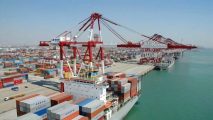
White Elephant: Kribi Port sinks to 395th globally after one of the sharpest drops in performance
-

President Putin says figures reflect ‘structural, deep, profound shifts’ in global economy
-

Dion Ngute reaffirms peace efforts amid fresh violence in Ambazonia
-

Yemen’s Houthis seize key island in Bab al-Mandab strait
14, September 2026
White Elephant: Kribi Port sinks to 395th globally after one of the sharpest drops in performance 0
Cameroon’s Kribi deep-sea port has recorded one of the world’s steepest declines in container-port performance since 2020, with longer vessel turnaround times placing it near the bottom of the World Bank’s latest global ranking.
Kribi ranked 395th out of 400 ports in the 2025 Container Port Performance Index (CPPI), published in June 2026 by the World Bank and S&P Global Market Intelligence. Its score fell to -216.5 points from -5 in 2020, a deterioration of 211.5 points over five years.
Calculations based on the report’s statistical appendix show that Kribi posted the fifth-largest decline among the 317 ports with scores available for both 2020 and 2025. Within the CPPI’s West Africa maritime region, only Conakry performed worse over the period, with a 278.9-point decline.
Kribi’s deterioration was not continuous. Its score fell to -118 in 2021 before recovering to -84 in 2022 and -62 in 2023. It then deteriorated sharply to -199 in 2024 and reached its lowest level in 2025. Kribi also performed well below the 2025 averages for West Africa, at -66.2 points, Sub-Saharan Africa, at -72, and lower-middle-income countries, at -9.
An Index of Port Time, Not a Percentage Change
The CPPI measures the time container ships spend in port while accounting for vessel size and the number of container moves during each call. Its data come primarily from Automatic Identification System signals, supplemented by port and operational information held by S&P Global Market Intelligence.
Each port’s final score is the average of an administrative index and a statistical index. The report breaks port calls into arrival time, berth time and departure time, but specifies that the CPPI calculation relies on arrival and berth time. The methodology, definitions and aggregation rules have been maintained across the 2020-2025 series to allow comparisons over time.
A score of zero represents the 2024 global average, which serves as the benchmark. A negative score therefore indicates longer turnaround times relative to that benchmark, but index points cannot be converted directly into hours.
Describing Kribi’s change from -5 to -216.5 as a decline of more than 4,200% would be misleading because the calculation would start from a negative value very close to zero. The relevant measure is the 211.5-point deterioration.
Kribi’s 2025 score is based on 183 vessel calls. The appendix shows that ships spent 47.3% of their port hours at berth. That figure does not refer exclusively to productive time: the World Bank defines berth hours as the period from all-fast to all-lines-released, including any idle time.
For Kribi, the report does not provide separate figures for anchorage waiting times, maneuvering, container handling or interruptions while vessels are at berth.
PAK Attributes Decline to Yard Congestion
The report does not provide a Kribi-specific explanation for the decline. Two officials from the Port Authority of Kribi (PAK), contacted by Business in Cameroon, attributed longer vessel stays to congestion at the container terminal operated by Kribi Conteneurs Terminal (KCT).
The first official pointed to “idle time,” including waits before berthing, delayed starts to container handling and interruptions while vessels remain at berth. The official rejected equipment or skills shortages as the cause and said KCT’s cranes regularly reach or exceed 24 container moves per hour, a level described as an international benchmark.
The CPPI, however, publishes no data on crane productivity at Kribi that would independently verify that claim.
The second official cited the lack of an Inland Container Depot, or dry port. Such a facility would allow containers that remain beyond their free-storage period to be transferred away from the maritime terminal. According to the official, the project was already under consideration in 2021 based on traffic forecasts but did not materialize.
The official linked its absence to an eight-hectare expansion of the container yard launched in 2026 to provide additional storage capacity. The source also said the terminal reached “100% congestion” in 2025, without specifying whether that referred to yard occupancy, an annual average or a temporary peak. PAK publicly acknowledged operational difficulties, delays and bottlenecks reported by customs brokers on July 30, 2026, but provided no indicators on yard occupancy or vessel turnaround times.
Feeder Delays May Extend Container Storage
Port officials also point to increased transshipment traffic. Since Phase II officially entered service on May 9, 2025, Kribi has been able to accommodate vessels up to 400 meters long with capacity approaching 24,000 twenty-foot equivalent units.
PAK valued the expansion at $793 million. It includes 715 meters of quay and a 51-hectare platform.
According to one official, at least one very large container ship now calls at Kribi each month and can unload several thousand containers for onward shipment to other ports in the subregion, including Douala. A CMA CGM service plan published in December 2025 confirms that Douala is served by feeder vessels on a route that calls at Kribi.
Shipping companies organize those feeder rotations. When a vessel scheduled to collect containers arrives several days or weeks late, cargo remains in the yard. Terminal teams must then move containers to free space before the next ship arrives. “No matter how productive your cranes are, it can be very difficult when you have a congested yard,” one source said.
That explanation is consistent with one of the mechanisms identified by the World Bank: saturated storage areas and poor coordination with hinterland networks can slow vessel handling. The CPPI score alone, however, does not establish that this is what happened at Kribi.
A fuller assessment would require monthly data on anchorage waiting times, berth inactivity, yard occupancy, container dwell times and feeder schedule reliability. Available information also does not specify the timeline for the planned dry port or when the additional eight hectares of container-yard capacity will enter service.
Source: Business in Cameroon