
26, November 2021
Several Southern Cameroonians injured by Cameroon gov’t forces in Kendem, Batibo and Bali 0
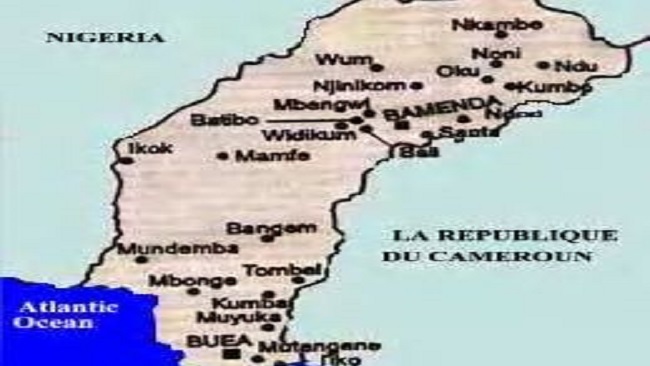
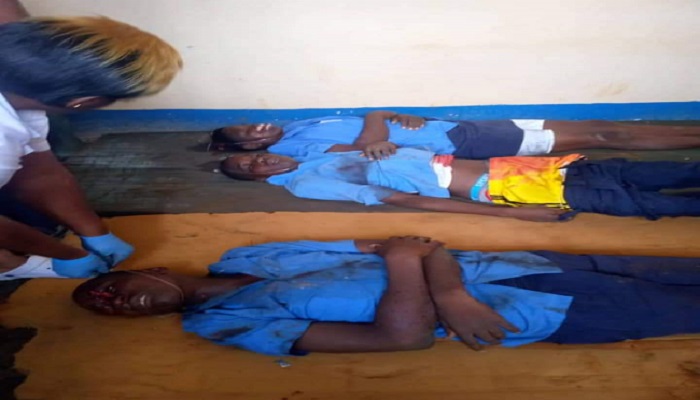
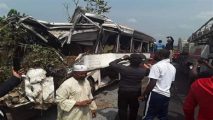
At least 45 Southern Cameroonians including women and children have been injured by soldiers loyal to the Biya Francophone regime in Yaounde on the Mamfe-Bamenda highway.
A Roman Catholic cleric cited sources in Kendem, Batibo and Bali as saying that 45 Southern Cameroonians were hit by bullets fired by Cameroon government troops fighting against Ambazonia Revolutionary Guards who recently blocked the main road linking Bamenda to Mamfe.
The prelate said that the 45 Southern Cameroonians had also suffered breathing difficulties due to inhaling French made tear gas used by the Cameroon government army soldiers against the Amba fighters in Kendem, Batibo and Bali.
Since the killing of two primary school pupils by Francophone army soldiers in Buea and Bamenda, Southern Cameroons has seen intensified clashes between Cameroon government troops and Southern Cameroons Self Defense Forces.
Also in Ekondo Titi, Cameroon government troops used live ammunition and bullets against students in Government Bilingual High School and blamed the attack on Amba fighters.
The war in Southern Cameroons has created a business empire for top military officers in Yaounde. About forty thousand Southern Cameroons civilians have lost their lives in this war. More than a million persons have fled to Nigeria and other countries as refugees, and millions have been made IDPs. More than 600 towns and villages and countless homes have been burnt down by French Cameroun troops. Hundreds of females have been raped (a good number deliberately infected with HIV and other STDs), scores of children killed in targeted killings, food and food crops and livestock destroyed to impose conditions of famine, water sources defiled and polluted to provoke a pestilence, and mass graves punctuate the landscape.
Genocide, war crimes and crimes against humanity are being committed in the Southern Cameroons by French Cameroun military which systematically continues to kill women, teenagers, and even babies, the elderly, the infirm. Presidents Emmanuel Macron, Paul Biya and Buhari bears direct responsibility for these heinous crimes.
The UN Security Council has so far failed to assume its responsibility under Chapter VII of the Charter of the United Nations to deal with French Cameroun’s colonial war in the Southern Cameroons. In the circumstances, it is not inconceivable that the Southern Cameroons abandons the self-defence posture to which it has so far restrained itself, in accordance with Article 51 of the UN Charter. It may eventually go on the offensive and broaden its offensive posture by targeting economic and social infrastructure in French Cameroun that support that country’s war effort, in the same way social and economic infrastructure in the Southern Cameroons continues to be targeted by the French Cameroun army. The objective of this new offensive would be to bring it home to Macron and Biya that their fanciful claim that “l’Ambazonieestcamerounaise” (Ambazonia belongs to Cameroun) is a pipe dream and that pursuing it will be very painful for French Cameroun in 2022 in the same way as the French claim that “l’Algerieestfranaise” (Algeria belongs to France) was for France in 1962. The people of the Southern Cameroons strongly reject any idea or suggestion, explicit or implicit, that the Southern Cameroons is an area under French influence given that the Southern Cameroons does not have and has never had any ties, colonial or otherwise, with France.
By Fon Lawrence with additional reporting from the Camcordnews desk
















26, November 2021
Netherlands tightens Covid health measures to stem record surge in cases 0
The Dutch government on Friday ordered further restrictions including a nighttime closure of bars, restaurants and most stores to stem a record-breaking wave of COVID-19 cases that is threatening to overwhelm the country’s healthcare system.
The surge in the Netherlands, the worst in Western Europe, came even though 85% of the adult population have been vaccinated, with infections now rising most quickly among schoolchildren, who are not vaccinated.
“The (infection) numbers per day are high, higher, highest,” caretaker Prime Minister Mark Rutte said at a televised press conference. “That means that we can’t get there with just a few small adjustments.”
The current wave of Dutch cases, running above 20,000 infections per day for the past week, has continued despite restrictions including the reintroduction of face masks and closure of bars and restaurants after 8 p.m. imposed by Rutte’s government earlier this month.
Rutte said on Friday non-essential stores would be closed from 5 p.m. to 5 a.m., and masks would be required in secondary schools.
His government urged everyone who can to work from home, and if they cannot, to follow social distancing guidelines.
The new measures go into effect from Nov. 28.
Some experts had argued that a short, near-total lockdown, including school closures, would be needed to push infections down.
Law enforcement officials were preparing for possible unrest after a demonstration in The Hague on Friday to protest against the new measures.
A government proposal – which is not yet policy – to bar unvaccinated people from public places prompted three nights of rioting last weekend.
Dutch hospitals were instructed on Friday to postpone all non-emergency operations to free up beds in intensive care units. Some patients have been transferred to neighbouring Germany.
Source: REUTERS