
26, January 2021
Bundes: Far-right AfD braces for surveillance 0
Germany’s domestic security agency is on the verge of announcing whether the far-right AfD will be placed under surveillance for posing a threat to democracy, dealing a potential blow to the anti-immigration party in a key election year.
After a two-year investigation and a report totalling over 1,000 pages, the Federal Office for the Protection of the Constitution (BfV) is to decide in the coming days if the Alternative for Germany (AfD) will be classed as a “suspected case” over its ties to right-wing extremism.
The classification would allow intelligence agents to shadow the party, tap its communications and possibly use undercover informants.
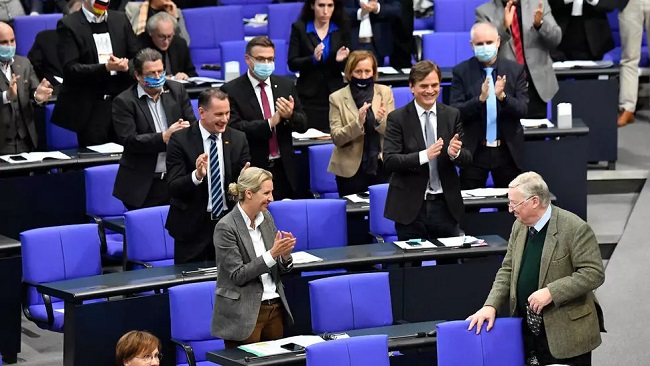
The anti-Islam, anti-immigration AfD has often courted controversy by calling for Germany to stop atoning for its World War II crimes. Senior figure Alexander Gauland once described the Nazi era as just “a speck of bird poo” on German history.
The BfV’s decision comes at a sensitive time for the AfD. While it is the largest opposition party in parliament, it has seen its ratings fall as the pandemic has kept the spotlight firmly on Chancellor Angela Merkel’s ruling coalition parties.
AfD leader Joerg Meuthen has vowed to take legal action if the BfV decides to begin surveillance, accusing the government-run agency of playing politics in what pundits have dubbed a “super election year” in Germany.
The AfD faces six regional elections this year and a general election on September 26, the first in over 15 years that won’t feature Merkel.
The first regional test will come with state polls in Baden-Wuerttemberg and Rhineland-Palatinate on March 14, where support for the AfD is hovering around 10 percent.
– Radical ‘Wing’ –
The AfD started out at as an anti-euro outfit in 2013 before capitalising on public anger over Merkel’s 2015 decision to allow in a wave of asylum seekers from conflict-torn countries like Syria, Afghanistan and Iraq.
The AfD took nearly 13 percent of the vote in the 2017 general election, allowing it to make its debut in the German Bundestag.
But the party has long been locked in an internal battle between an extremist faction and populist, conservative members who are wary of scaring off mainstream voters.
Germany’s domestic intelligence service already placed a radical fringe of the party, known as The Wing, under surveillance last year over its association with known neo-Nazis and on suspicion of violating the constitution.
The faction, led by firebrand Bjoern Hoecke, dissolved itself last March but many of its 7,000 members remain active in the AfD.
“This gives rise to doubts about whether they really lost influence,” Der Spiegel weekly said.
Hoecke, the AfD’s leader in Thuringia state, famously referred to Germany’s Holocaust Memorial in Berlin as “a monument of shame” and has called for a “180 degree reversal” in the country’s remembrance culture.
The AfD’s Thuringia branch and another one in Brandenburg have also been designated as “suspected cases” of right-wing extremism by the BfV.
The authorities’ concern about the AfD has grown after the country suffered a string of right-wing, anti-Semitic attacks in recent years. The risk of violence from Germany’s far-right scene is now considered the country’s top threat.
AfD chief Meuthen has struggled to rein in the party’s more radical figures, telling a congress in November that they would not win over voters by being “increasingly crude, aggressive”.
He also rubbished comparisons of the current coronavirus restrictions with a “dictatorship”, as AfD lawmaker Gauland had done.
Nevertheless, more than a few of the AfD’s 35,000 members are believed to harbour extremist sympathies.
One of them, Andreas Kalbitz, was the head of the AfD in Brandenburg before he was kicked out for hiding his past membership in a neo-Nazi youth group.
“The AfD could be declared a suspected case because it is dominated by the radical wing of the party, whose influence has only grown in recent months,” Hajo Funke, a political scientist at Berlin’s Free University, told AFP.
As for the party’s chances at the ballot box in 2021, Funke said “endless” infighting had left the AfD without clear policies, settling instead on “simply saying the opposite of whatever the government proposes”.
Source: AFP






















26, January 2021
Southern Cameroons Crisis: Atanga Nji Militia’s deadly PSS Mankon attacks 0
In the early hours of Friday 22nd and Saturday 23rd January, about 21 gunmen from the Atanga Nji Militia stormed PSS Mankon boarding school. The attackers attempted to lock the dormitories and later on set it on fire.
Yaoundé has already blamed the incident on Southern Cameroons Self Defense Forces but people in the know in Bamenda are saying the attacks were carried out in an area protected by government troops.
Some 60 girls and 73 boys were rushed out of the dormitories. Our correspondent in Bamenda revealed at the time of filing this report that three female students sustained life threatening injuries.
A source at the North West governor’s office that spoke to Cameroon Concord News but sued for anonymity said elements of the Cameroon government Army Rescue were in PSS Mankon on Saturday night at the time of the action and came under attack from Ambazonia Restoration Forces.
There are conflicting reports as to which side should be held responsible for Saturday’s attacks with the pro Biya Moderator of the Presbyterian Church in Cameroon, Rt. Rev. Fonki Samuel Forba saying “the source of the fire is yet to be ascertained”.
The office of the Southern Cameroons Vice President is maintaining a kind of deliberate silence on the matter and no Ambazonia group has claimed responsibility.
In a statement the Moderator noted that “Two separate fire incidences at the campus of PSS Mankon on Friday, 22nd and Saturday 23rd January 2021 affected three dormitories and the property of some students. The students in the affected dormitories have been relocated and the Proprietor, in collaboration with the Education Secretary and the administration of the school, is doing everything possible to ensure that affected students are well catered for.”
A beaming Senior Divisional Officer for Mezam, Simon Emile Mooh has ordered the Mayor of Bamenda II to begin reconstruction of the boys ‘dormitory while the Mayor of Bafut is to focus on the girls’.
By Fon Lawrence in Bamenda