
23, March 2020
Cameroon: Coronavirus numbers are rising 0
The number of Cameroonians carrying the deadly Coronavirus is increasing at a speed that is causing the country’s authorities to lose sleep.
Despite efforts by the government to draw attention to the danger waiting to strike the country, many Cameroonians have continued to live a life of recklessness.
In Douala and Yaounde which are heavily populated, many people have been going about their business as if nothing is happening despite the gory pictures coming out of Italy, China and the United States.
In Yaounde, the nation’s capital, army soldiers on Saturday resorted to force to close down many watering holes where there many people eating and drinking as usual in defiance of the government’s rules against the virus that is killing people around the world.
In Douala, bar owners have come up with brand new tricks to keep their clients. Rears doors into the drinking spots are now being used to access these drinking places which are potential hotspots.
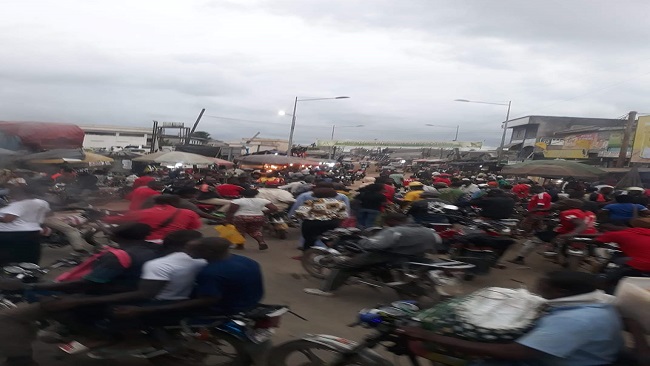
Thousands of Cameroonians are still visiting their local crowded markets to buy and sell as if there is no danger. And musical shows are unfortunately still a feature of the city’s social landscape.
The government knows it has a crisis on its hands and it is using its limited resources to raise awareness of the danger that is prowling the country’s streets.
But the message does not seem to be hitting its target. Cameroonians love their alcohol and with it, come many problems. The insidious virus loves crowds as that makes it easy for it to spread and Cameroonians are willingly granting it a platform for it to spread like wildfire.
While the government might be doing its best, it’s best is simply not good enough. So far, testing and diagnostic equipment is only available in Yaounde and Douala and 70%of the country’s population lives in other towns and cities.
Ever since the government came out with a slew of preventive measures, Cameroonians have continued to travel from one city to another in total defiance of government regulatory efforts aimed at containing the virus.
Like most European countries, the country’s government has also made some attractive noises about a possible lockdown, but these measures are more nominal than real.
Cameroon is not organized like Western countries and its citizens are noted for their indiscipline and disregard for the law.
Schools have been shut down, and some businesses have also been asked to close down for a period of time that might help to slow down the virus’ spread. A very great initiative that must be hailed. It is proof that the government wants to act.
However, its measures seem to be dead on arrival as the country’s citizens are simply ignoring them. Maybe if the government had followed up with supporting measures like Western countries have done, Cameroonians would have been very happy to comply with the government’s anti-coronavirus rules.
It will be hard for the country to be locked down as many Cameroonians do not have a steady source of income like people in the West. Many Cameroonians must go out every day to hustle in order to earn a meager income that will enable them to feed their families.
Store owners have to open for their clients to continue buying, and they themselves have to go to the big markets in downtown Yaounde and Douala to get supplies that will guarantee them a steady flow of income. This makes things really hard and the virus seems to be making hay while the sun shines in a country that also lacks proper healthcare facilities.
The hardest hits are commercial sex workers who can no longer display their assets in public, especially at night. The military is patrolling the streets of Yaounde and Douala at night and this is scaring clients of this old trade that has always been a huge vector in the spread of viral diseases such as HIV and Ebola.
The hardworking women of this sector are facing tough times and there are no government tax incentives to support the women who are being avoided by their former clients. If there are no tax incentives for registered businesses, it will be hard for the informal sector to have any financial support from the government.
The commercial sex sector is therefore under threat. This is a vulnerable sector. Since viruses are mostly transmitted through body fluids, it is clear that many of those who patronize this sector will prefer to keep a safe distance, as any close contact with these women could spell death.
This is not the first time that the sector is facing tough challenges. In the 1980s when HIV/AIDS became the new boogeyman, many commercial sex workers had to flee the streets and before anti-retroviral could be engineered, a generation of efficient commercial sex workers had been retired against their wish and without a retirement income. That is for those who were smart and lucky to leave early as HIV/AID had decimated the population of those involved in this business.
The government of Cameroon must continue to implement its measures to ensure that the virus is constrained. It must use the media to get its messages across. The Coronavirus is nobody’s friend and it has no regard for class.
Presidents, parliamentarians, lawyers, doctors and others are today its victims. If any Cameroonian still has doubts about what the virus can do, he or she should just watch TV to understand that this virus is extremely virulent.
It has hit Italy like a tonne of bricks, left Donald Trump with a sticky situation and made mincemeat of the global economy. The global tourism sector is the hardest hit and it will take many months for this once vibrant sector to recover. Many people have been laid off and as the virus continues to spread across the globe, many are scared that it will take a long time to find a cure for this virus that is still a challenge to scientists.
By Dr. Joachim Arrey
















23, March 2020
President Sisiku Ayuk Tabe is willing to talk peace, but only with UN backing 0
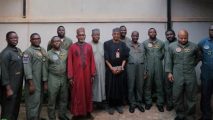
Sisiku AyukTabe is due to appeal his life sentence in court in April. The leader of the bloody quest for an independent Ambazonia in Anglophone Cameroon told DW about his terms for dialogue with the regime in Yaounde.
“It will be a shame for the international community to wait and come late, as was the case in Rwanda,” Sisiku AyukTabe told DW. The Ambazonian leader sounded the often repeated warning in a written reply to DW from his cell at Yaounde Principal Prison. AyukTabe and nine members of his de facto cabinet had just heard from their lawyers that their appeal case was postponed to April 16. A military court condemned the 10 men to life in prison for terrorism and incitement in August 2019. They had been among scores of separatists who were detained in a brutal crackdown by the regime of President Paul Biya. The separatist movement, AyukTabe told DW, is open to dialogue but on condition that the regime in Yaounde is not at the forefront. A UN-backed mediation process is the only way forward.
In 2017, secessionists declared the Anglophone parts of Cameroon, known also as Southern Cameroons, as an independent nation called Ambazonia ‘An issue of sovereignty’ “Southern Cameroons is fighting for a total and unconditional independence from Cameroon as opposed to the independence by joining [French Cameroon] to which we were lured by the United Nations and the Trusteeship System in 1961,” said AyukTabe. Four years into the separatist struggle, Biya still sees the conflict as an internal matter. His national dialogue for peace was stillborn and his decision to grant ‘special status’ for the English-speaking North West and South West regions rejected. “The Special Status as conceived by the regime of Cameroon’s president, Mr. Paul Biya, is clearly a joke in very bad taste,” said AyukTabe. Biya, he argues, is in no position to confer any status on any portion of the Anglophone regions. “The conflict in Southern Cameroons relates to issues of sovereignty brought about by a botched UN decolonization of the former trust territory of the Southern Cameroons under United Kingdom administration.” The people of the region are united and determined to right the wrongs of an aborted independence process and to “restore their sovereignty,” he told DW.
Anglophone separatists leaders were absent from President Biya’s dialogue for peace in September 2019 President Biya’s internal matter Political analyst John Ako agrees that Biya’s interventions to end the crisis to date are laughable at best. “Of what nature is the so called special status in Cameroon? A special status in reality including government officals is known as nothing. In fact there is no substance to the special status.” In the meantime, the bloodshed has continued unabated. An accurate picture of the atrocities and the cost to human life in the Anglophone regions is hard to gauge. The UN puts death toll at 3,000 and the number of internally displaced people at more than 679,000. In November 2016, lawyers and teachers in the region embarked on a series of street demonstrations to demand equal treatment. Their civic action later morphed into frequent running gun battles between the military and separatist fighters. AyukTabe and his followers have been engaged in a full-scale armed separatist struggle since. The bodies have been piling up and residents have been fleeing the most volatile parts of the Anglophone regions as Biya’s army tries to crush the movement. Some 60,000 of them have crossed the border into Nigeria. Over 855,000 children have been unable to attend school amid the fighting and tensions for several years. AyukTabe insists that Biya must withdraw the military from the streets of the regions, free those who have been detained over the conflict. That, and engaging in talks mediated by the UN, would address the root causes of the crisis.
Separatists are arming up Political analyst John Ako warns of the risk that fighting could escalate as separatist fighters, known locally as “Amba Boys” who started with Dane guns have now acquired sophisticated weaponry and experience. “The days are getting darker because these boys have not only gained experience and formal training in neighboring countries, but are bringing sophisticated weapons too,” Ako told DW. Human Rights Watch has reported that the armed separatists have committed untold atrocities in the Anglophone regions. AyukTabe told DW that the perpetrators were militias who are sponsored by the Biya regime that wants to “demonize“ the separatist movement. “The pace, intensity and gruesomeness of killings has accelerated in recent times. The presence of Ambazonian self-defence fighters is the only thing preventing the complete extermination of the civilian population in Southern Cameroons,” he said. “For the very few self-defence fighters that were foolish enough to heed to Mr. Biya’s call and dropped their weapons, they have been subjected to torture, imprisonment and even summary execution.” Ako says the question of which side is to blame is not that clear cut. “The Ambazonian soldiers are committing a lot of errors. If they miss their target and continue attacking civilians and civilian targets such as churches, markets, or schools, these are war crimes.”
Civilians in Cameroon caught up in separatist battle
An appeal court victory? In the separatist strongholds of Buea and Bamenda, many believe that the release of AyukTabe and other separatist leaders could signal a return to peace. “Let them be released so people can get back to their normal lives because there has been a lot of suffering,” Sangtum Banabas, a 33-year-old commercial motorbike rider, told DW. Tem Hycenth is sad that thousands have died in the Anglophone regions. He wants the two sides to the conflict to make peace for the sake of the people. Taniform Jonas is of another opinion. “Cameroon has no judicial system. It is only Almighty God who will free the detained Ambazonia leaders. I pray that President Paul Biya pardons them so we can have peace again,” the 67-year-old said. As Cameroon reports a rising number of coronavirus cases, concern is growing in the conflict-torn regions and many would like to see an end to conflict sooner rather than later, in order to deal with the outbreak. Ayuk Tabe and the others were arrested in Nigeria in January 2018 and extradited under questionable circumstances. Around seven months later, at a nightlong trial in a military court in Yaounde, he and his co-accused were convicted and sentenced to life in prison. The 10 had asylum status in Nigeria at the time of their arrest. AyukTabe and his de facto cabinet have appealed their conviction. The hearing is set for April 16, 2020 in the Yaounde Appeal Court. DW asked barristers what they thought of Ayuk Tabe’s pending appeal case.
President Paul Biya is one of Africa’s longest-serving leaders Diplomacy, not guns Defence lawyer Amungwa Tanyi Nico is sure that the verdict of the military court will ultimately be overturned. It has been a case that is “more political than judicial” being heard in “kangaroo courts,” he said. “We’ve been putting our best as usual in order to get the public to understand that our people can never have justice here because at the court of first instance — the military tribunal they were supposed to be freed. That court did not have the competence to try people with refugee status.” But Julius Achu, a lawyer for the regime in cases against the separatists, believes the appeals court could amend the military court’s verdict. “The judges take the decision according to their consciences and the law,” he told DW. It is his view that releasing the separatists would have little effect if the fighters who hiding out in the bushes of the Anglophone region fail to disarm. “There’s no government in this world that will ever accept that you take up arms and say we should separate and they accept to separate.”
Culled from DeustcheWelle