Featured
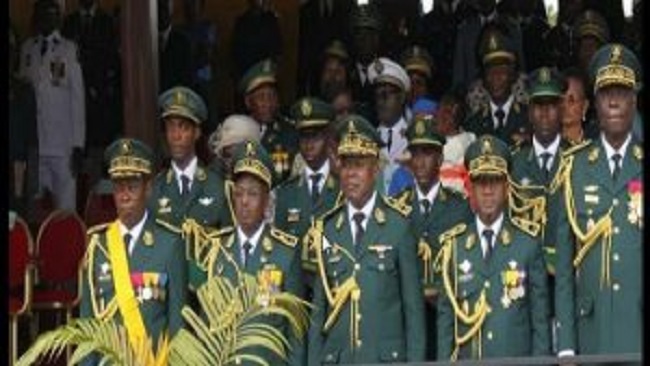 The Cameroonian army must put its conscience to the test
  Who really pushed for the return of the Vice President of the Republic?
  When politics fails a nation, football and the Church become the battleground
  Biya has had his era; Cameroon must now be allowed to enter its next one
  Biya’s hand: a source of glory and shame
Most Commented Posts
 4 Anglophone detainees killed in Yaounde
18 comments Chantal Biya says she will return to Cameroon if General Ivo Yenwo, Martin Belinga Eboutou and Ferdinand Ngoh Ngoh are sacked
13 comments The Anglophone Problem – When Facts don’t Lie
12 comments Anglophone Nationalism: Barrister Eyambe says “hidden plans are at work”
12 comments Largest wave of arrest by BIR in Bamenda
10 comments
Featured
-

Martinez Zogo Trial: questions over missing phone linked to Amougou Belinga
-

Revealed: Colonel Danwe admits ordering Martinez Zogo operation
-

Archbishop Nkea to battle decade of war with new peace Catechism
-

Southern Cameroons Crisis: 7 kidnapped by suspected Amba fighters in Bangourain
-
Southern Cameroons Crisis: 3 killed, 2 injured in bar shooting in Bamenda
-
US military nearing ‘breakdown’ amid sustained Iranian attacks
-
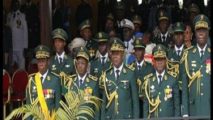
The Cameroonian army must put its conscience to the test
24, July 2026
Beti Assomo says military should increase focus on economic warfare threats 0
Cameroon’s Defence Minister Joseph Beti Assomo has called on senior military officers to strengthen their ability to identify and counter financial, technological and information-based threats.
Speaking in Yaounde on July 22 at the graduation ceremony of the 21st class of the International War College, or ESIG, Beti Assomo said modern economic warfare increasingly relies on financial pressure, strategic resources, digital technologies and information manipulation rather than conventional military force.
According to the minister, economic warfare extends beyond trade disputes and includes the use of financial flows, technology, supply chains, strategic resources and manipulated information to weaken rival states.
“The weaponization of financial flows, strategic resources and digital technologies has become a weapon in its own right. Our officers must learn to identify, analyze, master and counter these threats,” he said.
The minister’s remarks come as Cameroon remains dependent on international trade, foreign financing, imported technologies and cross-border infrastructure networks.
Potential vulnerabilities include reliance on imported equipment, exposure of transport and energy infrastructure, dependence on foreign markets for commodity exports, access to international payment systems, cyber operations and financial networks linked to armed groups. Pressure on supply chains, financial channels, strategic resources or digital systems could therefore have security consequences without involving direct military confrontation.
The issue is particularly relevant to sectors in which external dependence can affect both economic activity and national-security capabilities. Disruptions affecting imported technology, defense equipment, energy infrastructure or payment networks could constrain the state’s ability to operate and respond to crises.
Growing Institutional Attention
Beti Assomo’s remarks add to a series of initiatives showing that economic-security issues are receiving increased attention within Cameroon’s military and intelligence institutions. However, the government has not publicly presented these efforts as part of a single national strategy on economic warfare.
In May 2026, ESIG held its annual international colloquium in Yaounde under the theme, “Economic Warfare: What Are the Strategic Challenges for Africa?”
Opening the forum, Secretary of State for the National Gendarmerie Galax Etoga Yves Landry said modern conflicts were increasingly being conducted through economic and financial means, making strategic intelligence and economic autonomy important components of national security.
The colloquium examined sanctions, trade restrictions and control over strategic resources as instruments of influence and power projection. Discussions also covered industrial resilience, strategic planning, regional integration and technological sovereignty.
Participants highlighted strategic autonomy, technological sovereignty, regional economic integration and control over information narratives as areas requiring greater attention. These conclusions were presented as recommendations from the forum rather than as formally adopted government priorities.
Economic warfare has also featured in initiatives involving Cameroon’s intelligence services. In July 2025, the General Directorate of External Research, or DGRE, organized specialized training in economic intelligence and economic warfare for 50 intelligence professionals. The program focused on strategic intelligence, informational sovereignty, counter-influence operations and geoeconomic risks.
Reports on the training also referred to discussions over the possible creation of a National Centre for Economic and Strategic Intelligence. No formal announcement regarding the establishment of such a body has been made.
Efforts to Reduce Defense-Sector Dependence
Separately, Cameroon has pursued projects intended to expand domestic production capacity in the defense sector and reduce reliance on imported equipment.
In September 2025, the Ministry of Defence inaugurated a Central Tailoring Workshop for the Armed Forces and Gendarmerie in Yaounde’s Ekounou neighborhood. The facility can produce more than 750 combat uniforms a day, while the government has also referred to plans for footwear and ballistic-equipment factories.
In April 2026, the government also signed three agreements with local private-sector partners covering armored-vehicle conversion, ballistic-protection manufacturing and the production of mechanical spare parts. The agreements were presented as part of an import-substitution drive under Cameroon’s National Development Strategy, or NDS30.
Source: Business in Cameroon