2, April 2025
CPDM Crime Syndicate: Biya’s acolytes expected to fill bureau vacancies 0
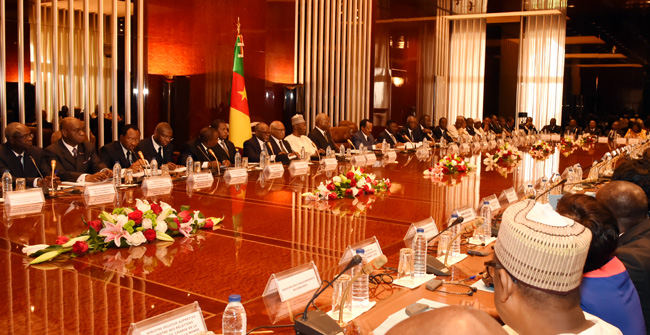
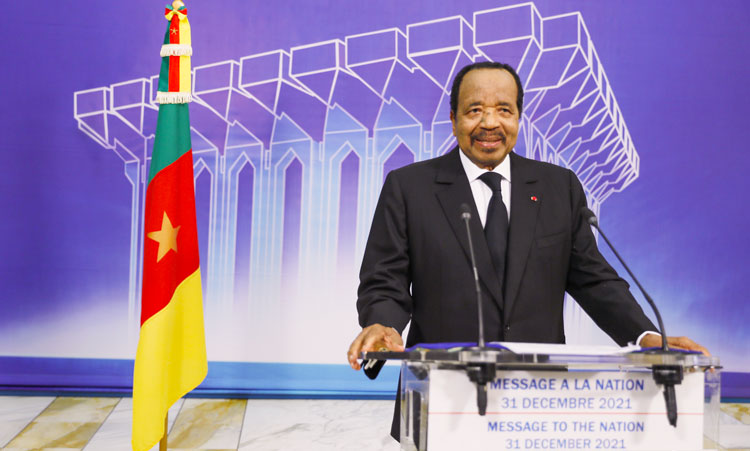
Recent appointments to the Central Committee of ruling Cameroon People’s Democratic Movement (CPDM) have fueled speculation about potential expansions to the party’s influential Political Bureau, party members and political analysts say.
The Political Bureau, considered the CPDM’s core decision-making body, has not been renewed since the 2011 congress and has seen its membership dwindle from 23 to 14.
The bureau, designed to assist the national president in managing party affairs between Central Committee meetings, is composed of 20 members elected by the congress and three appointed by the president.
Since 2011, seven members have died: Jean-Bernard Ndongo Essomba (Centre), Medjo Delphine (South), Sultan Mbombo Njoya Ibrahim (West), Janvier Mongui Sossomba (East), Mohamadou Abbo Ousmanou (Adamawa), Zang Nguele Rose (Centre), and John Ebong Ngolle (Southwest).
Additionally, Emmanuel Bonde (East), appointed to the Constitutional Council, has also passed away. Former minister Marafa Hamidou Yaya, imprisoned since 2012 for embezzlement, further reduces the bureau’s ranks, leaving only 14 of the original 23 members.
A party congress would not only facilitate the inclusion of new members into the Political Bureau but also finalize the recent Central Committee additions, which followed the President’s appointments on March 26.
Source: Business in Cameroon




















3, April 2025
Race for the Unity Palace: Kamto’s strategy sparks clash ahead of election 0
A public spat has erupted within Cameroon Renaissance Movement (MRC), with former party executive Armand Noutack accusing activist Wilfried Ekanga of labeling party founders “careerists.” Noutack’s comments followed Ekanga’s social media post criticizing those who sought legislative or municipal office, a move Ekanga attributed to “careerism.” Noutack, expelled from the MRC in July 2023 by leader Maurice Kamto, was reacting to Ekanga’s defense of the party’s 2020 election boycott.
Ekanga’s remarks came in response to Sosthène Médard Lipot, another former MRC executive, who, during an April 1 appearance on state broadcaster CRTV, criticized the boycott. Lipot argued that the MRC would continue to suffer from the decision, revealing he only learned of the boycott while filing his candidacy at the Yaoundé Urban Community. “The overwhelming majority of party officials, myself included, were surprised by Maurice Kamto’s decision,” Lipot stated.
Calling the unilateral decision a “major strategic mistake,” Lipot expressed shock and confusion. “You can imagine the emotional shock. I didn’t know how to explain to anyone that I had no idea what was going on,” he said.
Ekanga, however, defended the boycott, stating, “No one in the MRC regrets the boycott. On the contrary, we celebrate it every 1982 seconds. It was the best political decision of the last ten years! Especially since it in no way prevents us from putting forward a candidate in the elections.”
Noutack countered, mocking Ekanga’s stance. “While Maurice Kamto claims that the MRC has elected officials (one wonders how), Ekanga boasts about a boycott that supposedly eliminated the ‘traitors.’ Very well, but then where do the elected officials Kamto talks about come from? Jupiter?“
Noutack further questioned Kamto’s consistency, noting his past electoral attempts. “Since the party’s creation, Maurice Kamto has never missed an election: in 2013, he tried to become a member of parliament… failure. In 2018, he aimed for Etoudi… failure. In 2020, since it didn’t directly concern him, he chose to boycott, citing the Anglophone crisis and the electoral code.“
Former MRC executives and political opponents argue that Kamto should bear the consequences of the 2020 boycott, given that the cited reasons—the Anglophone crisis and electoral law criticisms—remain unresolved.
Beyond the internal disputes, questions remain regarding Kamto’s eligibility to run in the 2025 presidential election. Cameroon’s electoral code requires candidates to be nominated by a party with institutional representation or secure 300 endorsements. The MRC’s 2020 boycott complicates the first option.
Kamto claims his party has elected officials who joined post-election, meeting the legal requirement. However, legal experts dispute this, arguing only officials elected under the party’s banner qualify. Without a valid nomination, Kamto may be forced to seek endorsements, a process often hindered by political pressure.
This debate, dividing opposition and legal circles, casts uncertainty over the MRC’s electoral strategy and Kamto’s 2025 candidacy.
Source: Sbbc