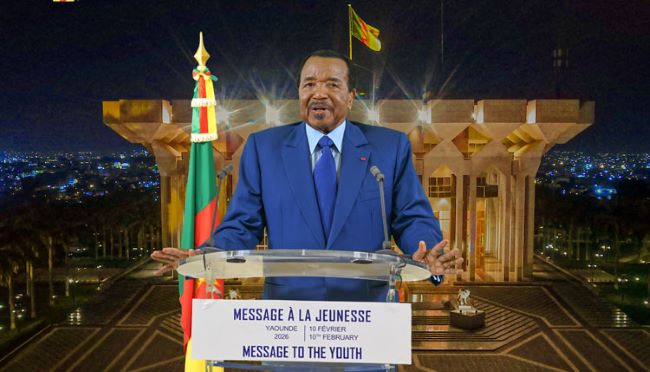
10, February 2026
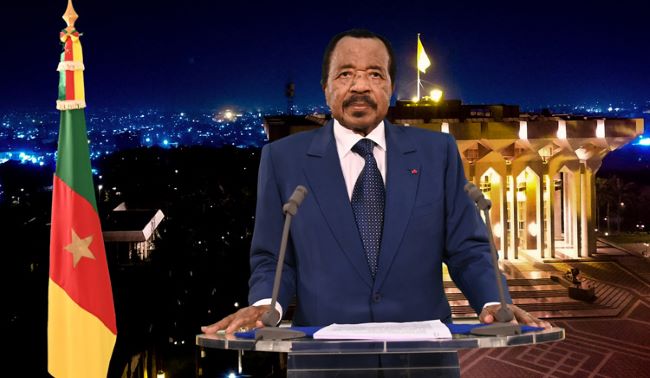
Biya’s message to the Youth on the 60th edition of the National Youth Day 0
My dear young compatriots,
The celebration of this sixtieth edition of the National Youth Day is once more a welcome opportunity for me to address you on the many issues that concern you.
I am aware that these issues relate to your current situation, but also, and above all, to your future. They concern your difficulties, frustrations, fears and worries. They also relate to your hopes, expectations and legitimate aspirations.
My dear young compatriots,
I am fully aware of your concerns, all the more so because, under my authority, the Government is making tireless and commendable efforts to seek appropriate solutions to them.
This comes as no surprise. I have never stopped, and will never stop, caring about you.
My dear young compatriots,
As I address you this evening, just a few months after my re-election as President of the Republic, I wish to express my deep satisfaction for the role you played in this election and, above all, to thank you most sincerely for your invaluable support, without which none of this would have been possible.
I am aware that the key element in this particularly hard-fought election was undoubtedly the support of a large majority of young people for the vision for society as well as your appreciation of the track record I presented. I also sincerely believe that it reflects the trust and loyalty you have consistently shown me since I assumed office at the helm of our country. For this, I am deeply grateful to you.
My dear young compatriots,
When taking the oath of office, I made a solemn commitment before you and before the entire Nation, to devote all my energies for the advent of a stable, united and prosperous Cameroon.
I intend to honour this commitment, regardless of the difficulties and obstacles arising from an ever increasingly challenging international environment. I am convinced that we will succeed in achieving this objective together, thanks to my unwavering determination, your courage and your multiple talents.
My dear young compatriots,
I am aware that some of you are at a loss when you encounter difficulties in finding a job or achieving your goals. This prompts you to doubt the future and to give up on your dreams or embark on some dangerous venture.
This can, in no way, be the solution. I encourage them to rather persevere. I encourage them to continue to trust their abilities. I encourage them to continue to be enterprising and forge ahead, no matter the difficulties and obstacles. This is the key to success.
My dear young compatriots,
I promised you in my recent speeches, that your integration into the labour market would be one of the main priorities of this seven-year term.
That is the objective of the Special Youth Employment Promotion Plan that I recently announced. The Government has already prepared related incentive measures. The Plan aims to foster genuine synergy between the State, the private sector and the wider society to promote job creation for young people.
In this regard, I would like to mention, among other things, tax exemptions granted to businesses that recruit young graduates, the allocation of 50 billion CFA francs provided for in the Finance Law to promote youth entrepreneurship, the increase in subsidies to the National Employment Fund, and measures taken to integrate young people into State-financed labour-intensive works.
All these efforts, my dear young compatriots, mark the start of implementation of the commitments I made recently to you.
My dear young compatriots,
Under my authority, the Government will continue to allocate substantial resources to strengthen and improve the education system.
My objective is to offer as many of you as possible the opportunity to access quality training, that will enable you not only to find jobs, but also to create them.
As you are aware, recruitment in the public sector or enterprises cannot alone fully resolve the thorny issue of youth unemployment. That is why I will continue to encourage youth entrepreneurship and ensure that young people receive appropriate Government support to that end.
Despite the challenging context, I am pleased to note that many of you are excelling in the agricultural processing, construction, services and digital sectors where you start up businesses and create jobs each day. With each passing day, you distinguish yourselves with boldness and competence in all areas of national life.
In this regard, I would like to commend your invaluable contribution within our defence and security forces to ensuring our common protection.
I would like to pay tribute to all of you, young people in the informal sector, who have chosen to steer clear of criminal and delinquent activities and struggle daily to feed your families. Note that, in my view, there is no such thing as odd-job and there will never be. You all play an essential role in the building and progress of our beloved and great country.
That is why I will ensure that an increasing number of you, women like men, are gradually entrusted with high responsibilities in the management of public affairs.
Various opportunities come to my mind in this regard, including the upcoming reshuffle of managers of State corporations, the formation of the next government, which I know is eagerly awaited, as well as the organization of legislative and municipal elections, though the timeframe for the elections may require a minor adjustment due to pressing constraints, in compliance with the relevant provisions of our laws, especially the Constitution.
My dear young compatriots,
I would also like to remind you this evening that besides the rights you have, you also have responsibilities towards your parents and the national community. I wish to appeal especially to your sense of responsibility. The future of our beloved and great country, Cameroon, lies in your hands. You must be aware of this. You should therefore resolutely shun the excesses in which some of you have unfortunately drifted in recent times, including delinquency, alcohol abuse, drug use, immoral behaviour, the excessive and abusive use of social media, etc.
I also urge your parents and educators to act responsibly. They must fully assume their responsibility towards you and refrain from tolerating, facilitating or encouraging your deviant behaviour. In this regard, I have issued firm instructions to the relevant authorities to strengthen the protection of young girls in schools, families and workplaces, as they are too often victims of all kinds of harassment and abuse.
My dear young compatriots,
I wish to reaffirm my commitment to spare no effort in creating the most conducive conditions for your development. This underpins the instructions I have issued to the Government to act more effectively. It is the objective of the reforms I intend to implement soon to improve the functioning of the State. It is also the objective of the relentless fight I intend to wedge against corruption and the embezzlement of public funds.
My dear young compatriots,
As you prepare to celebrate the 60th anniversary of the national day dedicated to you, I wish to commend the maturity you have consistently demonstrated in all circumstances. Once again, I commend your decisive contribution to building our great and beautiful nation.
I urge you to continue working to preserve our precious achievements, namely peace, national unity and stability of our institutions.
Happy Youth Day to you all!
Long live Cameroon!












20, February 2026
Ethnic armies and the democratization process in Cameroon: an impediment to democratic consolidation 0
Cameroon presents a compelling case of the complexities surrounding civil- military relations and the democratization process in post-colonial African states. Since independence in 1960, the country has experienced extended one- party rule, contested multiparty reforms beginning in the 1990s, and recurrent tensions between the central government in Yaoundé and various ethnic, regional, and political actors. A key, yet under-mined, dimension of this political trajectory is the role of the ethnic character of the army and how it has functioned as an obstacle to democratic deepening and political liberalization. This article argues that the ethnic configuration of Cameroon’s military establishment has been a significant hindrance to democratization by reinforcing patrimonial state structures, undermining civilian authority, and inhibiting the development of inclusive national institutions. While the literature on ethnic armies and coups in Africa (e.g., Harkness 2006) offers valuable frameworks, Cameroon’s experience highlights how ethnic dynamics within the army interacts with politics, neopatrimonialism, and sociopolitical fragmentation to impede democratic consolidation.
HISTORICAL BACKGROUND: ETHNICITY, STATE FORMATION, AND THE MILITARY IN CAMEROON
Cameroon’s colonial history-first German under German rule (1884-1916), produced divergence administrative legacies. These legacies have shaped post- independence identities and political structures. The reunification of British Southern Cameroons and French Cameroon in 1961 created a state with significant linguistic and regional cleavages, most notably between Anglophone and Francophone communities. Overtime, these divisions have been translated into political competition and grievances. The Cameroon Armed Forces (Forces Armees Camerounaise, FAC) were establishment under French colonial influence, with early officer corps dominated by recruits from northern and Francophone elite network. This pattern of recruitment contributed to perceptions of the military as an instrument of the dominant political bloc rather than a neutral, national institution. As President Ahmadou Ahidjo consolidated power in the 1960s and 1970s, he used patronage and co-optation to secure the military’s loyalty, embedding ethnic and regional loyalty within military structures. Under Paul Biya, who succeeded Ahidjo in 1982, the military remained an essential pillar of regime survival. Biya’s early purges of Ahidjo loyalists-including army officers from northern and Muslim communities-reinforced the perception of the military as an arena of factional competition. Instead of fostering professionalization and national coherence, the army became increasingly tied to the President’s personal networks and loyalist ethnic/regional blocs, especially those linked to the Beti-Ewondo group from the Centre and South regions. This pattern has important implications for democratization, as outlined below.
A. UNDERMINING CIVILIAN CONTROL OF THE MILITARY
A core prerequisite for democratization is the establishment of civilian supremacy over the armed forces. In Cameroon, the military’s recruitment patterns and internal hierarchies have often reflected ethnic and regional dominance rather than meritocratic professionalism. The privileging of officers from ethnic networks has created informal power centers within the army that are interconnected with ruling party elites. In turn, this undermines the capacity of democratic institutions-parliaments, courts, political parties-to exercise meaningful oversight over security forces. When the military is perceived as loyal to certain elite factions rather than to the constitutional order, it obedience to civilian authority becomes contingent. This conditional obedience weakens democratic accountability and allows the executive to wield the army as a tool of political coercion rather than national defense. An example to substantiate this point was the post election violence that ensued after the proclamation of the October 11, 2025, presidential election result. Several Cameroonians were killed and many were incarcerated by the regime.
B. REINFORCING NEOPATRIMONIALISM AND ELITE DOMINATION
Ethnicized military structures compliment broader neopatrimonial state practices in Cameroon, where political power is centralized around the presidency and distributed through patronage networks. Senior military appointments, promotions, and postings are often used as rewards to loyalists from key ethnic constituencies particularly in the centre and south regions of Cameroon. This practice not only marginalizes other groups but also embeds the military within the executive’s patrimonial rent-seeking apparatus. Accordingly rather than serving as a professional force capable of defending democratic norms and institutions, the army operates as another arena of elite competition and patronage distribution. This undermines the development of autonomous democratic actors and reinforces centralized, authoritarian governance.
C.PERPETUATING ETHNIC AND REGIONAL CLEAVAGES
The ethnicisation of the army has also had indirect but powerful effects on national unity. By privileging certain ethnic groups within military hierarchies, the states reinforce broader social perceptions of exclusion among marginalized communities. This has been particularly salient in Cameroon’s Anglophone regions where perceptions of exclusion from political power and state institutions-including security forces-have fueled long-running grievances and conflict. This dynamics complicate democratization by generating cycles of mistrust, resistance, and militarized dissent. Instead of inclusive dialogue and political participation, dispute over representation and identity are increasingly securitized-a pattern antithetical to democratic deepening.
D.REIFORCING EVIDENCE FROM COMPARATIVE SCHOLARSHIP
The argument that ethnic armies can impede democratization resonates with broader comparative research. Scholars such as Kristen Harkness have shown that the ethnic structuring of security forces in Africa is associated with recurring coups and democratic fragility, as leaders manipulate military composition to secure political survival. In the Cameroon’s case why the military has not staged a successful coup since the early years of independence, its embeddedness within patronage and ethnic networks has nonetheless served a similar stabilizing-yet-anti-democratic function. Rather than challenging the executive through coups, the army’s loyalty is instrumentalized to suppress dissent, reinforce the ruling elite’s dominance, and marginalize alternative political voices. This pattern underscores the need to broaden the concepts of coups to include other forms of military interference that undermine democratic processes.
E. COUNTER ARGUMENTS AND LIMITATIONS
A potential counter argument is that Cameroon’s military has largely abstained from direct political takeover, suggesting a degree of professionalism or restraint inconsistent with ethnicisation. However, this perspective overlooks how the army’s alignment with the incumbent regime functions as a direct impediment to democratization. This absence of coups does not equate to democratic health if military is used to suppress opposition, intimidate civil society, or entrench executive power. Another critic is that ethnic considerations within the army are overstated related to other factors, such as economic incentives, global geopolitics, or institutional weakness. While these factors are undeniably significant, the ethnic dimension in Cameroon amplifies and intersects with them, intensifying the obstacles to democratic reforms.
F. POLICY AND REFORM IMPLICATIONS
It should be worth mentioning that, addressing the impediment of ethnicised military structures requires:
1- A Security Sector Reform (SSR) that prioritizes meritocratic recruitment, transparent promotion systems, and professional training.
2- The reawakening of institutional oversight mechanisms, including strengthening parliamentary committees on defense and ensuring budgetary transparency.
3- The convening of a National Dialogue on inclusion, particularly addressing grievances in Anglophone regions to mitigate the ongoing crisis for close to a decade today and expanding representation within the security forces.
These reforms, while politically challenging, are essential for decoupling the military from elite-ethnic patronage dynamics and enabling democratic consolidation.
CONCLUSION
Using the failed coup attempt in April 1984, to his advantage, Biya then moved forward with discriminatory hiring and promotion policies of his own, within both the civilian government and the military. Over the course of his reign, which continues today, southerners have come to dominate both politics and military (Minority Rights Group 2010). In particular, members of Biya’s southern Bulu group, as well as members of the closely related Beti group, disproportionately hold key positions in the military. Stability was thus re-achieved through renewed ethnic matching policies. Cameroon’s experience demonstrates that ethnicised military structures can constitute a significant obstacle to democratization. By undermining civilian control, reinforcing neopatrimonialism, and perpetuating ethnic cleavages, the army has not only failed to support democratic deepening but has actively sustained authoritarian resilience. Understanding the specific ways in which ethnic dynamics shape civil-military relations is very crucial for both scholarship and policy aimed at fostering democratic transition in Cameroon in particular and across Africa in general
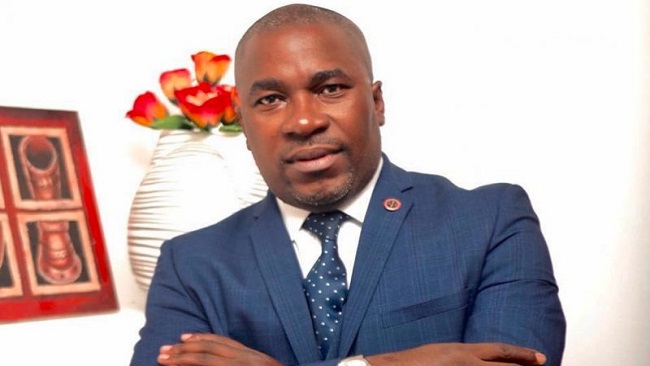
Dr. TARH NTANTANG is the Founder/CEO of Ntantang Research and Consulting Centre (NRCC) in Yaoundé-Cameroon. He is a policy expert and practitioner in democratic support, peace building, and governance with over a decade of experience across Africa. He holds a doctorate in political Economy at the University of Yaoundé 1 and a certified climate migration scholar at York University, Toronto, Canada.