21, September 2022
Southern Cameroons Crisis: Children should be able to return to school 0
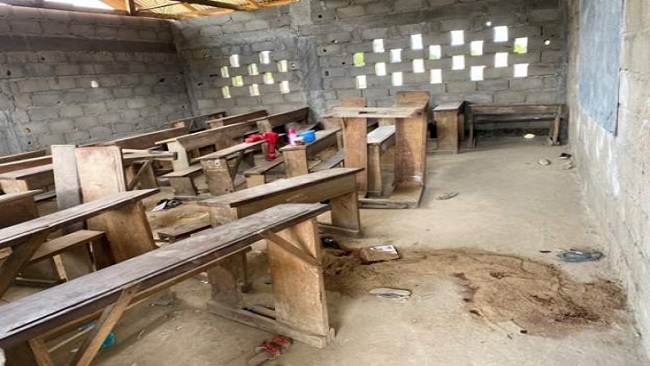
Since 2016, fighting between separatist insurgents and the military has disrupted the education of over 700,000 children in Cameroon’s two Anglophone regions. As the school year starts in September, education in the conflict-affected regions is at risk again. The two sides should strive to protect schools from being attacked and keep classrooms open.
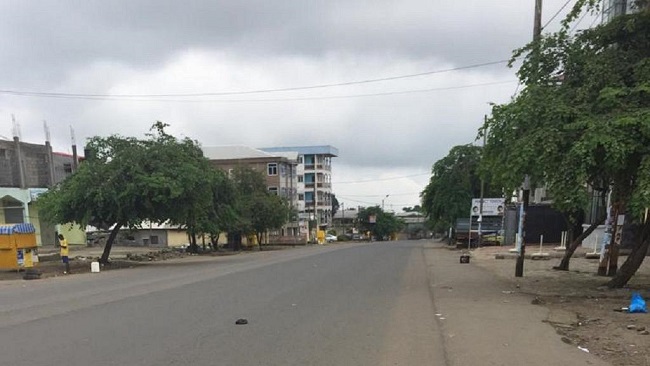
At the start of Cameroon’s academic year on 5 September, schools in the two Anglophone regions kept their doors shut to comply with a general strike (locally known as a “ghost town” operation) imposed by separatist militias combating the government in Yaoundé. The following day, only a handful of schools offered classes, primarily in the relatively safe towns of Buea and Limbe.
School’s out
Some separatist groups have ordered public schools in the Anglophone regions to remain closed until at least 1 October. On that day five years ago, separatists proclaimed the independent Federal Republic of Ambazonia, as they call the North West and South West regions. In response to the boycott, government officials said they considered shuttering so-called community schools, which are run by volunteers in separatist-controlled areas.
Civilians have borne the brunt of the fighting between separatist militias and Cameroon’s security forces. The conflict has killed about 6,000 people, displaced more than 500,000 and severely disrupted access to government services in the Anglophone regions. Attempts by Anglophone peace campaigners and foreign facilitators to resolve the conflict peacefully have stalled. Sadly, as Cameroon’s conflict parties repeatedly use access to education to push their political objectives, children are paying a disproportionately high price. The UN estimates that two of every three schools in the North West and South West have closed indefinitely.
The Anglophone crisis began in 2017 when lawyers and teachers staged peaceful protests aimed at preserving the two regions’ distinct legal and educational systems. At the time, unions and civil society organisations called for a school boycott in order to push for negotiations with the government and demand the release of detained Anglophone activists. A heavy-handed army crackdown on protesters calling for the two regions’ secession from Francophone Cameroon then hardened the resolve of many Anglophones, triggering armed rebellion.
Yet, though popular at first, the school boycott quickly lost support as separatist militias began destroying schools and killing teachers who continued working. Tens of thousands of children were denied the chance to go to school for months on end, sometimes years. By 2018, an estimated 4,000 Anglophone schools had shuttered, eventually depriving over 700,000 children of regular classes for almost four academic years.
Some died in the mayhem, too. In October 2020, suspected separatists stormed a private school in the town of Kumba, slaughtering at least seven children and injuring thirteen others. In 2021, separatists killed four students and a French language teacher in Ekondo Titi.
The lack of access to quality education is worsening the already dire socio-economic crisis plaguing the Anglophone regions. Pressure from Anglophone civil society prompted some separatist groups to formally call off the school boycott in 2020, but attacks on schools continue unabated. Overall, the conflict has severely harmed the education system. Schools that are still operational are often damaged or overcrowded. Teachers have fled, without being replaced. Parents who can afford to do so are now sending their children to schools in the Francophone regions.
Disproportionate struggles
The targeting of schools has had a particularly pernicious impact on girls. Parents who have seen their incomes dwindle prefer to send their boys to school, keeping girls at home to help with chores or small trades. Yet others who have fled to Cameroon’s Francophone regions have to fend for themselves, sometimes leaving their daughters out of school and vulnerable to recruitment into sex work.
Despite successful campaigning against the school boycott by Anglophone communities and women groups over the past two years, the latest tug of war over education risks robbing thousands of children of the chance to learn yet again. More critically, it could set the scene for another military escalation by raising tensions ahead of 1 October, when separatist sympathisers typically hold anti-government protests.
Instead of calling for a school boycott or threatening to close voluntary learning centres, Cameroon’s conflict parties should use the start of the school year as an opportunity to mitigate the suffering of children in the Anglophone regions and build trust with local communities. Separatist activists in Cameroon and abroad should unconditionally call off all school boycotts. If they do so, the government in Yaoundé should acknowledge the gesture as a de-escalating measure.
For their part, international partners who are committed to resolving the Anglophone conflict should urgently remind the two sides of their obligations to protect civilians and ensure children’s right to education.
Culled from The Africa Report














22, September 2022
Battle For Southern Cameroons: Peace Foundation Fears for Anarchy as Militias Get Out of Control 0
Groups claiming to be fighting for the independence of the Northwest and Southwest English-speaking regions of Cameroon have been increasing in number, a situation that is running out of control, the leadership of the Catholic peace and charity foundation, Denis Hurley Peace Institute (DHPI), has said, and expressed concern that the Central African nation may be sliding into anarchy.
In a Tuesday, September 20 interview with ACI Africa, DHPI Director, Johan Viljoen, said that leaders of the various separatist groups who have been attacking locals are no longer able to manage “their own fighters”.
“It is clear that the leaders of the various groups of separatist fighters have no control over their own fighters. An attack happens and you see the leaders issuing statements condemning the attack carried out by their own people. The fighters have gone out of control and what we fear is that the situation in the Northwest and Southwest parts of Cameroon may be deteriorating into anarchy,” Mr. Viljoen said.
The DHPI Director recounted that what started in 2017 as a pro-independence movement in the Northwest and Southwest region of Cameroon known as Ambazonia, and supported by all locals, has since evolved into separate militia groups that have turned against locals in a series of kidnappings for ransom and, sometimes, killings.
The Director of the peace entity of the Southern African Catholic Bishops’ Conference (SACBC) recounted that at the onset of the independence struggle in the Northwest and Southwest regions of Cameroon, the most recognized pro-independence leader, Julius Ayuk Tabe, was imprisoned, but continued to enjoy widespread support even as the Cameroonian military engaged the fighters to stem the insurgency.
Today, however, infighting amongst pro-independence groups has resulted in what the DHPI Director has referred to as “breakaway interim governments” with each one claiming to be the legitimate representative of the Ambazonian people.
The various factions often engage in armed attacks on each other, Mr. Viljoen said, and explained, “Atrocities against civilians by the Cameroonian army hardly happen anymore. Kidnappings and attacks on villages are now mostly committed by separatists.”
According to the DHPI Director, the tide is turning in the Northwest and Southwest regions of Cameroon as people who have undergone immeasurable suffering at the hands of the militias now express a preference for the President Paul Biya-led government over the separatist fighters.
“Grassroots sentiment is now turning against the separatists, with many locals saying that if these are to be the military and police force of an independent Ambazonia, then they are probably better off under the Biya government,” Mr. Viljoen told ACI Africa September 20.
He expressed concern that attacks against churches and kidnapping of church personnel including Priests and Nuns have been increasing, and said, “We really fear for the safety of our Priest, Sisters, Seminarians and other Church personnel.”
Asked about the reason behind the targeting of the Catholic Church, the DHPI Director said, “I have no idea. We can’t say that it is Christians that are being targeted because the Anglophone crisis has no religious bearing.”
He continued, “I would say the Church is a soft spot. There has also always been the perception that the Catholic Church has a lot of money. Anyone who works in the Church would say that this is a wrong perception.”
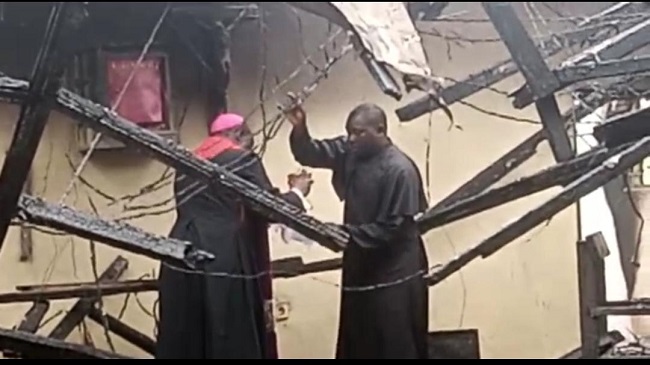
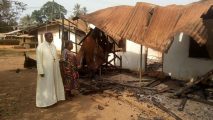
Mr. Viljoen made reference to the September 16 arson attack on St. Mary’s Catholic Nchang Parish of the country’s Mamfe Diocese during which five Priests and a Catholic Nun were among those kidnapped, and said that those kidnapped “have not been heard of since then”.
The Director of the peace entity of the Catholic Bishops in Botswana, Eswatini, and South Africa underlined the need for separatist fighters to cease attacking locals in order to regain the support of local communities in the English-speaking region.
“The pro-independence movement now faces two choices. Either unite, abstain from attacks and kidnappings against local people and churches and win back the hearts and minds of local communities. Or end up like Somalia, Eastern DRC or South Sudan, trapped in an endless cycle of internecine warfare and killing,” DHPI says in a report shared with ACI Africa on Monday, September 19.
In the September 20 interview with ACI Africa, Mr. Viljoen expressed concern that Cameroon could especially end up like South Sudan that has been experiencing war that was sparked by a disagreement between the country’s current President Salva Kiir and former opposition leader, Dr. Riek Machar in December 2013.
“At first, the leaders in South Sudan enjoyed the support of the locals because they were fighting for the independence of South Sudan. But the infighting between the leaders is what caused the current crisis in the country. I fear that Cameroon may end up this way,” the Director of DHPI said.
Culled from ACI Africa