
17, October 2017
Philemon Yang is not a wise and trans-formative Southern Cameroons politician 0
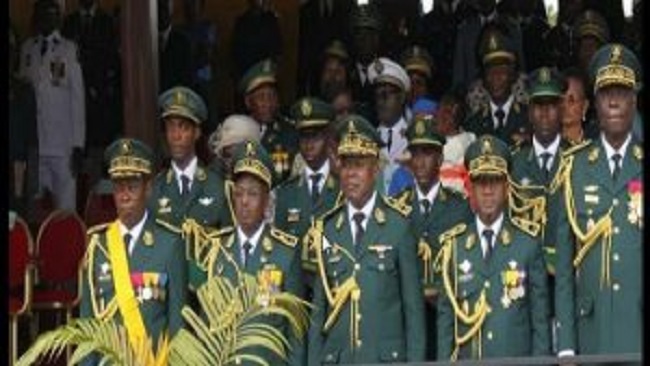
Long ruled by a vicious, malicious and a sadist passing for a Roman Catholic , Cameroon could soon be in the hands of a military thug who may be more in tune with La Republique’s overwhelmingly young population currently hostile towards the people of Southern Cameroons for their lack of understanding of the political history and reunification agreements that were signed in 1961.
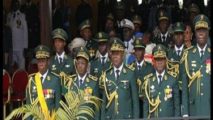
The young man in question is a Beti-Ewondo army colonel (names withheld), whose role in the killings of hundreds of Southern Cameroonians last week has been highly appreciated by many French Cameroun political elites. But few in Yaoundé now expect a swift transition without chaos.
From his Intercontinental hotel apartment in Geneva, Biya ousted the vastly more experienced Anglophone military officials from command operations including Brigadier General Elokobi Daniel Njock, General Ivo Yenwo and the newly appointed General Ekongwese all of whom have good working relations with the powerful Minister of Territorial Administration and Decentralization, Rene Sadi.
The move laid the foundation for the genocide currently going on in Southern Cameroons and ended a period of uncertainty within the Anglophone military top brass. It also raised questions about the wisdom of empowering an inexperienced army colonel so quickly when General Rene Meka is still in control.
In some ways, the decision was to assist the youthful defense minister, Joseph Beti Assomo who has been having major difficulties dealing with the old guards in the army hierarchy. Roughly 80 percent of senior French Cameroun military officers are above the age of 70 and there is no one among them who has cultivated an image as a dynamic leader, keen to take a dying nation into the modern era.
Added to this funny arrangement is what they call in La Republique “reserve generals”. These are retired army generals who are still under the government’s payroll and are still enjoying all the benefits of a senior official in the Cameroun army. They include Pierre Semengue and Tataw James.
The young Francophone colonel has pushed to increase the influence of the Rapid Intervention Battalion and the National Gendarmerie who are roaming the streets and public places of every Southern Cameroons state, counties and villages, interfering in private lives.
The killings of dozens of Southern Cameroonian citizens and the policy of militarization of the territory however, has been reckless. This policy has prompted even the moderate leadership of the outlawed Cameroon Anglophone Civil Society Consortium led by Barrister Agbor Felix Nkongho to join in resisting talks orchestrated by Prime Minister Philemon Yang and accusing Yaoundé of following an “extremist ideology”.
Biya has indeed created problems for Cameroon as a nation and for Nigeria following the influx of thousands of Southern Cameroons refugees into Ikom, Calabar and some to Lagos. The gang of young Beti-Ewondo officers now running the political show in Yaoundé have found common cause with anti Anglophone cabinet members such as the Minister of Justice, Laurent Esso who despite having Anglophone children in his first marriage with Justice Arrey gave his blessings to the genocide going on in West Cameroon, the Minister delegate in charge of the gendarmerie, Jean Baptiste Bokam, Higher Education Minister, Fame Ndongo, Communication Minister, Issa Tchiroma and Defense Minister Beti Assomo.
In addition, the young soldiers have picked an unnecessary fight with the leadership of the Roman Catholic Church in Southern Cameroons, partly because the Bishops did not cite with the Biya regime and support the crackdown like the Francophone Bishops have done.
The young soldiers and the hardliners in government have acted without thinking through the consequences. So, Biya has turn back to his Anglophone Prime Minister Philemon Yang for redress. We of the Cameroon Concord News Group think it is too little too late. Philemon Yang is not a wise and trans-formative Southern Cameroons politician. For the time being, he needs the guidance of more experienced hands, including men like Barrister Ben Muna and former governor David Aboum, whom many Southern Cameroons political elites consider their best friend in La Republique du Cameroun.
Prime Minister Philemon Yang said he was carrying a message of “peace and hope” from President Biya to the people of the Republic of Southern Cameroons. Yes Mister Prime Minister, for your information, “You do not talk peace with a friend or a brother!! You talk peace with an enemy.
By Soter Tarh Agbaw-Ebai
Cameroon Concord News Group














21, October 2017
Biya goes home to bid farewell to friends and family 0
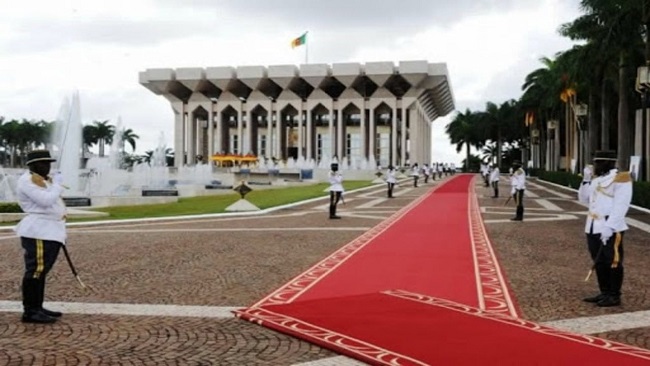
The Republic of Cameroon’s President, Paul Biya, on October 21 landed at the country’s main international airport in Yaounde where he was welcomed by his entire government and many ruling party supporters. He received in audience the eighty-three-year-old senate president, Marcel Nyat Njifenji, who is a long-time friend of the ailing president and a stalwart of the ruling party. Mr. Biya also received the National Assembly Speaker, Cavaye Yegue Djibril, who struggles to carry himself around. Mr. Cavaye Yegue Djibril has been in the national assembly for more than half a century.
The government of Mr. Biya is full of octogenarians who have been in the corridors of power for more than sixty years and are prepared to ruin the country before leaving the world. Also on hand to receive the 85-year old dictator were a bunch of dancers and Anglophone students recruited to demonstrate that the country was one and indivisible. But the reality in the two Anglophone regions is unfortunately different. Following the declaration of independence on October 1, 2017, by the two Anglophone regions, many Anglophones were killed at the behest of the country’s president whose methods of governance of choice are intimidation and corruption. This has caused almost all Anglophones to see secession as the only option that can bring them peace.
However, behind the scenes and numerous cameras that were on hand to welcome the president, is the fear that anything might happen anytime soon as Mr. Biya’s collaborators are aware of his deteriorating health and are scared that hemight be back home just to bid farewell to them and his family, as his failing health will surely take a nosedive in the weeks ahead. The Anglophone problem is a nightmare that will not go away anytime soon and this will surely take a toll on the old president’s health. Even before heading to New York last month, Mr. Biya had to stop over in Geneva for him to get a medical boost from his doctors, but the long trip to New York was so demanding on him that he had to return to Switzerland for more medical support that is costing the country an arm and a leg. Our source in Geneva advised that Mr. Biya who addressed an empty hall at the United Nations last month had been in Switzerland for almost a month where he was receiving treatment for a malignant cancer that is robbing the dictator of his strength and happiness. According to our source, besides cancer, Mr. Biya is also dealing with high blood pressure and a failing heart that may give up anytime soon.
According to images beamed by the country’s national television, Mr. Biya had a hard time alighting from the chartered aircraft that brought him back to a country that is facing serious socio-political challenges. Mr. Biya whose real age is not known, has,over the last months, had a hard time sleeping, our source at the presidency said, adding that the “Monarch” has, over the last month, been chewing sedatives like candy, a situation that is concerning to his entourage, especially his wife who is gradually coming to terms with the fact that she will soon be a widow. It is rumored that the “Monarch” has headed home with an entire pharmacy, with sedatives accounting for about 60% of all the medicines that were on the chartered flight.
Other sources close to the government stress that Mr. Biya’shealth has been a problem for many years, but it took a turn for the worse when Anglophones decided to challenge his authority. He had declared in January 2017 that the form of the state was non-negotiable and since January, Anglophones at home and abroad have been working hard to make the Anglophone crisis a millstone around his neck. The government has since January tried to take a few cosmetic measures to appease Anglophones, but the English-speaking minority has been resolute and determined to walk away from a union whose foundation is, at best, shaky.
Around the world, many people and leaders blame the government for the escalation of the crisis. They argue that instead of opting for dialogue, Mr. Biya and his collaborators have always resorted to colonial-style methods which have plunged the country into a serious political crisis. The arrest and transfer of Anglophone leaders to Yaounde in January 2017, coupled with the disconnection of the Internet only made things worse, as the entire world condemned the violence that was unleashed on innocent Anglophones. The Anglophone crisis has been going on now for one year and instead of taking concrete measures or implementing reforms that can help keep the country together, Mr. Biya has been ignoring the English-speaking minority, believing that time will help address his problems for him. But his strategy of attrition is failing and failing woefully, as many Anglophones are prepared to stay the course. Currently, schools and courts are not in session in the Anglophone regions and the massive slaughter of Anglophones on October 1 has pushed many youths out of the country, with thousands currently training in Nigeria in order to launch a massive offensive when the time comes. Before October 1, a few bombs had gone off in Bamenda and Douala, but the discovery of another bomb on October 20 in a school in Bamenda has left many parents on edge.
Currently, the ruling CPDM has taken its show to the road,with the Prime Minister, Yang Philemon,heading to Bamenda to preach peace and unity to Anglophones who have decided to be deaf to whatever so-called Anglophone elites will be preaching to them. In the South West region, these CPDM militants are all over the place like a bad rash, but they are not posting any good results as the people are simply ignoring them. The timing of the visit is indeed ill-advised as Anglophones are still mourning their dead while others are still living in the jungle due to the fear struck into their minds by the rampaging and trigger-happy government troops.
The Anglophone crisis has put the country in the spotlight for all the wrong reasons and this has caused the United Nations, the Vatican, and other international organizations to call for inclusive dialogue that will result in the building of a country that will meet the needs of both Anglophones and Francophones. “Cameroon must urgently rethink a policy of ‘murderous repression’ in its restive English-speaking regions or risk the crisis spiraling into an armed uprising,” the International Crisis Group (ICG) warned Thursday, October 19. In a report on the political crisis in the Central African nation, the NGO said“the government’s crackdown on the anglophone minority had failed and had only served to fuel a clamor for independence,” adding that Cameroon’s President Paul Biya, 85, must act swiftly to find a serious political solution to the crisis, urging the international community to speak out firmly against state violence that has resulted in the loss of many lives. “If he hopes to avoid an armed uprising in Anglophone regions, which would without doubt have an impact in the Francophone zone, the Cameroonian president must go beyond superficial measures and take responsibility in order to find political solutions to the crisis.”
As Mr. Biya returns home, he knows he has a sticky situation on his hands. He might have declared at the beginning of the year that the form of the state was non-negotiable, but with the crisis escalating by the day, he must understand that the solution is at the negotiating table. Violent repression and corruption will surely not cut it. Allowing government surrogates to spread across the Anglophone regions like ragweed to talk peace to a hurting people will not yield the results he is looking forward to. He must remember that the Anglophone crisis is a crisis that will not go away anytime soon if proper measures are not taken. Years of marginalization have emboldened the people. This problem will continue to stalk Mr. Biya and his government for a long time, especially as the Anglophone Diaspora is involved. This is a Diaspora that is rich and has the capacity to destabilize the government. It will be preposterous to hold that the issues will go away by throwing money at them or by simply ignoring them. These problems have been around for more than half a century and if they are not properly addressed they could result in a popular revolt that will drag dissatisfied Francophones into the struggle.
By the editorial team