25, March 2018
German police arrest ex-Catalan leader on Danish border 0
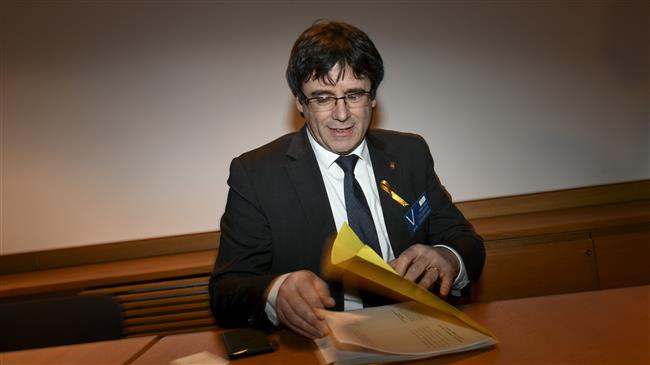
Catalonia’s former President Carles Puigdemont has been detained by German police as he was crossing the border with Denmark by car.
The arrest on Sunday came just two days after Spain’s Supreme Court vowed to prosecute 13 key separatists, including Puigdemont and his nominated successor Jordi Turull, over their role in the region’s failed breakaway bid.
Puigdemont “was arrested today at 11:19 am by Schleswig-Holstein’s highway patrol force,” a German police spokesman said, adding that the detention was based on a European warrant.
“He is now in police custody”, added the spokesman.
Separately confirming his arrest in Germany, Puigdemont’s party spokeswoman Anna Grabalosa said, “It happened as he crossed the Danish-German border. He was treated well and all his lawyers are there. That is all I can say.”
Puigdemont was picked up by German police as he was traveling back to Belgium, his lawyer Jaume Alonso-Cuevillas said on Twitter.
He “was heading to Belgium to present himself, as always, at the disposal of Belgian courts,” added Alonso-Cuevillas.
On Friday, Spanish Supreme Court judge Pablo Llarena issued an international arrest warrant for Puigdemont, accusing Catalonia’s former president of organizing the vote on secession in October last year.

The independence referendum, called by Puigdemont despite objections from Madrid, triggered an unprecedented political standoff between Catalonia and Spain. Puigdemont used the yes vote as a base to make a declaration of independence on October 27, prompting Madrid to dismantle his government and the regional chamber, where he made the declaration.
Following the referendum vote, Puigdemont fled to Belgium to avoid prosecution on charges of sedition and rebellion. A number of his ministers, along with senior regional authorities, have been jailed or freed on bail over similar charges.
The new Catalan parliament was formed after snap elections in December in which pro-independence parties, like that of Puigdemont’s, retained their majority.
While separatist parties won Catalonia’s regional elections, they have been unable to form a government for the region as numerous leaders are in exile abroad or in jail.
Puigdemont to appear in court on Monday
Later on Sunday, Spanish court officials said Puigdemont would appear before a judge on Monday after he was detained by German police on a European arrest warrant issued by Spain.
“The sole purpose of this appearance is to verify the identity of the person arrested. The regional tribunal of Schleswig-Holstein in the town of Schleswig will then have to decide if Mr. Puigdemont has to be taken into custody” in view of handing him over to Spain, the court was quoted by AFP as saying.
Source: Presstv


























26, March 2018
Paul Biya: Cameroon’s ‘absentee president’ 0
Cameroon’s President Paul Biya has been in power for 35 years. But while his longevity in office is a talking point at home, the time he spends out of the country has stirred international comment – as Paul Melly, an associate fellow of Chatham House, explains.
Criticised by some for a supposedly “hands-off” style of rule, Cameroon’s President Paul Biya recently held a cabinet meeting for the first time in more than two years.
Presidential elections are scheduled for October and Cameroonians are waiting to hear if the 85-year-old will seek a further term. But no such announcement was made at the meeting.
Mr Biya has been in power since 1982, making him one of Africa’s longest serving leaders. Under his rule, Cameroon has survived an economic crisis and moved from being a one-party state to multi-party politics.
But it has also been marked by endemic corruption and reversal of democratic gains, leading to the abolition of term limits in 2008, which allowed the octogenarian to run for re-election in 2011.
Today’s Africa is changing. The era of decades-old presidencies is slipping away. Satellite TV and the internet tell a growing urban audience about democratic changes of power in other sub-Saharan countries.
Some 60% of Cameroonians are under 25 and so were not even born when President Biya first came to power. There is massive demand for jobs and viable livelihoods.
The opposition Social Democratic Front has now recognised these generational realities. Earlier this year, the party’s leader, John Fru Ndi, 76, stepped aside to make way for a new presidential candidate, 49-year-old businessman and former pilot Joshua Osih.
Swiss hotel
This is the challenge that confronts Mr Biya as he decides whether to stand for a further term that could take him into a fourth decade in power in a country hungry for change.
His repeated absences from the country have riled critics.
His foreign travels have been the subject of an online spat between the state-owned Cameroon Tribune newspaper and the Organised Crime and Corruption Reporting Project (OCCRP), which calculated the amount of time the president spent abroad using reports from the daily newspaper.
The OCCRP estimates that the president spent nearly 60 days out of the country last year on private visits.
It also alleges that he spent a third of the year abroad in 2006 and 2009. The Intercontinental Hotel in Geneva is said to be his favourite destination.
The state-owned Cameroon Tribune called their investigation “a clear electoral propaganda”.
Back home, President Biya adopts a low-key style, staying out of the limelight and sometimes retreating to his home village.
He entrusts the day-to-day running of the government to the Prime Minister, Philemon Yang, who holds monthly gatherings of a “cabinet council”.
The prime minister is accorded wide latitude to manage the work of his ministerial team, while the head of state meets senior figures in private at the presidential palace in the capital, Yaoundé.
Culled from the BBC