
10, June 2024
Marian Apparition Reported at a Parishioner’s Home in Cameroon Requires Thorough Discernment: Archbishop Nkea 0
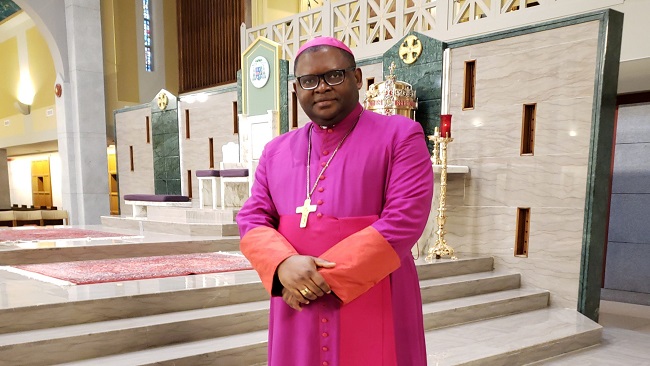
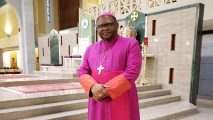
Thorough discernment is needed in the alleged apparition of the Blessed Virgin Mary at the residence of a faithful in the Catholic Archdiocese of Bamenda, the Archbishop of the Metropolitan See has said.
On June 6, thousands of Christians and non-Christians flooded the residence of Madam Dorothy Enow Manyor, a member of the All Angels Small Christian Community, in the Immaculate Conception Ngomgham Parish, following an alleged apparition of the Blessed Virgin Mary at the home.
In a statement issued on June 8, Archbishop Andrew Fuanya Nkea recalled the recent guidelines on apparitions which the Vatican issued on May 17, saying, “God is present and active in our history…This action of the Holy Spirit can also reach our hearts through certain supernatural occurrences, such as apparitions or visions of Christ or the Blessed Virgin, and other phenomena.”
“No one can, or is allowed to pronounce with certitude at this time, that the Blessed Virgin Mary is appearing in the said house in Ngomgham,” Archbishop Nkea clarified.
He emphasized that “whatever is happening in Ngomgham, needs thorough discernment and due process by the competent Ecclesiastical Authorities, as stipulated in the Norms from the Holy See of 17th of May, 2024, to be sure of this phenomenon.”
“Until this is done and established by the Church, this private house cannot be considered as a public place of prayer, and all Catholic Christians are therefore encouraged to frequent their parish churches and Diocesan/Parish Shrines for public prayer and veneration of the saints, especially the Blessed Virgin Mary,” the Local Ordinary of Bamenda Archdiocese who also serves as President of the National Episcopal Conference of Cameroon (NECC) said.
He appealed to those frequenting Ms Dorothy’s home to allow her privacy, saying, “This family where this phenomenon is taking place, has a right to their privacy and quiet family life. Therefore, people should kindly respect their rights and allow them the peace they deserve.”
The Cameroonian Catholic Archbishop further said he will set up a commission of Theologians to study the phenomenon for the people to see and understand what is really happening concerning the alleged apparition.
Archbishop Nkea recalled that two years ago, the Archdiocese of Bamenda celebrated the Marian Year where Christians “had an in-depth study of the Blessed Virgin Mary and her role in the economy of salvation.”
“The year ended with a Marian Congress and many Christians have the Acta of this congress. We were encouraged to pray the Rosary and to remain close to the Blessed Virgin Mary who is Comforter of the Afflicted, Help of Christians, Mother of the Church, and Queen of Peace,” the Archbishop added.
He urged the faithful to continue to pray as the Archdiocese embarks on discerning the alleged apparition at Dorothy’s home.
“May the same Blessed Virgin Mary, whose Feast we celebrate today under the patronage of her Immaculate Heart, intercede for us, now and at the hour of our death. Amen,” Archbishop Nkea implored.
Source: aciAfrica










11, June 2024
Malawi’s vice president, former first lady among 10 people killed in plane crash 0
Malawi’s Vice President Saulos Chilima was killed in a plane crash, the nation’s president said on Tuesday, after searchers located the wreckage of the aircraft in a foggy forest.
The military plane carrying Chilima, 51, and nine others disappeared on Monday, after it failed to land in the northern city of Mzuzu due to bad weather and was told to return to the capital, Lilongwe.
“The search and rescue team have found the aircraft … completely destroyed with no survivors, as all passengers on board were killed on impact,” Malawi’s President Lazarus Chakwera said addressing the nation.
“Words cannot describe how heartbreaking this is,” he said, describing the accident as a “terrible tragedy.”
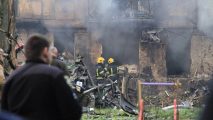
Photographs shared with AFP by a member of the military rescue team showed army personnel standing on a foggy slope near debris bearing the registration number of the Malawi Army Air Wing Dornier 228-202K aircraft.
Rescuers had been combing a fog-cloaked forest south of Mzuzu on Tuesday, after authorities located the last tower it transmitted to before the plane disappeared.
Earlier, army commander General Paul Valentino Phiri said other countries, including Malawi’s neighbours, had been aiding the search effort, with support including helicopters and drones.
The group departed just after 9:00 am (0700 GMT) from Lilongwe on Monday to attend the funeral of a former cabinet minister some 370 kilometres (230 miles) away in Mzuzu.
Malawi’s former first lady Shanil Dzimbiri was also on board.
Widely loved
Chakwera said he had previously flown on the same aircraft for similar trips. The crew had successfully operated it just hours before the accident, he added.
“And yet, despite the track record of the aircraft and the experience of the crew, something terrible went wrong with that aircraft on its flight back to Lilongwe, sending it crashing down,” he said.
First elected vice president in 2014, the charismatic yet stern-talking Chilima was a widely loved figure in Malawi, particularly among young people.
But in 2022, during his second stint in the job, Chilima was stripped of his powers after being arrested and charged with graft over a bribery scandal involving a British-Malawian businessman.
Last month, a Malawian court dropped the charges and he resumed his official duties.
“Chilima was a good man, a devoted father and husband, a patriotic citizen who served his country with distinction and a formidable vice president,” Chakwera said.
“I consider it one of the greatest honours of my life to have had him as my deputy and counsellor for the past four years.”
Source: AFP