4, March 2023
US: President Biden had cancerous skin lesion removed in February 0
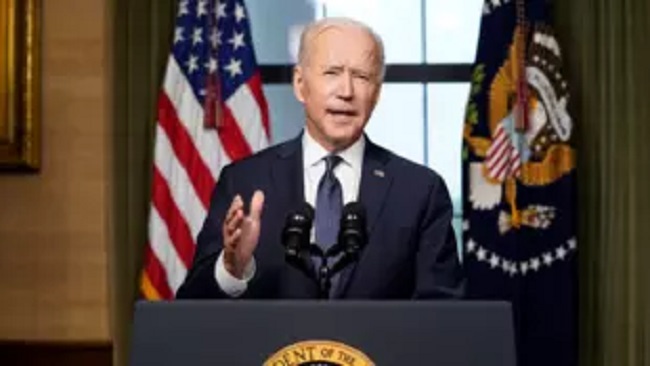
US President Joe Biden, 80, had a cancerous skin lesion successfully removed from his chest in February, his doctor said Friday.
The lesion, detected during a routine medical examination, was a basal cell carcinoma, which “do not tend to ‘spread’ or metastasize,” Biden’s physician, Kevin O’Connor, said in a report made public by the White House, adding that “no further treatment is required.”
The lesion was removed during Biden’s annual medical checkup on February 16, after which the president was declared “fit for duty.”
“The site of the biopsy has healed nicely and the president will continue dermatologic surveillance as part of his ongoing comprehensive healthcare,” O’Connor said in the Friday report.
He noted that basal cell carcinoma were generally more innocuous than “more serious skin cancers such as melanoma or squamous cell carcinoma.”
“President Biden remains a healthy, vigorous, 80-year-old male, who is fit to successfully execute the duties of the Presidency, to include those of as Chief Executive, Head of State and Commander in Chief,” O’Connor said in February following Biden’s medical examination.
The checkup was the final one before an expected announcement by Biden, the oldest person ever to be US president, to declare he is running for reelection in 2024.
At the February appointment, Biden completed a series of tests that he began last year at Walter Reed National Military Medical Center, a complex in the Washington suburbs with a presidential facility.
O’Connor at the time wrote that the president had spent “a good deal of time in the sun in his youth” and that he had already been treated regularly for removal of localized, non-melanoma skin cancers.
Source: AFP















4, March 2023
Africa follows Asia in giving Russians green light for Paris Olympics 0
Africa’s National Olympic Committees have followed their Asian counterparts in giving the green light on Saturday for Russian and Belarusian athletes to compete at the 2024 Paris Olympics.
Russia and its ally Belarus have been sidelined from most Olympic sports since Russian forces invaded Ukraine last February.
However, in January the International Olympic Committee (IOC) said it was seeking a “pathway” for Russians to take part in the Games.
Following that announcement, the Olympic Council of Asia (OCA) offered athletes from both countries the chance to compete in this year’s Asian Games.
That was a significant move because they could gain qualifying marks in competition in Asia to allow them to compete in Paris.
Africa has now followed suit.
The motion — to allow Russians and Belarusians to compete under a neutral flag — was passed unanimously by the executive committee of the Association of National Olympic Committees of Africa (ANOCA) at their meeting in Nouakchott, Mauritania.
“The members came out unanimously in favor of the participation of Russian and Belarusian athletes in all international competitions,” the ANOCA said in a statement.
It said ANOCA president, the Algerian Mustapha Berraf, had reiterated that the body “aligns itself with the position of the International Olympic Committee and its President Dr. Thomas Bach”.
The statement continued: “It will thus be a question of allowing Russian and Belarusian athletes to participate in complete neutrality without any sign of identity in the Paris 2024 Olympic Games.”
The IOC has explained that its reasoning was based on its belief that “no athlete should be prevented from competing just because of their passport”.
But their stance has been met with contempt by Ukraine whose sports minister Vadym Goutzeit said such a move was “unacceptable” and called for a boycott if they are allowed to compete.
Many western nations also questioned the move.
Germany’s National Olympic Committee went public last month, declaring it is not “the right time to allow athletes with a Russian or Belarusian passport to compete in international competitions again.”
In a letter in February, more than 30 countries, including Canada, France, Great Britain, Poland, Sweden and the United States, expressed concern about how the athletes could be neutral, particularly given the “strong links and affiliations between Russian athletes and the Russian military”.
The letter asked the IOC for “clarifications” on the neutrality required for Russian and Belarusian athletes at the Olympics.
The IOC responded that the letter ignored the human rights of Russian and Belarusian athletes.
Source: AFP