24, July 2022
Biya has turned Cameroon into a ticking time-bomb that he cannot defuse 0
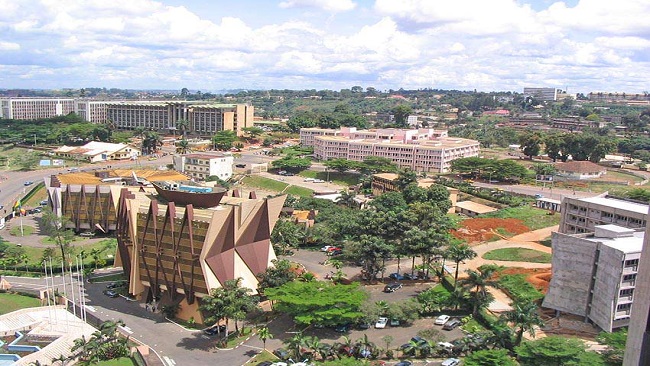
The Civil Cabinet at the Presidency of the Republic released a tentative program on President Emmanuel Macron’s visit saying that Biya or his representative will welcome the French leader at the Nsimalen International airport.
The program clearly reveals that Biya is now an X Factor and his regime is unsustainable. For the first time in the history of the country, the presidency as an institution is not sure on who is going to receive a visiting French president.
To be accurate, Biya and his regime have no capacity to reform the sinking ship. The Francophone dominated administration is facing growing economic woes, crumbling infrastructure, warring elites and a serious secession crisis in Southern Cameroons.
For more than three decades, the 89-year-old Biya has relied on military action as his government’s prime means of legitimizing its power, something that has only become evident since the Ambazonia standoff exploded in 2016.
Before the Southern Cameroons Crisis, Biya and his criminal gang were looking fairly stable and could last for several years without profound change.
With age telling on Biya and fuel crisis hitting Cameroon’s bottom line, political elites and the military leadership, the only sharp tool in Biya’s box is his kinsmen and women in the military, and Biya is increasingly flexing them in the Far North and in Southern Cameroons.
Now, Cameroon is actively, almost openly aggressively, bolstering activity in the Far North against Boko Haram Camerounaise, rebels from the Central African Republic and armed bandits in the cities of Douala and Yaoundé including Ambazonia Restoration Forces.
Political commentators noted that the last edition of the Africa Cup of Nations hosted in Cameroon was one of the most militaristic in years.
The French have been supplying Biya with outdated tanks, post World War I missiles, expired electronic warfare systems and flying coffins passing for fighter jets. But what is more disturbing for the French now is Cameroon’s next president.
The problem for President Emmanuel Macron is that France doesn’t seem to have a long-term vision any more for its “former” colonies in Africa. President Macron himself has been jumping from solving crisis to solving crisis all over Francophone Africa-Guinea, Mali, Chad, Burkina Faso, Ivory Coast, and Macron is gradually drifting toward Anglophone Africa where leaders think properly and where political and strategic solutions are constantly being applied rather than military solutions.
It is hard to tell what Biya’s biggest problem right now is! Everything in Cameroon is crashing and fast and even Francophone millionaires are fleeing an economy which now has no room to expand.
And with foreign and local investors running away, Biya now has very limited choices: play nice with the Bamilekes, which means relax the Beti Ewondo grip on the Douala Port and pretend to ignore the Bamileke boycott of the Kribi Port or be replaced as Head of State by a Bamileke. Neither of these sound like options Biya is comfortable with!
So what does this actually mean for the so-called one and indivisible Cameroon? The answer is simple: collapse. Cameroon is indeed is a plane in a tailspin.
By Soter Tarh Agbaw-Ebai


24, July 2022
The Holy Father Pope Francis arrives in Canada to apologise for Indigenous school abuse 0
Pope Francis arrived Sunday in Canada, where he is expected to personally apologize to Indigenous survivors of abuse committed over a span of decades at residential schools run by the Catholic Church.
The head of the world’s 1.3 billion Catholics landed at Edmonton’s international airport shortly after 11 am (1700 GMT).
He was welcomed by Canadian Prime Minister Justin Trudeau and Mary Simon, the country’s first Indigenous governor general, as well as Indigenous leaders in an airport ceremony that began with drums and chanting.
Afterwards Francis received welcome gifts from Indigenous leaders, shaking or kissing their hands and making conversation with each before the short ceremony ended.
During the 10-hour flight from Rome Francis told journalists travelling with him that “we must be aware that this is a penitential journey.”
The 85-year-old pontiff’s Canada visit is primarily to apologize to survivors for the Church’s role in the scandal that a national truth and reconciliation commission has called “cultural genocide”.
From the late 1800s to the 1990s, Canada’s government sent about 150,000 First Nations, Metis and Inuit children into 139 residential schools run by the Church, where they were cut off from their families, language and culture.
Many were physically and sexually abused by headmasters and teachers.
Thousands of children are believed to have died of disease, malnutrition or neglect.
Since May 2021, more than 1,300 unmarked graves have been discovered at the sites of the former schools.
A delegation of Indigenous peoples travelled to the Vatican in April and met the pope — a precursor to Francis’ six-day trip — after which he formally apologized.
But doing so again on Canadian soil will be of huge significance for survivors and their families, for whom the land of their ancestors is of particular importance.
The flight constituted the longest since 2019 for the pope, who has been suffering from knee pain that has forced him to use a cane or wheelchair in recent outings.
The pope was in a wheelchair Sunday and used a lifting platform to board the plane in Rome, and was also in a wheelchair on the tarmac in Edmonton, an AFP correspondent accompanying him said.
‘Too late’
After resting Sunday, the pope will travel Monday to the community of Maskwacis, some 100 kilometres (62 miles) south of Edmonton, and address an estimated crowd of 15,000 expected to include former students from across the country.
“I would like a lot of people to come,” said Charlotte Roan, 44, interviewed by AFP in June. The member of the Ermineskin Cree Nation said she wanted people to come “to hear that it wasn’t made up”.
Others see the pope’s visit as too little too late, including Linda McGilvery with the Saddle Lake Cree Nation near Saint Paul, about 200 kilometres east of Edmonton.
“I wouldn’t go out of my way to see him,” said the 68-year-old.
“For me it’s kind of too late, because a lot of the people suffered, and the priests and the nuns have now passed on.”
McGilvery spent eight years of her childhood in one of the schools, from age six to 13.
“Being in the residential school I lost a lot of my culture, my ancestry. That’s many years of loss,” she told AFP.
After a mass before tens of thousands of faithful in Edmonton on Tuesday, Francis will head northwest to an important pilgrimage site, the Lac Sainte Anne.
Following a July 27-29 visit to Quebec City, he will end his trip in Iqaluit, capital of the northern territory of Nunavut and home to the largest Inuit population in Canada.
There he will meet with former residential school students, before returning to Italy.
In total, Francis is expected to deliver four speeches and four homilies, all in Spanish.
Francis is the second pope to visit Canada, after John Paul II, who visited three times (1984, 1987 and 2002).
Source: AFP