10, June 2022
Corrupt France: CCTV footage during Champions League final has been deleted 0
Pressure was growing Friday on French authorities after the surprise revelation CCTV footage from the Stade de France during the Champions League final last month has been deleted, with critics alleging a deliberate cover-up.
The French Football Federation revealed Thursday to a commission at the French Senate the images had been destroyed automatically having not been subject to a warrant from judicial authorities, in line with French law.
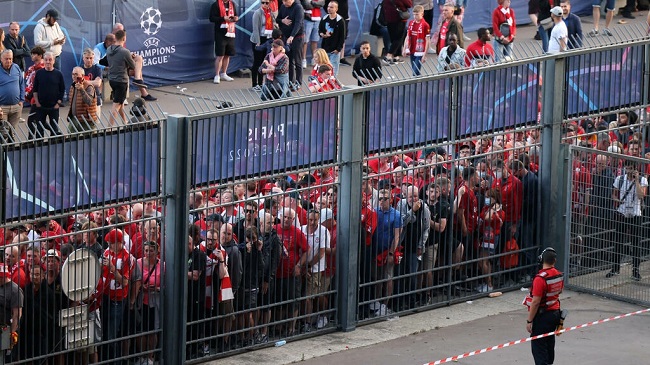
The revelation adds to the controversy after crowd control problems, tear gas and street crime marred the final at Paris’ Stade de France between Liverpool and Real Madrid on May 28.
France’s reputation has taken a battering as laid out in a government report on Friday.
It said the “chain of failures” by French authorities has inflicted “severe damage” on the image of the country.
Opposition politicians seized on the latest revelations about the CCTV footage to hammer the authorities.
“It’s called covering your tracks,” far-right National Rally leader Marine Le Pen told BFMTV on Friday.
“The fact that there is no CCTV footage allows their huge lies to be covered,” Le Pen added, pointing to the initial claim from the French government that fake tickets on an ‘industrial-scale’ caused the pandemonium.
Police asked Stade de France for the footage, but only on Thursday evening after it became public that the images had been destroyed, a source close to the case told AFP Friday.
“Yesterday’s information that the images would not be kept for one month, but only a few days, led us to ask for them,” Bobigny prosecutors, in charge of the investigation into fake tickets, said.
The State de France is allowed to store CCTV footage for a maximum of 30 days, but the servers only have the capacity to store them for seven or eight.
On Twitter French police said Thursday the images taken by the Stade de France cameras may no longer exist but that the police still had their images.
But Socialist vice-president of the Senate’s law commission David Assouline said Friday on Franceinfo radio he was “stupefied” by the news, adding it demonstrated an “incredible lack of co-ordination” between the police and politicians.
-‘State scandal’-
Liverpool mayor Steve Rotheram, questioned by the Senate commission after the FFF delegation, said that he failed “to understand why the videos were destroyed”.
“We’re heading straight towards a state scandal,” the head of the opposition Republicans (LR) faction in the Senate, Bruno Retailleau, told RFI radio, adding the destruction of the CCTV footage was an “intentional act … to make evidence disappear”.
But ruling party MP Aurore Berge said on RMC radio that there were enough elements for the investigation.
“We have plenty of witness statements and images that should nonetheless guide (the investigators),” Berge said.
On Thursday the chief of the Paris police Didier Lallement admitted in front of the Senate commission investigating the May 28 chaos that the security operations for the Champions League final were a “failure”.
“It was a failure because people were pushed around and attacked. It’s a failure because the image of the country was tarnished,” he said.
Lallement and Interior Minister Gerald Darmanin initially blamed the mayhem on as many as 40,000 Liverpool fans who massed at the stadium without tickets or with counterfeit tickets.
That figure has been widely disputed since by witnesses and media using images from the ground, and Lallement admitted yesterday: “Perhaps I made a mistake with the figure I gave to the minister”.
He acknowledged there were not 30,000 to 40,000 “at the gates of the stadium” but maintained that several thousands were “in the vicinity” of police checkpoints at the Stade de France to the north of the capital.
Many Liverpool supporters struggled to enter the stadium, leading to kick-off being delayed by more than half an hour and crushes at the entry gates, where police fired tear gas.
The government’s initial decision to blame Liverpool fans for the problems caused tensions between France and Britain, while raising questions about the capacity of Paris to host the Rugby World Cup next year and the Olympic Games in 2024.
Source: AFP



















10, June 2022
Exclusive: Yerima weighs in on Mamfe Hospital Disaster 0
Ambazonia Interim Government Statement on the Mamfe Hospital Disaster
Fellow Ambazonians,
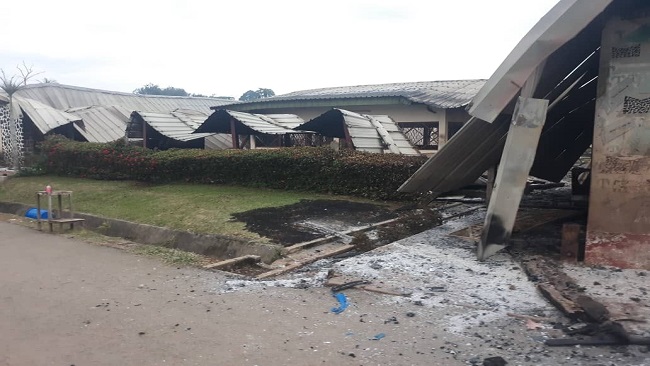
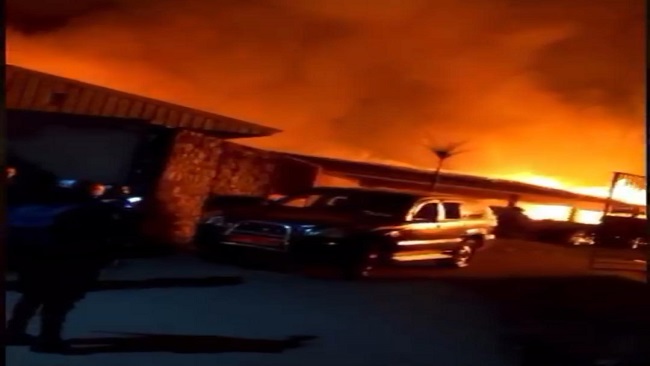
Yesterday, 9 June 2022, the Mamfe District Hospital, Manyu County, was burned down by unidentified arsonists. This savagery and crime against humanity was deliberate and designed to terrorize and traumatize our population. The act is despicable, unacceptable, and ill-advised, and the Interim Government of Ambazonia condemns it in the strongest possible terms. The hearts of all Ambazonians go out to all the patients, and hospital workers caught up in this criminal enterprise. The Interim Government of the Federal Republic of Ambazonia wishes a speedy recovery to all who sustained injuries during the attack.
Over the last three years, all over Ambazonia, criminal militias have been working with the French Cameroun regime in Yaoundé to sabotage our resistance and quest for independence. The Interim Government of Ambazonia has therefore commissioned Ambazonia Intelligence Services and Ground Zero commanders operating in Manyu to investigate this shameful act in Mamfe. The Interim Government of Ambazonia shall liaise with the EU, AU, and the UN including major international organizations to bring the perpetrators of this shameful act to swift justice.
People of Ambazonia, our fight for freedom represent an unyielding rejection of delinquency in any form, shape or manifestation. This rejection is consistent with international law, which gives hope to colonized people struggling for their liberation. Hospitals, Churches and Schools must remain free from attacks at all times. History teaches us that many nations have won their liberation battles, and we shall overcome.
Fellow Ambazonians, we will continue to fight until self-determination is achieved. Be neither discouraged nor distracted despite the repeated doses of cranial activities in our midst. Our time shall come. French Cameroon is a nation that has no respect for human lives and international norms. But we must continue fighting for freedom and justice with respect for international standards.
We have many more years of struggle and suffering before us as the path we have chosen is full of danger, but it is a path worth taking. The cost of freedom is high, but we must pay the price, and we must pay that price with respect for our people. As a people, one path we shall never choose is the path of criminality. Our task is simple; we must win and live free or die in the process of freeing ourselves.
Thank you
Dabney Yerima
Vice President
Federal Republic of Ambazonia