25, April 2023
US says Sudan warring parties agree to 72-hour ceasefire after hundreds killed 0
Sudan’s battling generals have agreed to a three-day ceasefire, US Secretary of State Antony Blinken said Monday, after 10 days of urban combat killed hundreds, wounded thousands, and sparked a mass exodus of foreigners.
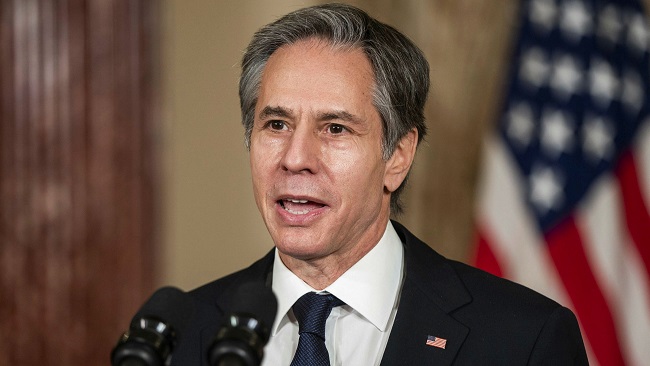
Previous bids to pause the conflict failed to take hold but Blinken announced: “Following intense negotiation over the past 48 hours, the Sudanese Armed Forces (SAF) and the Rapid Support Forces (RSF) have agreed to implement a nationwide ceasefire starting at midnight on April 24, to last for 72 hours.”
Blinken’s statement came two hours before the truce was to take effect.
It came after the UN chief warned Sudan is on “the edge of the abyss” following fighting between the rivals who have waged unprecedented battles in the capital, Khartoum, as well as elsewhere in the country.
The fighting pits forces loyal to army chief Abdel Fattah al-Burhan against those of his former deputy Mohamed Hamdan Dagalo, who commands the paramilitary Rapid Support Forces (RSF).
The RSF emerged from the Janjaweed militia that then-president Omar al-Bashir unleashed in Darfur, leading to war crimes charges against Bashir and others.
The Forces of Freedom and Change, the main civilian bloc which the two generals ousted from power in a 2021 coup, said the truce would allow for “dialogue on the modalities of a permanent ceasefire.”
At least 427 people have been killed and more than 3,700 wounded, according to UN agencies.
Among the latest to die was the assistant administrative attache at Cairo’s embassy in Khartoum, Egypt’s foreign ministry said. The official was killed while heading from home to the embassy to follow up on evacuation procedures, it said.
More than 4,000 people have fled the country in foreign-organised evacuations that began on Saturday.
The United States and multiple European, Middle Eastern, African and Asian nations launched emergency missions to bring to safety their embassy staff and Sudan-based citizens by road, air and sea.
But millions of Sudanese are unable to flee.
They are trying to survive acute shortages of water, food, medicines and fuel as well as power and internet blackouts.
UN agencies reported some Sudanese civilians were able to escape “areas affected by fighting, including to Chad, Egypt and South Sudan”.
“Morgues are full. Corpses litter the streets” said Attiya Abdallah, head of the doctors’ union, which on Monday reported scores more casualties after sites in south Khartoum were “heavily shelled”.
UN Secretary-General Antonio Guterres warned that the violence in Sudan — already one of the world’s poorest countries, with a history of military coups — “could engulf the whole region and beyond”.
“We must all do everything within our power to pull Sudan back from the edge of the abyss,” Guterres said.
He had also, again, called for a ceasefire.
Britain requested an emergency UN Security Council meeting on Sudan, which was expected to take place on Tuesday, according to a diplomat.
A UN convoy carrying 700 people completed an arduous 850 kilometre (530 mile) road trip to Port Sudan on the Red Sea coast from the capital, where they left behind gunfire and explosions.
The United Nations head of mission Volker Perthes said the convoy arrived safely.
“Thirty-five hours in a not so comfortable convoy are certainly better than three hours’ bombing and sitting under the shells,” he said.
A UN statement separately said he and other key staff will “remain in Sudan and will continue to work towards a resolution to the current crisis”.
‘Unspeakable destruction’
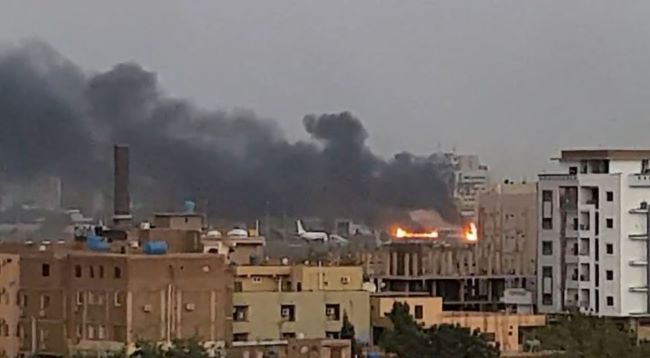
With Khartoum airport disabled after battles that left charred aircraft on the tarmac, many foreigners were airlifted out from smaller airstrips, to countries including Djibouti and Jordan.
US special forces swooped in with Chinook helicopters Sunday to rescue diplomats and their dependents, while Britain launched a similar rescue mission.
European Union foreign policy chief Josep Borrell said more than 1,000 EU citizens had been taken out during a “long and intense weekend” involving airlift missions by France, Germany and others.
China said Monday it had “safely evacuated” a first group of citizens and would “try every means to protect the lives, properties and safety of 1,500 plus Chinese compatriots in Sudan”.
Source: AFP















29, April 2023
Over 400 civilians dead as rival forces continue to fight over control of Sudan 0
Gunfire and heavy artillery fire persisted Saturday in parts of Sudan’s capital Khartoum, residents said, despite the extension of a cease-fire between the country’s two top generals, whose battle for power has killed hundreds and sent thousands fleeing for their lives.
The civilian death toll jumped Saturday to 411 people, according to the Sudan Doctors’ Syndicate, which monitors casualties. The fighting has wounded another 2,023 civilians so far, the group added, although the true toll is expected to be much higher. In the city of Genena, the provincial capital of war-ravaged West Darfur, intensified violence has killed 89 people. Fighters have moved into homes and taken over stores and hospitals as they battle in the densely populated streets, the syndicate said.
Khartoum, a city of some 5 million people, has been transformed into a front line in the grinding conflict between Gen. Abdel Fattah Burhan, the commander of Sudan’s military, and Gen. Mohammed Hamdan Dagalo, who leads the powerful paramilitary group known as the Rapid Support Forces. The outbreak of violence has dashed once-euphoric hopes for a democratic transition in Sudan after a popular uprising helped oust former dictator Omar al-Bashir.
Foreign countries continued to evacuate their citizens while thousands of Sudanese fled across borders. Britain said it was ending its evacuation flights Saturday, after demand for spots on the planes had declined. The United Arab Emirates announced Saturday it had started evacuating its citizens along with nationals of 16 other countries.
Over 50,000 refugees — mostly women and children — have crossed over to Chad, Egypt, South Sudan and the Central African Republic, the United Nations said, raising fears of wider instability in the region. Ethnic fighting and turmoil has scarred South Sudan and the Central African Republic for years while a 2021 coup has derailed Chad’s own democratic transition.
Those who escape Khartoum face more obstacles on their route to safety. The overland journey to Port Sudan, where ships then evacuate people via the Red Sea, has proven long and risky. Hatim el-Madani, a former journalist, said that paramilitary fighters were stopping refugees at roadblocks outside Khartoum, demanding they hand over their phones and valuables.
“There’s an outlaw, bandit-like nature to the RSF,” he said, referring to Dagalo’s Rapid Support Forces. “They don’t have a supply line in place. That could get worse in the coming days.”
Airlifts from the country have also posed challenges, with a Turkish evacuation plane even hit by gunfire outside Khartoum on Friday.
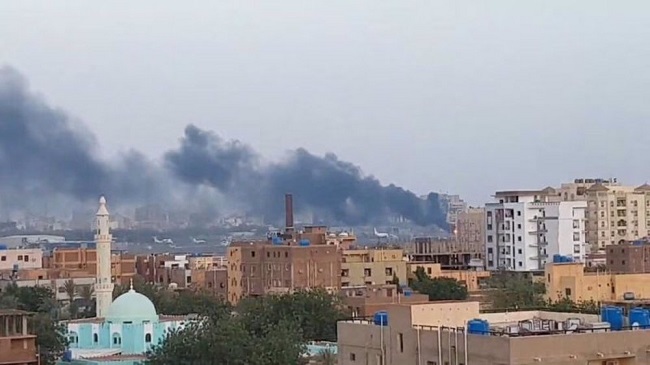
On Saturday — despite a cease-fire extended under heavy international pressure early Friday — clashes continued around the presidential palace, headquarters of the state broadcaster and a military base in Khartoum, residents said. The battles sent thick columns of black smoke billowing over the city skyline.
In a few areas near the capital, including in Omdurman, some reported that shops were reopening as the scale of fighting dwindled. But in other areas, terrified residents hunkered down reported explosions thundering around them and fighters ransacking houses.
Now in its third week, the fighting has left swaths of Khartoum without electricity and running water. The Sudanese Health Ministry put the latest overall death toll at 528, with 4,500 wounded.
Those sheltering at home are running out of food and basic supplies. Residents in the city of Omdurman, west of Khartoum, have been waiting at least three days to get fuel — complicating their escape plans.
The U.N. relief coordinator, Martin Griffiths, said that U.N. offices in Khartoum, as well as the cities of Genena and Nyala in Darfur had been attacked and looted. Genena’s main hospital was also leveled in the fighting, Sudan’s health ministry said.
“This is unacceptable — and prohibited under international law,” Griffiths said.
Over the past 15 days, the generals have failed to deal a decisive blow to the other in their struggle for control of Africa’s third largest nation. The military has appeared to have the upper hand in the fighting, with its monopoly on air power, but it has been impossible to confirm its claims of advances.
“Soon, the Sudanese state with its well-grounded institutions will rise as victorious, and attempts to hijack our country will be aborted forever,” the Sudanese military said Saturday.
Both sides in the conflict have a long history of human rights abuses. The RSF was born out of the Janjaweed militias, which were accused of widespread atrocities when the government deployed them to put down a rebellion in Sudan’s western Darfur region in the early 2000s.
A unit of Sudan’s armed forces, known as the Central Reserve Police, have been sanctioned by the United Staets for grave human rights violations against Sudan’s pro-democracy protesters.
Accusations of rape, torture and other abuses against demonstrators carried out by the unit first surfaced in 2021, after Burhan and Dagalo joined forces in a military coup that ousted a civilian government. The Sudanese Interior Ministry confirmed the deployment of the Central Reserve Police in Khartoum on Saturday, posting photos of the fighters riding with heavy machine guns mounted on pickup trucks.
Former Prime Minister Abdalla Hamdok, who was ousted in the 2021 coup, appealed to the international community from a conference in Nairobi, Kenya, to push for an immediate halt to the conflict. He warned that a full-blown civil war in the strategically located country would have consequences not just for Sudan but for the world.
“God forbid if Sudan is to reach a proper civil war … it is a huge country and very diverse … it would be a nightmare for the world,” he said.
But the generals have so far rejected attempts at a compromise. Regional mediators have been unable to travel to Khartoum because of the chaotic fighting.
African Union Chairperson Moussa Faki said he would nonetheless try to send peacekeepers to the country.
“I’m ready to go there myself, even by road,” Faki said. “We ask the two generals to create the conditions for us to go to Khartoum.”
Source: AP