28, February 2022
Racist and unfair treatment of Africans at border crossings in Ukraine 0
Nigeria, South Africa and other African governments scrambled on Monday to help their nationals escape the Russian invasion in Ukraine as reports emerged of racist and unfair treatment of their citizens at border crossings.
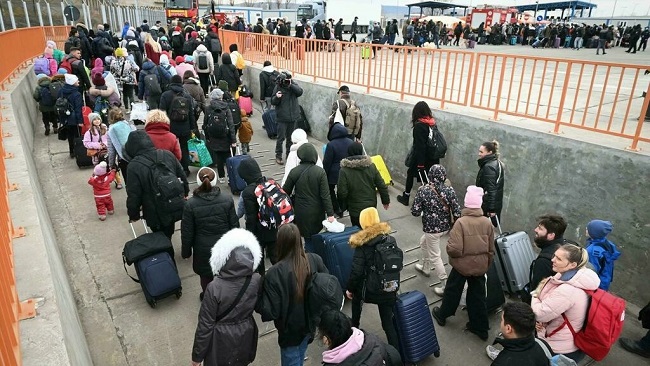
African nationals, many of them students, are among hundreds of thousands of people trying to flee into Poland and other neighbours.
Nigeria on Monday urged border officials in Ukraine and elsewhere to treat its citizens equally.
“There have been unfortunate reports of Ukrainian police and security personnel refusing to allow Nigerians to board buses and trains heading towards the Ukraine-Poland border,” said presidential advisor Garba Shehu in a statement.
“In one video widely circulating on social media, a Nigerian mother with her young baby was filmed being physically forced to give up her seat to another person.”
He said there are also reports of Polish officials refusing Nigerian citizens entry into Poland from Ukraine.
“It is paramount that everyone is treated with dignity and without favour,” said Shehu.
A group of South Africans, mostly students, have been stuck at the Ukrainian-Polish border, the country’s foreign ministry spokesman, Clayson Monyela, said on Twitter.
The South African ambassador to Warsaw was at the site trying to get them through, according to Monyela who on Sunday had said Africans were being “treated badly” at the Polish-Ukraine border.
Poland’s ambassador to Nigeria Joanna Tarnawska dismissed claims of unfair treatment.
“Everybody receives equal treatment. I can assure you that I have reports that already some Nigerian nationals have crossed the border into Poland,” she told local media.
She said Nigerians could stay for 15 days. Even invalid documents were being accepted to cross the border and Covid-19 restrictions were lifted, she added.
The Ukrainian embassy in Nigeria could not immediately be reached for comments.
‘Kept outside’
Some Nigerians who made it across the borders described frightening journeys in the dark to reach traffic-packed frontiers where they were made to wait as officials gave priority to Ukrainian women and children.
Stephanie Agekameh, a medical student now in Poland, said officials at the Medyka border crossing were responding first to Ukrainians.
“One of the officers came and told us it’s harder for us foreigners because they have to get in touch with our government in different countries,” she said by text message.
Speaking from Korczowa in Poland, Nigerian managerial sciences student Agantem Moshe, said Ukrainian police had pushed Africans out of the way to make way for women and children.
“From the Polish side it was smooth, they were professionals. In Ukraine, they kept us outside in the cold,” he said.
The UN said that more than half a million refugees from Ukraine had so far crossed into neighbouring countries.
Nigeria’s embassies in Bucharest said it had received 130 Nigerians from Ukraine. Another 74 were accounted for in Budapest, where another 200 were expected on Monday, the foreign ministry said.
Another 52 had arrived in Warsaw with another 23 being processed.
“We assure Nigerians that all hands are on deck and arrangements are being put in place to effectively evacuate our citizens in safety and dignity,” Nigerian official Gabriel Aduda said in a statement.
Ghana’s government said it would meet with parents of students stuck in Ukraine on Tuesday and sent embassy officials to border points to help.
Ivory Coast, which according to state media has 500 nationals in Ukraine, said it was also making arrangements for their evacuation.
Kenya’s foreign affairs ministry said 201 citizens were in the country, most of them students.
It said last week all Kenyans were safe and accounted for but that some were stuck at the Polish border because of visa restrictions.
Nigerian accountant Lukmon Busari was relieved his son, a fourth-year medical student, was already out after waiting for a day on the Polish border.
“Initially they didn’t allow them to move as they gave priority to Ukrainians, to women and children. Eventually they allowed them into Poland,” Busari told AFP by telephone.
“According to him, the Polish authorities did a marvellous job. He left on Thursday and got to the border on Thursday night, and he got into Poland on Friday.”
His son was currently resting in Poland before coming home.
“We are seeing how we can clear a flight for him to come back to Nigeria.”
Source: AFP
















4, March 2022
Russia seizes Europe’s largest nuclear power plant 0
Ukrainian authorities say Russian forces seized the largest nuclear power plant in Europe Friday after a building at the complex was set ablaze during intense fighting.
Fears of a potential nuclear disaster at the Zaporizhzhia plant spread alarm across world capitals, before authorities said the fire in a building identified as a training center, had been extinguished.
Ukraine’s president accused Russia of resorting to “nuclear terror” and seeking to repeat the Chernobyl disaster after saying that Russian forces attacked a nuclear power plant.
Russia’s defense ministry, however, blamed the attack at the site on Ukrainian saboteurs, calling it a monstrous provocation.
Earlier, in a video message, President Volodymyr Zelensky urged world leaders to prevent Europe from “dying from a nuclear disaster”.
US Energy Secretary Jennifer Granholm said there was no indication of elevated radiation levels at the Zaporizhzhia plant, which provides more than a fifth of the total electricity generated in Ukraine.
Local officials also said that essential equipment at the station was unaffected and radiation levels were normal.
An official at the state enterprise that runs Ukraine’s four nuclear plants said there was no further fighting, the fire was out and Zaporizhzhia was operating normally.
“(Nuclear power plant) personnel are on their working places providing normal operation of the station.”
A video from the plant showed one building aflame, and a volley of incoming shells. The head of the International Atomic Energy Agency said Ukrainian authorities had assured the IAEA that “essential” equipment were unaffected.
Russia has already taken control of the Chernobyl plant, about 100 km north of Kiev, which has been one of the most radioactive locations on earth since it saw an explosion in its fourth reactor in April 1986.
Financial markets in Asia spiraled out of control as early reports of the incident emerged, with stocks falling and oil prices soaring further.
“Markets are worried about nuclear fallout. The risk is that there is a miscalculation or over-reaction and the war prolongs,” said Vasu Menon, executive director of investment strategy at OCBC Bank.
Culled from Presstv