29, November 2023
Dortmund association celebrates 25th anniversary with international conference 0
25 years of Africa Positive
Dortmund-based association celebrates its 25th anniversary with the conference “Sustainable development and the role of the media – changing perspectives between Africa and Europe”. The conference took place on the 18th November 2023
The conference focused on the United Nations Sustainable Development Goals (SDGs) adopted in 2015, which aim to achieve peace and prosperity for all humanity by 2030 as part of an action plan.
The current situation regarding efforts to achieve these goals and further developments from a European and African perspective were discussed in presentations and working groups.
Keynote speaker, Dr. Oluseyi Soremekun from the United Nations Information Centre in Nigeria, called for a strong political will from the so-called developing countries to implement the goals. National governments must not only translate improvements into words, but also into action. He also called for better representation of developing countries in international politics.
Prof. Dr. Jürgen Scheffran from the University of Hamburg stated that six (of nine) so-called planetary boundaries had been reached. As all of the world’s major problems are interlinked, politics must focus on the “global whole”. The significance of national borders was becoming less important. So-called tipping points in political decisions would irreversibly steer developments in one direction or another. Scheffran went on to say that North-South cooperation was particularly important when it came to climate change. We must not play off against each other here – this is also linked to the causes of flight.
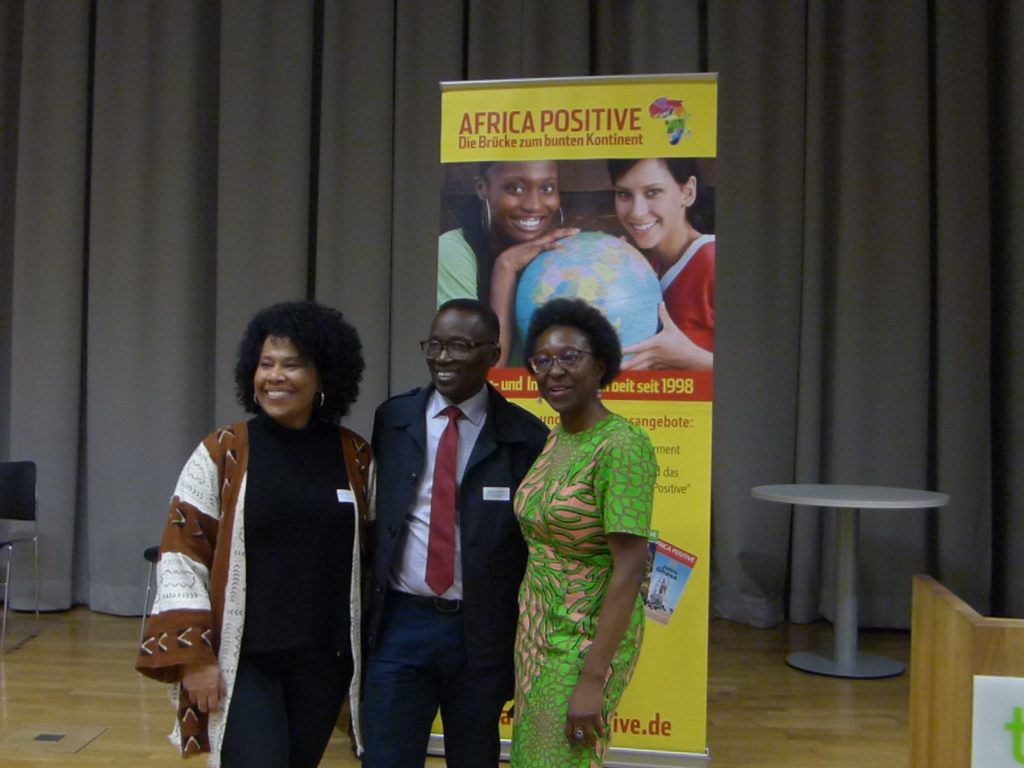
Nathalie Yamb, a pan-Africanist from Switzerland, called on African governments to initially only utilise the continent’s resources on the African continent and only sell them to other parts of the world if they are not needed in Africa.
The debate in these working groups focussed on two main questions: How have the corona pandemic and the war in Ukraine affected the implementation of SDGs? How should global goals such as SDGs be implemented in a world where there is no uniform monopoly on the use of force and where power is unfairly distributed?
During the discussion, it became clear that the first question has the answer in the second question. Unfairly distributed power relations have led to resource-rich countries in Africa being asked by countries such as Germany to mine more coal, for example, which diverts the focus away from global sustainability goals.
Another important point of discussion was that the world, especially the major powers, use their advantages in the world for their own national interests, usually at the expense of sustainable development goals. Connections between national and global goals are ignored, as are crisis situations.
As the global community in the form of the United Nations (UN) has no monopoly on the use of force, sustainable development cannot be enforced on a global scale. Against this background, the new, emerging multipolar world order was seen as problematic in some cases. At the same time, most participants were of the opinion that countries in Africa could have a better chance of protecting and asserting their own interests in the multipolar world order. There was a broad consensus that the multipolar world needs rules in order to be able to treat national and global interests fairly.
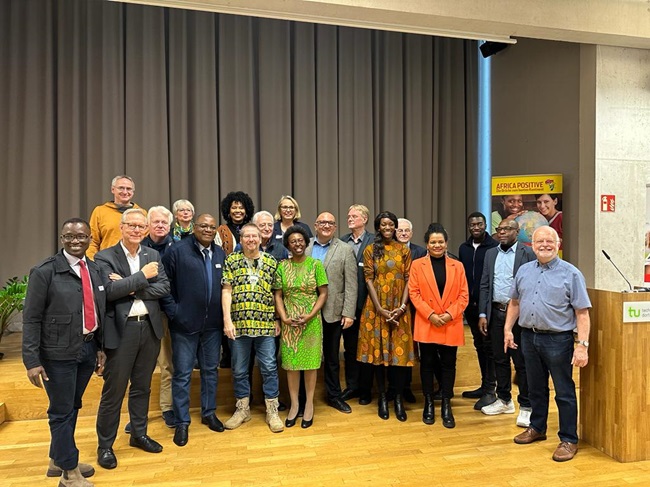
Africa Positive, one of the oldest and most successful African organizations in Germany, celebrated its 25th anniversary at its birthplace, TU Dortmund University, with numerous prominent guests and participants from African countries, Germany and Switzerland. Around 130 people took part in the international conference “Sustainable development and the role of the media – changing perspectives between Africa and Europe”.
Among the guests were well-known personalities from politics and other areas of public life: Thomas Westphal, Lord Mayor of the City of Dortmund, Mayor Barbara Brunsing, Police Commissioner Gregor Lange, former Mayor Ullrich Sierau, keynote speaker Dr Oluseyi Soremekun from the United Nations Information Centre in Lagos, Nigeria, Prof. Dr Jürgen Scheffran from the University of Hamburg and members of the state parliament Anja Butschkau and Volker Baran as well as Astrid Müller from the Foundation for Environment and Development NRW.
About Africa Positive e.V.
Africa Positive e.V. was founded 25 years ago by computer science student Veye Tatah from Cameroon at TU Dortmund University. Initially, the magazine of the same name was at the centre of the association’s work. The name “Africa Positive” refers to an important motivation for the magazine – the conviction that the African continent offers a lot of positive perspectives, especially when negative developments are specifically named. At the same time, it was hoped that differentiated reporting would help to break down prejudices against Africa and its people, facilitate dialogue at eye level and highlight its innovative strength.
Today, Africa Positive supports numerous intercultural activities and various projects in the areas of media work, development policy, youth work, integration, science and education.
In November 2018, the Africa Institute for Media, Migration And Development (AIMMAD) was founded for educational and research issues. Its work focuses on “journalism in a global context”.















15, December 2023
UK: Prince Harry wins 15 claims in phone-hacking case against Mirror publisher 0
Prince Harry has won 15 claims in his case accusing Mirror Group Newspapers of unlawfully gathering information for stories published about him.
A judge has ruled in his favour on almost half of the sample of 33 stories used in his claims of phone hacking and other methods.
A High Court ruling found evidence of “widespread and habitual” use of phone hacking at the Mirror newspapers.
Prince Harry described it as a “great day for truth” and accountability.
He was awarded £140,600 in damages and in a statement read out on the Duke of Sussex’s behalf outside the High Court, his lawyer David Sherborne called the ruling “vindicating and affirming”.
“This case is not just about hacking – it is about a systemic practice of unlawful and appalling behaviour, followed by cover ups and destruction of evidence, the shocking scale of which can only be revealed through these proceedings,” he said.
“I’ve been told that slaying dragons will get you burned. But in light of today’s victory and the importance of doing what is needed for a free and honest press – it’s a worthwhile price to pay,” Prince Harry’s statement said.
He also called on the police and prosecuting authorities to “investigate bringing charges against the company and those who have broken the law”.
The stakes have also been high for the Mirror newspapers – the Daily Mirror, Sunday Mirror and People – with estimates that £100m has already been spent on damages and legal costs over previous hacking cases.
Mr Justice Fancourt ruled that unlawful information gathering had been “widespread” at all three of the Mirror titles and had become “habitual”.
In response a Mirror Group Newspapers spokeswoman said: “We welcome today’s judgment that gives the business the necessary clarity to move forward from events that took place many years ago.
“Where historical wrongdoing took place, we apologise unreservedly, have taken full responsibility and paid appropriate compensation.”
The landmark ruling follows Prince Harry’s appearance at the High Court in June, where he became the first senior royal of modern times to give such extensive evidence in court in person.
Over two days, he was grilled about his claims that the group’s newspapers had published many stories about him, over several years, based on phone hacking and other unlawful ways of obtaining information.
Source: BBC