17, April 2023
Intense fighting continues in Sudan for third day as civilian death toll nears 100 0
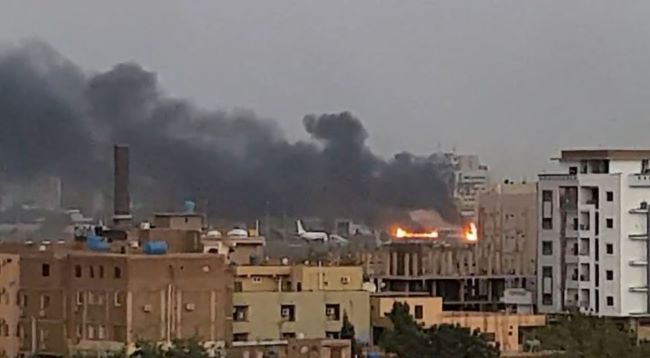
For a third consecutive day, people in Sudan woke up to the ear-splitting sounds of heavy artillery and bombardment by warplanes on Monday as the death toll neared 100 following violent unrest.
According to reports, explosions rocked the Sudanese capital Khartoum Monday amid fierce fighting between the country’s military and the powerful paramilitary Rapid Support Forces (RSF).
“The death toll among civilians… has reached 97,” the doctors’ union said, adding later that “dozens” of fighters had been killed and injured.
According to media reports, the figure does not include all casualties as many could not reach hospitals due to difficulties in movement amid the fighting.
The Central Committee of Sudan Doctors, a pro-democracy organization, also reported dozens of deaths among security forces, and some 942 wounded.
The intense conflict, which has seen air strikes, tanks on the streets, artillery fire and heavy gunfire in crowded neighborhoods both in Khartoum and other cities across Sudan, has triggered international demands for an immediate ceasefire.
The World Health Organization (WHO) warned that “several” of Khartoum’s nine hospitals receiving injured civilians “have run out of blood, transfusion equipment, intravenous fluids and other vital supplies”.
Katharina von Schroeder, a charity worker with Save The Children, who has been sheltering at a school with her son, told BBC they had hoped things would calm down when they arrived in search of shelter, but decided to stay put after clashes in the city escalated and spread to outside the capital.
She noted that several hundred children at least are trapped in similarly dangerous circumstances around Khartoum.
Meanwhile, the UN representative in Sudan on Monday slammed the failure by both the army and rival paramilitary forces to stop fighting during an agreed humanitarian pause to evacuate the wounded.
Volker Perthes said he was “extremely disappointed that humanitarian cessation of hostilities, that both the Sudanese Armed Forces and the Rapid Support Forces had committed to, was only partially honored yesterday”.
Violence erupted in Sudan on Saturday between Sudanese armed forces loyal to General Abdel Fattah al-Burhan, and the RSF, a paramilitary force led by Sudan’s deputy leader, Mohamed Hamdan Dagalo, known as Hemedti.
Hemedti, belonging to a family of camel herders, rose from lowly beginnings to head a widely feared Arab militia that crushed a revolt in Darfur, winning him influence and eventually a role as the country’s second most powerful man, and one of its richest.
He has played a prominent role in his country’s turbulent politics for 10 years, helping topple his one-time benefactor President Omar al-Bashir in 2019 and later quashing protests by Sudanese seeking democracy.
As deputy head of state, Hemedti, with little formal education, has taken on some of Sudan’s most important portfolios in the post-Bashir era, including the crumbling economy and peace negotiations with rebel groups.
Source: Presstv


















17, April 2023
Insecurity grows in Cameroon as reintegration efforts stall 0
Former Boko Haram fighters and members who return to communities in Cameroon pose a significant security threat to civilians. The lack of effective reintegration increases the chances of former combatants returning to violence, encouraged by the rise in lucrative organised crime, the circulation of illicit weapons and inter-communal conflicts.
The first step in successful reintegration is the screening of defectors. But this process is lacking in Cameroon, where the roles of Boko Haram associates who surrender are not clear. By distinguishing between fighters, hostages, couriers, slaves or logisticians, those who remain radicalised and dangerous, are identified. For example, in Amchidé near the Nigerian border, community sources told ISS Today that former combatants sometimes threatened civilians.
A National Committee for Disarmament, Demobilisation and Reintegration (CNDDR) was created in 2018, but the law establishing it doesn’t mention those kidnapped by Boko Haram. Hostages who escape and return home are often mistaken for ex-combatants. Managers at the Méri disarmament, demobilisation and reintegration centre in northern Cameroon say the facility houses both former hostages and fighters. So, in addition to the legal gaps, the lack of screening makes it difficult to resolve the problem.
Deficiencies in the reintegration process are detrimental to those who leave violent extremist groups. Former associates can face reprisals from Boko Haram’s victims because no prosecutions or reconciliation have taken place to prove their innocence or guilt. For example, many cases were reported of innocent former members being stigmatised in Mayo Moskota.
There is also a lack of clarity around prosecuting Boko Haram fighters, even though the Lake Chad Basin Regional Stabilisation Strategy and international standards cover this. Prosecution is important for reintegration, as it helps counter impunity and allay the fears of Boko Haram’s victims. But since the Méri centre was opened in 2020, no residents have been pardoned, exonerated or convicted of a terrorist act before being reintegrated into the community.
This highlights another problem – the lack of legal harmonisation in Cameroon. The 2014 law that imposes the death penalty on anyone found guilty of, or complicit in, acts of terrorism doesn’t promote reintegration. And the CNDDR decree is silent concerning amnesty or legal proceedings against former fighters.
Infrastructure such as cantonment centres – where returnees stay before being reintegrated – is also lacking. Méri’s secondary prison was transformed into a deradicalisation centre, but despite having space for only 150 residents, it houses over 2 500, according to the CNDDR. It also lacks training materials to facilitate former combatants’ economic integration. A regional cantonment centre should be built in Mémé in the commune of Mora, which has been declared the regional CNDDR headquarters for the Far North.
The lack of infrastructure means that many who leave Boko Haram prefer to integrate directly into communities. In 2021, the communes of Mora, Mayo Moskota, Kolofata, Mokolo, Makari, Waza, Logone-Birni and Fotokol alone were home to 584 former fighters and members. That number has since increased.
Many former combatants and members also live among internally displaced persons in Zamaï. They could become targets for reprisals from Boko Haram victims, or be attacked by insurgents who consider them traitors.
National guidance on reintegrating former members is essential. In 2017, the Far North Region governor encouraged Boko Haram fighters to defect, offering an outreach programme and a three-part protocol involving screening, deradicalisation and reintegration. On returning home, they pledged to abandon all interaction with Boko Haram, swearing on the Koran in the presence of community members and traditional and religious authorities. This initiative fell away when the CNDDR was created, but its achievements and lessons should inform ongoing reintegration processes.
Community sources say over 100 former fighters and members – disillusioned by their treatment at the Méri centre or left unmonitored in communities – have returned to Boko Haram since leader Abubakar Shekau died in 2021. The poor conditions in the Méri centre would also deter many fighters from surrendering.
National guidance on the organised reintegration of former members is essential
In the absence of successful reintegration, terrorism continues in the region. At the same time, armed robbery, hostage-taking and road ambushes are rising. Weapons are circulating, increasing insecurity and fuelling community conflicts. Reintegration is vital to reduce the threat of violent extremism and mitigate the upswing of organised crime linked to the presence of former Boko Haram associates in communities.
A clear process must be defined, including steps, objectives, outcomes and indicators. An inclusive, transitional justice approach should involve local communities, traditional leaders, community-based organisations, the media, researchers and the private sector.
Counter-terrorism legislation must also be harmonised at the national and regional levels. The principles for disarmament, demobilisation and reintegration in the Lake Chad Basin Regional Stabilisation Strategy must guide this process.
Source: Defense Web