24, October 2022
French President Macron meets Pope Francis for the third time 0
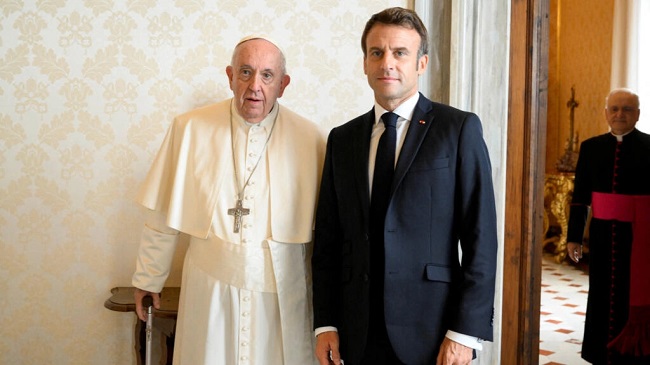
French President Emmanuel Macron and Pope Francis held nearly an hour of private talks on Monday, part of Macron’s trip to Italy to attend an international conference.
Macron, accompanied by his wife Brigitte, arrived at the Vatican and was greeted with an honour guard of Swiss Guards in the San Damaso courtyard before taking an elevator to the official papal study in the Apostolic Palace.
Francis, 85, was using a walking stick due to a painful knee, but looked cheerful as he chatted with Macron and posed for photographs with the French leader and his wife.
The two leaders then discussed “the conflict in Ukraine, with special attention to the humanitarian situation”, the Vatican said in a statement. “Particular consideration was given to the region of the Caucasus, the Middle East, and Africa,” it said. The Vatican said their private talks lasted 55 minutes.
Macron was escorted through ornate papal palace corridors by Swiss Guards, on his third visit to the Vatican since becoming president.
He gave Francis a 1796 first edition French-language copy of German philosopher Immanuel Kant’s “Perpetual Peace”.
He previously met Francis at the Vatican in June 2018 and less than a year ago, in November 2021.
Macron is in Italy to attend an international conference organised by Italy’s Sant’Egidio Community, a worldwide peace and charity group.
He and the pope will jointly close the conference at a special ceremony at the Colosseum in Rome on Tuesday.
Opening the conference on Rome’s outskirts on Sunday, Macron said he believed there was a chance for peace in Ukraine, even as Russia warned the conflict could escalate.
(FRANCE 24 with REUTERS)




















24, October 2022
Prevent Rather than Fight the Next Pandemic with a One Health Approach: World Bank 0
As the world continues to deal with the devastating effects of COVID-19, the World Bank is today releasing a new report that proposes actionable solutions to end the cycle of devastating pandemics.
The pace of emerging infectious disease (EID) outbreaks has increased at an average annual rate of 6.7 percent from 1980 onwards and the number of outbreaks has grown to several hundred per year since 2000. This is largely due to humans extending their global footprint, altering natural habitats, and accelerating the spillover of animal microbes into human populations.
Seventy-five percent of EIDs and almost all known pandemics result from increased contact between animals and people, causing more than 1 billion human infections and 1 million deaths each year. This, coupled with increasing movement of goods and people around the world, has demonstrated the ease of spread and volatility of EIDs.
In Putting Pandemics Behind Us: Investing in One Health to Reduce Risks of Emerging Infectious Diseases, policymakers, governments, and the international community are urged to invest in pandemic prevention and to move away from the business-as-usual approach based on containment and control after a disease has emerged. The report estimates that prevention costs guided by a One Health approach – which would sustainably balance and optimize the health of people, animals, and ecosystems – would range from $10.3 billion to $11.5 billion per year, compared to the cost of managing pandemics which, according to the recent estimate by the G20 Joint Finance and Health Taskforce, amounts to about $30.1 billion per year.
“Prevention is better than cure. COVID-19 has shown that a pandemic risk anywhere becomes a pandemic risk everywhere. The economic case for One Health is powerful – the cost of prevention is extremely modest compared to the cost of managing and responding to pandemics,” said Mari Pangestu, World Bank Managing Director of Development Policy and Partnerships.
Prevention costs are only about a third of the cost of preparedness, and less than 1 percent of the cost of COVID-19 in 2020 – when the global economy contracted by 4.3% or about $3.6 trillion worth of goods, services and other output lost, and the public health response. Ultimately, prevention is a global public good: no country can be excluded from benefiting and there is no limit to how many countries can benefit. Unfortunately, there is chronic underinvestment in prevention and countries must take action. In addition, when prevention is successful, the benefits are invisible and do not manifest as crises that demand immediate attention. One Health is the global approach required to break this cycle of panic, neglect, and underinvestment.
Successful implementation of One Health will require improved coordination, communication, and collaboration between sectors reinforced by capacity building. It means managing trade-offs between development and holistic health objectives, and sharing costs more equitably through global coordination of policy and financing actions.
Investing in One Health is an investment in humanity’s future. The framework is holistic and helps governments, international organizations, and donors direct financial resources to optimize scarce funding resources and prevent pandemics. One Health actions to prevent disease outbreaks are cost-effective, with an estimated annual rate of return of up to 86 percent. Now is the time to mainstream One-Health, leave the cycle of panic and neglect behind us, and put the notion that prevention is better than the cure into reality.
Contacts:
In Washington: Meriem Gray, mgray@worldbank.org
For Broadcast Requests: David W. Young, dyoung7@worldbankgroup.org