23, March 2021
Nigerian police confirms recovery of Cameroonian flag, military uniforms in Adamawa 0
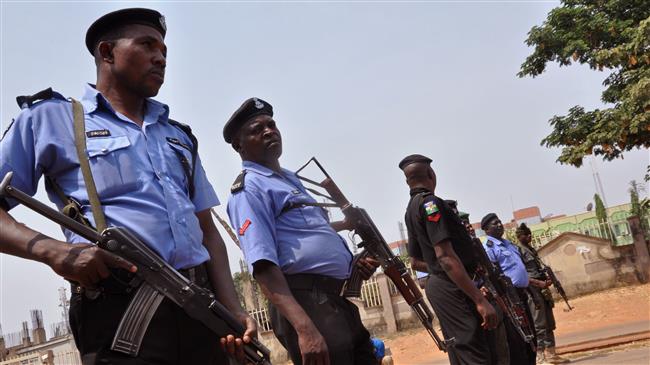
The Police Command in Adamawa has confirmed the recovery of Cameroonian national flag and nine Military camouflage uniforms at Lamunde Hill in Gumti National Park in Toungo Local Government Area of state. The News Agency of Nigeria (NAN) reports that Lamunde hill is part of Gashaka-Gumti National Park located along the Nigeria-Cameroon border.
Mr Aliyu Adamu, the Commissioner of police in the state, confirmed the development in a statement issued on Monday in Yola. Adamu said: “On the 19/3/2021, the Command disconnected criminal networks terrorizing communities along Nigeria-Cameroon border and Southern part of Adamawa state in general.
“The operation was carried out by Toungo Police Division and the Special Hunters of Pulaaku Association at Lamunde Hill situated at Gumti National Park in Toungo Local Government Area. “During the operation, a total of nine military Camouflage uniforms of Cameroon rebels, Cameroon national flag and one motorcycle, among other items were recovered.” He explained that the joined operation chased the suspected criminals into their hideout in a gun fire exchange.
The police commissioner said that the suspected criminals escaped with gunshot wounds into Cameroon after exchange of gunfire. “We are advancing to make sure that the suspects are apprehended,” Adamu assured. The police commissioner noted that the successes followed a credible information from good citizens after rampant cases of kidnapping, armed robbery and banditry in the areas. He commended the Toungo Divisional Police Officer and his gallant officers for a well-done job. He assured the good people of Toungo and Adamawa as a whole of the command’s commitment to keeping the state safe.
Source: Vanguard News Nigeria



















23, March 2021
Out of sight: Cameroon’s downward spiral of violence and displacement 0
A combination of deadly attacks by non-state armed groups in the Far North region and growing violence in the English-speaking Northwest and Southwest regions continue to trigger massive but underreported displacement in Cameroon.
Most displacement associated with conflict in Cameroon has historically occurred in the Far North, the poorest region of the country and the one that suffers the most from the Boko Haram insurgency. In 2020, however, seven in ten internally displaced people (IDPs) in Cameroon were forced to flee because of violence in the English-speaking regions.
“Since 2017, UN agencies have been warning of a tragedy in the making in Northwest and Southwest regions,” says IDMC director Alexandra Bilak. “Reports of thousands of new displacements since the beginning of the year and school attacks that have left children dead show that this is now a reality.”
Non-state armed groups fighting to secede from the rest of the country have been targeting schools and teachers they say are sponsored by the central government in French-speaking Yaoundé. Entire families are being forced to flee repeatedly to avoid kidnappings and harassment.
“Many IDPs look for a safe haven in Cameroon’s largest cities. But there they face a new set of challenges in accessing services and employment and often end up displaced again as a result of disasters,” explains Alexandra Bilak. In August 2020, the worst coastal flooding in decades rendered nearly 5,000 people homeless in Douala, Cameroon’s economic capital. Last year, floods also swept through the semi-arid Far North region, where they forced people already displaced from conflict areas to move again.
The total number of new displacements in Cameroon nearly doubled in 2020, compared to 2019. Over one million people are now internally displaced. The country also hosts around 435,000 refugees from Nigeria and the Central African Republic. If displacement continues at this rate and goes unreported, humanitarians will not be able to evaluate people’s needs and deliver effective assistance. “Without evidence, you cannot prevent, respond, or find lasting solutions to this neglected crisis”, warns Alexandra Bilak.
Source: Internal displacement