19, June 2020
East Africa braces for another locust invasion 0
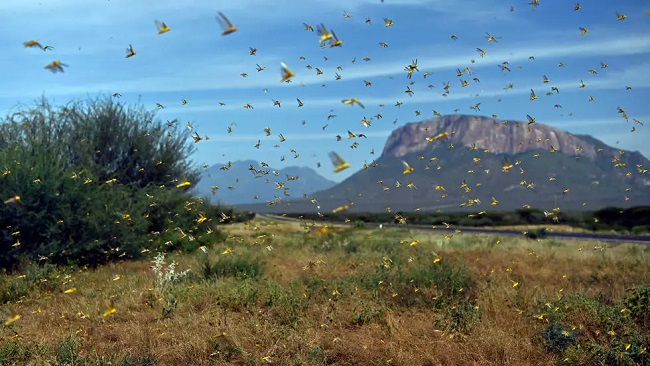
East Africa is bracing for a third outbreak of desert locusts, with billions of the destructive insects about to hatch and threaten food supplies in a region already reeling from damaging rains and the coronavirus pandemic.
Spurred by favourable weather conditions, the migratory pests have descended on East Africa in record numbers since late 2019 and another wave is about to take to the skies despite the concerted use of pesticides.
“Tens of thousands of hectares of cropland and pasture have already been damaged across the Horn and East Africa,” the International Rescue Committee said in a report this month, noting even a small swarm could devour the same amount of food in a day as approximately 35,000 people.
In Ethiopia between January and April, locusts destroyed 1.3 million hectares of grazing land and nearly 200,000 hectares of crops, resulting in the loss of 350,000 tonnes of cereals, IGAD, the East Africa regional organisation, said in a June report.
But these initial estimates — corresponding to the first and second locust waves — do not fully capture the extent of damage as field surveys have been hindered by the coronavirus pandemic.
“Until we get extended figures, I would just say Ethiopia was definitely the most affected in terms of croplands, then Somalia,” says Kenneth Kemucie Mwangi from ICPAC, the climate monitoring programme of IGAD.
Somalia, which like Kenya experienced heavy rains and flooding in recent months that left scores dead, had already declared a “national emergency” against the locust scourge in February.
So far East African neighbours Tanzania, Rwanda and Burundi have been spared the insects, which travel in huge swarms billions of insects strong, and can migrate 150 kilometres (90 miles) in a single day.
– 400 billion killed –
The World Bank in May approved a $500 million (445 million euro) programme to help countries vulnerable to hunger in East Africa fight the pests eating their way across the region.
Pesticide spraying operations have been underway since February, helping wipe out staggering numbers of the insects capable of multiplying their numbers 20-fold every three months.
“About 400,000 hectares were controlled in the region between January and mid May. We estimate that 400 billion locusts have been exterminated,” says Cyril Ferrand, a Nairobi-based expert with the FAO.
“We can’t estimate the total population because we don’t have access to certain areas, especially in Somalia. But we know that it’s been seriously reduced.”
In Kenya, where swarms blotted out the sky for miles in recent months, locusts have retreated to just three semi-arid counties in the country’s far north.
Fortunately too, forecasts of dire hunger did not materialise as the first swarm to arrive from Yemen in 2019 spared the end-of-year harvest, as the crops were already too mature.
The insects, which can eat their body weight in food in a single day, strip the leaves but not seeds.
“We have not seen signs of a large scale impact on food security,” says Lark Walters of the Famine Early Warning Systems Network, a US-funded food security monitoring organisation.
– Disaster after disaster –
However that doesn’t mean the impact hasn’t been keenly felt on among vulnerable communities where access to food is fragile, and any shocks can cause immense hardship, he said.
East Africa has endured a string of disasters of near-Biblical proportions in 2020: surging rain and devastating floods, locusts and then amid it all — a viral pandemic.
“Somali pastoralist communities have had three years of drought, then the locusts, now Covid, which will prevent them from exporting their livestock,” said Ferrand of the FAO.
“For them it’s disaster after disaster, so their resilience is already very low. The slightest shock can push them into extreme poverty.”
These shocks can ripple too through the wider economy, where coronavirus lockdowns and border closures have already dragged on trade and caused financial hardship.
On June 11, the credit rating agency Fitch Ratings noted that while coronavirus was the primary factor affecting growth “the ongoing desert locust invasion represents significant downside risk to East Africa’s macroeconomic stability”.
The looming third wave still lies as eggs beneath the soil, but is predicted to hatch in coming weeks, just as farmers take to the fields.
“We have concerns for the June-July harvest,” said Waters.
Warmer weather, more rain and wind gusts are expected to direct the insects northwards, deep into the Horn of Africa and as far as Yemen, areas that will become more conducive to their reproduction in the coming months.
Source: AFP























19, June 2020
Atanga Nji Boys attacking Southern Cameroons businessmen and highly placed civil servants 0
The Southern Cameroons Interim Government says armed militias backed by Cameroon regime forces have attacked scores of Ambazonian businessmen and women including highly placed civil servants in both the Northern and Southern Zones of the Federal Republic of Ambazonia as the ruling Biya Francophone regime presses ahead with its crackdown on pro-independence activists.
Vice President Dabney Yerima, citing Ambazonia Intelligence sources reported on Thursday that pro-Yaounde armed militias passing for Amba Fighters are storming into residence and demanding huge amounts of money from the local population in Bamenda, Kumba, Buea and Mamfe.
Several innocent Southern Cameroons civil servants and businessmen are currently being held in undisclosed locations by the armed militias created and sponsored by the Minister of Territorial Administration, Paul Atanga Nji.
Last month, the exiled Southern Cameroons leader raised the issue of the Atanga Nji Boys in a letter addressed to the European Union and the United Nations in which he observed that the French Cameroun authorities were also preventing imprisoned Ambazonia leader Barrister Blaise Shufai from receiving appropriate medication.
Southern Cameroonians have been staging almost daily ghost town operations and armed resistance ever since a pro-independence uprising began in West Cameroon four years ago. The people of Southern Cameroons-Ambazonia are calling for complete separation and independence from La Republique du Cameroun.
The French Cameroun regime, in return, has ignored the calls and is pressing ahead with its heavy-handed crackdown and persecution of the people of Southern Cameroons and their leadership.
By Isong Asu