22, September 2018
‘Imagine in five years’: how education became a casualty of Southern Cameroon’s war 0
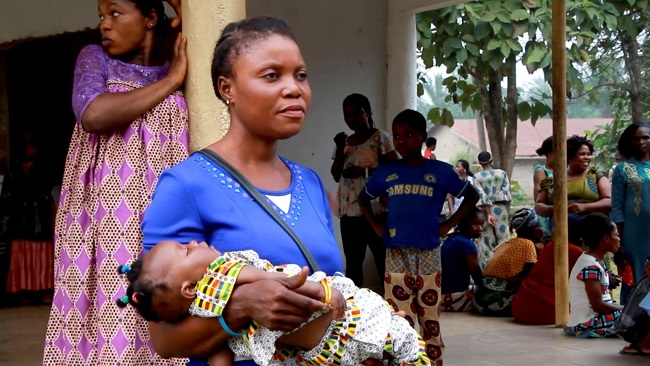
If Simon had the chance to tell his class about his summer holidays, the seven-year-old Simon would no doubt mention the large tarpaulin sack that for almost four months served as his sleeping bag and his magic carpet.
When the family fled their home in the town of Batibo, in Cameroon’s north west, his mother used grain bags to carry her two youngest children as Simon ran alongside. Later, out in the open jungle, all three children slept inside the bags.
“It protected them from the snakes and the mosquitoes,” says Rebecca, Simon’s mother, 25, her voice still sounding panicked as she describes the exodus and the stray bullets she feared could hit her children.
But Simon will not be telling any summer holiday stories this year. Like tens of thousands of other Cameroonian children, school has been suspended for yet another year.
The crisis in Cameroon’s two English-speaking regions – the north-west and south-west – began in October 2016 with peaceful protests by lawyers and teachers demanding the wider use of English, rather than French, in local courtrooms and schools, as well as more English-speaking school teachers, adherence to a dual legal system and a fairer allocation of resources.
But the situation has spiralled out of control amid a vicious war of kidnapping, decapitations and the burning of entire villages.
Classrooms have become part of the ongoing warfare between the government and separatist forces. School attendance is compulsory for all Cameroonian children until the age of 12, but gunshots on the streets and threats from separatist forces mean many are denied this right.
In recent months, teachers who dared to show up for work have been killed, and buildings burned. This week an unknown group of men stormed a school in Buea, capital of the south-west region, attacking students and teachers with machetes and guns. This followed reports that on 3 September, the first day of the academic year, gunmen attacked a secondary school in the town of Bafut, about 25km from Bamenda, the capital of the north-west region, kidnapping five pupils.
Condemning such incidents, Jacques Boyer, who represents Unicef, the UN children’s agency, in Cameroon, said: “All children in the north-west and south-west regions – like any other children across the country – must be able to go to school in peace.”
Unicef estimates published this month show that, of more than 300 million five- to 17-year-olds not in school worldwide, one-third live in conflict areas.
But Unicef is not providing any educational support for people living in the affected regions and there appears to be little help from other organisations. Cameroonians are being left to get on with things themselves.
The country’s two Anglophone regions are home to approximately a fifth of the country’s population, estimated at 23 million. More than 180,000 people have fled their homes in the Anglophone areas, and families are growing increasingly anxious about the impact of missed schooling on their children.
“Imagine five years from now, the children still not going to school – what will happen to them?” says Bridget, 50, a retired nurse who fled her north-west hometown. “They will become a terror group fighting the government.”
Such fears may already be a reality. Claire, 38, from Kumbo, north-west region, says children she used to see in her church now run around the neighbourhood with guns.
“One of their leaders is a girl whose grandmother was burned alive in her home [by government forces],” she says. “Now she’s one of the ones giving orders.”
Today, she can shoot a gun. “But what will happen to her when she is arrested?” says Claire.
There are also worries that lack of schooling will increase already high teenage pregnancy rates. According to the Cameroon Medical Council, one in four pregnancies in the country are among school-age girls.
Though there are no official statistics, parents from the north-west region who have fled to the capital, Yaoundé, say they have noticed more pregnant teenagers. With shops and businesses closed, schoolgirls are looking for cleaning or babysitting jobs, leaving them at risk to abuse.
More affluent families have sent their children to schools in the French-speaking parts of the country, and cities like Douala and Yaoundé are beginning to feel the squeeze.
Sandrine, 17, a student at Deido billingual high school in Douala, says class sizes have increased considerably. “In theory, there are supposed to be around 40 students in a classroom, but that’s a joke,” she said. “It’s more like a hundred.”
During last summer’s exams season, she said students had to turn up extra early to claim a desk or face being turned away.
For those stuck in the crisis-ridden regions, private education – which is becoming ever more expensive – is the only option, says Frances, a mother of one in Kumba.
“The teacher charges 30,000 [West African CFA] francs per month, so for nine months the fees will be 270,000 francs (£370), while school used to cost just 90,000 per year,” she says.
Organising home schooling is not always possible, adds Frances, since group gatherings of more than five people can attract the attention of the authorities.

“I haven’t got a job, and I can’t afford the school fees,” she says. She does not speak French, the working language in the capital. She is afraid people will turn on her when they realise where she is from.
“We are too afraid to even go outside and speak English,” she says. Other mothers nod in agreement. Surveying the calm Yaoundé traffic, Claire, about to return to Kumbo, says she fears young people in her hometown will be a lost generation. “You can sacrifice anything, but not the future of the children.”
*All names have been changed at the request of the interviewees, who feared repercussions if identified.
Source: The Guardian
















22, September 2018
Tanzania president orders arrests over ferry disaster as death toll rises 0
Tanzanian President John Magufuli on Friday ordered the arrest of the management of a ferry that capsized in Lake Victoria, killing 151 passengers.
The death toll from the sinking has risen to 151, state-run TV station TBC said Saturday as rescue workers pressed on with the search to find more people feared drowned.
In a speech broadcast on TBC 1 public television, Magufuli said “it appears clear that the ferry was overloaded”, adding that “negligence has cost us so many lives… children, mothers, students, old people”.
“I ordered the arrest of all those involved in the management of the ferry. The arrests have already begun,” he added. President Magufuli declared four days of national mourning on Friday and said that the government would pay funerary costs for the victims.
Authorities have begun a criminal investigation into the MV Nyerere, which sank with an unknown number of passengers aboard on Thursday afternoon near Ukara, the lake’s biggest island, which is part of Tanzania.
Initial estimates indicated that the MV Nyerere was carrying more than 200 people onboard, when the ship’s capacity is just 101. It went down just a few metres from the dock in Ukerewe district, according to national ferry services operator TEMESA, but it is likely that most on board did not know how to swim.
But it was hard to establish the precise number of passengers on board since the person dispensing tickets had also drowned with the machine recording the data lost. “There were more than a hundred passengers on board when the ferry sank, it is feared that a significant number have lost their lives,” said George Nyamaha, the head of Ukerewe district council.
The ferry was also carrying cargo including sacks of maize and cement when it capsized close to the dock.
Reporting for FRANCE 24 from Tanzania, Emmanuel Makundi noted that while the cause of the accident was not immediately clear, he had interviewed a witness who was on the lake shore at the time of the accident: “He said that as the ferry was approaching the shore, many people tried to reach the gate and that led a car that was onboard the ferry to topple over. That led the ferry to list on one side, causing the accident.”
In 1996, a ferry disaster on Lake Victoria in the same region killed at least 500 people. In 2012, at least 145 people died in a ferry disaster in Tanzania’s semi-autonomous archipelago of Zanzibar in the Indian Ocean, on a vessel that was overcrowded.
(FRANCE 24 with REUTERS, AFP)