8, February 2019
US can no longer ignore alleged atrocities by Cameroon gov’t forces-Gen. Waldhauser 0
The United States has cut some military aid to Cameroon over human rights concerns but the countries’ relations remain excellent, the U.S. ambassador asserted Thursday, while the central African nation’s government remained silent. France said it would not follow the U.S. lead despite a call by Amnesty International for other donors to take similar action.
The U.S. move against a key security partner, confirmed late Wednesday, came after videos circulated online last year showing Cameroonian forces shooting and killing civilians, including women with small children strapped to their backs. The videos were verified by Amnesty International and other global media outlets.
Cameroon is fighting both a separatist movement in its Southwest and Northwest regions and Boko Haram extremists in the Far North, with some attacks carried out by women. The State Department has urged “greater transparency in investigating credible allegations of gross violations of human rights by security forces.”
“We are not going to stop security cooperation with Cameroon. We have our differences, Cameroon is a sovereign country and the United States is a sovereign country,” Ambassador Peter Henry Barlerin said Thursday after meeting with Cameroon’s government spokesman Rene Emmanuel Sadi. “Relations between Cameroon and the United States are excellent and longstanding and we aim to continue that relationship.”
The Pentagon and State Department said the reduced U.S. support involves armored vehicles, boats, aircraft upkeep and parts, helicopter training and an invitation to a partnership program. Some 300 U.S. troops are based in the northern town of Garoua to train and assist Cameroon’s military, including in its fight against extremism.
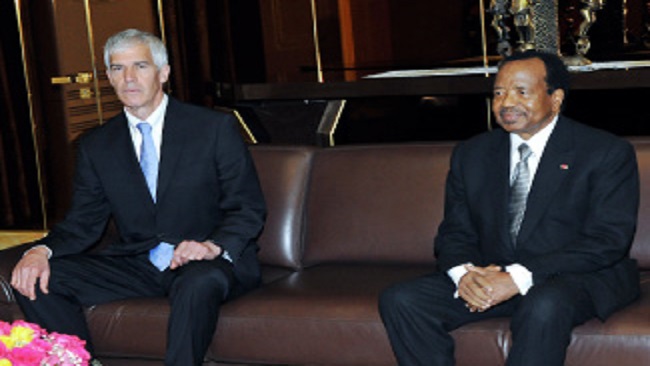
In Washington, the head of the U.S. Africa Command, Gen. Thomas Waldhauser, told the Senate Armed Services Committee that he had met with Cameroon’s President Paul Biya alongside the U.S. ambassador before elections in October.
“We were very emphatic with President Biya that the behavior of his troops, the lack of transparency, could have a significant impact on our ability to work with them,” Waldhauser said. The U.S. has put on hold several security assistance programs in recent months, he said.
The U.S. military’s main role in Cameroon is limited to training local counterterrorism forces to combat Boko Haram and “they have been a good partner with us, counterterrorism-wise,” Waldhauser said. Nonetheless, he added, the U.S. cannot “neglect the fact that there are alleged atrocities in what’s gone on there.”
Waldhauser said AFRICOM will continue to take cues from the State Department and the ambassador on security assistance.
/arc-anglerfish-arc2-prod-mco.s3.amazonaws.com/public/RS25L4VFRFDCHKLYTOF6MOX5N4.jpg)
U.S. Marines assigned to Special Purpose Marine Air-Ground Task Force-Crisis Response-Africa ground combat element trained with the Cameroon Marines in infantry tactics at a training site in Cameroon, Feb. 14, 2018. (Gunnery Sgt. Rebekka S. Heite/Marine Corps)
The security and human rights concerns have posed a challenge for 85-year-old Biya, one of Africa’s longest-serving leaders. He became president in 1982 and won another term in October, after which the military launched fresh offensives against the separatists.
The United Nations has said some 430,000 people in the Southwest and Northwest regions have fled the fighting between security forces and English-speaking separatists who seek independence from the largely French-speaking country.
In December, the top U.S. diplomat for Africa, Tibor Nagy, said he feared the separatist crisis could get “much, much” worse and warned against a “brutal response” to extremism. Cameroon’s government in the past has said it would investigate alleged abuses.
Local businessman Eric Njowir welcomed the U.S. decision, saying he hoped other countries will take similar action. Countries that help Cameroon militarily also include Israel, Germany and China. “What the military has been doing is against human rights and human freedoms,” Njowir said. Source: MilitaryTimes















8, February 2019
Southern Cameroons Crisis: “Cameroon is a ticking time bomb” 0
A senior Cameroon government official has said Cameroon is a ticking time bomb. The official, who has elected anonymity, holds that with the chaos taking place in the country, it is clear that if things are not properly managed, the country might derail into a full-blown chaos.
The senior official who spoke to the Cameroon Concord News Group Chairman over the phone was referring to the running battles between hawkers and policemen in Yaounde on Friday, February 8, 2019, which resulted from a bad decision by a police officer who molested a hawker in the Yaounde Central Market, the country’s largest market. The other hawkers quickly jumped into the fray to support their colleague and this developed into a huge stand-off between the hawkers and government security forces.
“Cameroon is a ticking time bomb and if care is not taken, it might go off and the consequences might be far-reaching. This country is gradually drifting into chaos. There are demonstrations every day in the country and the government appears to be unable to put a handle on the issues. We are all living in fear. Even senior government officials are wary of the path the country is taking. We hope things could be brought under control to spare the country the type of chaos we see in other countries,” he said.
“The Anglophone crisis seems to have opened the floodgates for demonstrations and chaos. Even Francophones are now courageous to challenge their own authorities. Anglophones might have lost so many lives, but their determination and selflessness has taught Francophones that they must stand up for themselves. The government has to be very careful the way it handles some of these issues. The country is a tinder box and any little thing can trigger a huge fire,” he stressed.
“Things have gotten worse since the last presidential election whose results Professor Maurice Kamto is protesting. His determination to reclaim his victory is causing some government officials to lose sleep. Many of them have already sent their children out of the country. They are scared of any reprisals in the event of a regime change. They know they have not handled things properly and the use of brute force has not helped matters, especially in the North West and South West regions. We are all living in fear. If I were still young, I would have migrated to another country just to escape the disaster that is hanging over our country like the Sword of Damocles,” he said.
“President Biya is out of steam. Those around him are manipulating him. They are mostly people related to his wife and they are simply implementing Chantal Biya’s agenda. Our country is in for real trouble and the days ahead are not promising. We need divine intervention. Our country is bleeding. The country is losing its young human resources in a war that was declared out of arrogance. Besides, the war itself is consuming lots of resources. The Anglophone regions have been contributing much to the country’s GDP, but with the fighting getting more violent by the day, the country is being robbed of those resources that could help make life better for all Cameroonians. The lock-down is already biting the government and I hear there will be a more rigorous lock-down after February 14. This will trigger more problems and many more souls will be lost,” he regretted.
The economic chaos resulting from the war has hit the country like a ton of bricks and it will take Cameroon a long time to recover from the mess it has created for itself. The country is cash-strapped and some of its allies have bad news for the government. The Anglophone problem has now become a millstone around the government’s neck. The people are sick and tired of a government that has nothing to show for its long stay in power. Its ailing and senile leaders hold that only violence can address all the issues facing the country. They are mistaken. Times have changed and approaches must also change if peace has to prevail.
The failure to embrace new ways is ruining many things and enabling nepotism and tribalism to rear their ugly heads. The country is clearly dealing with many crises. The arrest and detention of Professor Maurice Kamto, the clear winner of last year’s presidential election, has opened a new front in the battle to oust the crime syndicate that has been ruling the country for more than five decades.
But it is the Southern Cameroons crisis that is finally robbing the Yaounde government of its sleep. For more than two years, the Yaounde government has been ignoring calls for an inclusive dialogue as a major step towards addressing the political and military crisis that has put the country in the spotlight for all the wrong reasons. For three years now, the country’s two English-speaking regions have been the theater of a bloody conflict that has already consumed more than five thousand lives, including some 2,000 army soldiers. The number of those injured is in the thousands too and there is no end in sight.
Government forces are the primary suspect of the violence that has made life unbearable in the two English-speaking regions of the country, as they have the nasty habit of shooting at any and everything, especially when some of their colleagues have fallen in combat.
While the Yaounde government thinks it can ignore every call, the Americans have been figuring out how to bring the corrupt government in Yaounde to order. Americans just like their Canadian and British allies have kept urging the country’s president, Paul Biya, and his government to do the right thing for the sake of peace and stability in the Central African nation which, for many decades, was considered by many in the world as an oasis of peace in a desert of chaos.
But the refusal of the ailing and senile Cameroon president to listen to the world has been upsetting many in the international community, especially the United States government which has been extending military and financial help to the cash-strapped dictator in Yaounde. The government’s refusal has prompted the US government to cut millions of dollars in security and military aid to Cameroon amid growing concerns over the Cameroonian government’s dismal human rights record.
According to a US official who spoke to CNN, the US intends to “terminate” over USD17 million in security aid, including funds for radars, four defender-class patrol boats, nine armored vehicles, training programs for C-130 airplanes and helicopters and the withdrawal of an offer for Cameroon to be a candidate for the State Partnership Program.
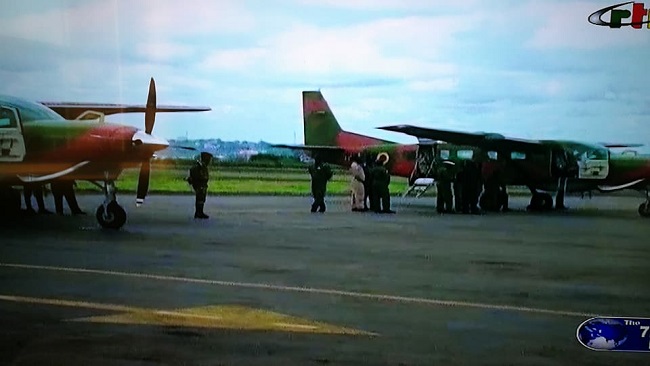
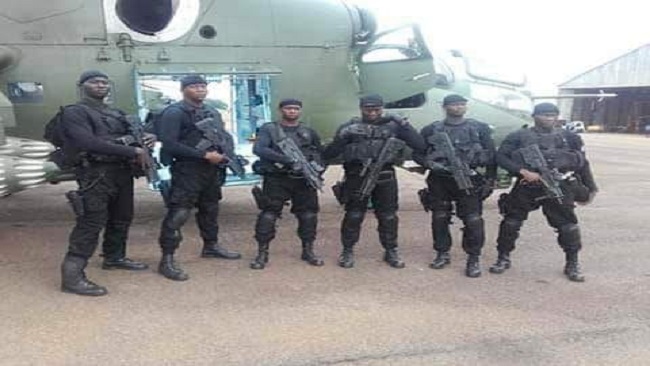
A planned US funded upgrade to a Cessna aircraft belonging to Cameroon’s elite Rapid Intervention Battalion has also been terminated. The battalion, which has been previously advised by US troops, has been accused of engaging in human rights abuses. Some of the security assistance money had been put on hold by Congress due to those concerns.
Last May, the US Ambassador to Cameroon, Peter Henry Barlerin, gave a speech that accused pro-government Cameroonian security forces of conducting “targeted killings, detentions without access to legal support, family, or the Red Cross, and burning and looting of villages.”
The US government has continued to urge the Cameroonian government to take all credible allegations of gross violations of human rights seriously, investigate those allegations thoroughly, hold accountable the perpetrators of such abuses, and disclose the outcome of the investigations to the people of Cameroon, these calls have falling on deaf ears because the Yaounde dictators holds that only a military solution can bring peace to the troubled country.
“We have informed the Cameroonian government that lack of progress and clarity about actions undertaken by the government in response to credible allegations of gross violations of human rights could result in a broader suspension of US assistance,” the State Department official said, adding that the US has “been assured by the government of Cameroon at the highest levels that US security assistance will not be diverted from other than its intended purpose.”
Another State Department official emphasized that “it is in Cameroon’s interest to show greater transparency in investigating credible allegations of gross violations of human rights abuses by security forces, particularly in the Northwest, Southwest, and Far North Regions.”
“The successes of the Cameroonian military — in part as a result of our training and equipment — have yielded long term and sustainable increases in Cameroon’s ability to defend its territory, its borders, and come to the aid of its neighbors, in particular northeast Nigeria and the Central African Republic,” the official said, adding that they “recognize the great cooperation we have had in the fight against Boko Haram and in restoring maritime security in the Gulf of Guinea.”
“For the time being, other programs will continue. We do not take these measures lightly, but we will not shirk from reducing assistance further if evolving conditions require it,” they said. One US official said those programs include education programs for Cameroonian officers focused on professionalization and peacekeeping as well as continuing to support “select counterterrorism and maritime security programs that have been evaluated to have low risk of diversion to the Anglophone region.”
It should be stated that the Pentagon has already withdrawn an offer for Cameroon to participate in its State Partnership Program, a “security cooperation program” that teams US state National Guards with host nation militaries. Originally the Defense Department had intended Cameroon to partner with the Nebraska National Guard. The US has 14 such partnerships with African countries, including Cameroon’s neighbor Nigeria.
The State Department is also seeking to have an additional USD 10 million that was placed on hold released to fund the sustainment of certain military equipment already in Cameroon’s possession such as Cessna airplanes, mud boats for patrolling Lake Chad, and Scan Eagle Drones.
The US has had hundreds of troops in Cameroon tasked with training, advising and assisting local forces in their fight against ISIS West Africa, Boko Haram and other violent extremist organizations in the Lake Chad Basin region.
US Africa Command launched an investigation last August to determine if US personnel were aware of allegations of torture of suspected terrorists being carried out by US-trained Cameroonian troops from the Rapid Intervention Battalion at a base that was also frequently used by US military advisers.
The results of that investigation were not made public, but a US defense official told CNN that the investigation “found that US military forces in Cameroon were not involved in or aware of human rights violations committed by Cameroonian forces.”
However, the official said the Defense Department and State Department “will assess the validity” of claims by Amnesty International that Cameroonian forces engaged in torture in a “separate investigation.”
Gen. Thomas Waldhauser, the commander of US Africa Command, is scheduled to testify Thursday before the Senate Armed Services Committee. The Trump administration recently decided to cut the number of US troops in Africa engaged in counterterrorism with the bulk of those reductions expected to take place in West Africa.
Meanwhile, another State Department officer who spoke on condition of anonymity to the Cameroon Concord News Group’s chairman over the phone said that with the events unfolding in Cameroon, it is clear that the Biya regime now belongs to the past. The government is anti-democracy. It is jailing and killing opponents who hold political views that are not in line with its own.
“The US stands for democracy and we will not support a regime that is killing its own people. We grant millions in aid to the government and we support many programs in Yaounde to further democracy in Cameroon, but the government’s behavior in recent years has proven that it is not willing to be part of the democratic world and we think it clearly belong to the past. If Mr. Biya and his government do not take appropriate measures to be in line with 21st Century governance principles, the US and its allies will ensure that the government pays for the violations it has been accused of,” the official said.
“If the reduction in military aid does not bite as planned, our administration will resort to other methods and this will include, but not limited to freezing the assets of senior government officials and refusing them and their children visas. We will be working with our allies to make sure Mr. Biya ends the violations taking place in Cameroon,” the official concluded.
It is clear that these measures will hit the Yaounde government like a ton of bricks, especially as rights groups are working hard to ensure the country’s president acts in accordance with international human rights law.
Amnesty International, a global human rights group, has already called on the US to press other donors to cut assistance to Cameroon. In response to reports that the US government has decided to cut security and military aid to Cameroon amid concerns over its human rights record, Adotei Akwei, deputy director for advocacy and government relations for Amnesty International USA said there was evidence Cameroon security forces had been involved in human rights violations.
“Cameroonian security forces have indiscriminately killed, arrested, and tortured people, firing on crowds, displacing thousands of civilians, and destroying entire villages with impunity. These abuses continue, following the presidential elections that took place in October that returned 36-year-incumbent Paul Biya to power.
“The United States must continue to show that it takes human rights violations committed with its aid seriously, through the suspension of all security assistance until the Cameroonian government can show it has not been utilized to commit serious violations of international law and persons responsible have been held accountable. The Trump administration should press other donors of security assistance to review their programs and insist on accountability and reform within the Cameroonian security forces”.
In June 2017, Amnesty International issued a report on torture in Cameron entitled Cameroon’s Secret Torture Chambers: Human Rights Violations and War Crimes in the Fight Against Boko Haram. In June 2018, the organization released a report detailing abuses in Cameroon’s Anglophone crisis, ‘A turn for the worse: Violence and human rights violations in Anglophone Cameroon’. The report was based on in-depth interviews with over 150 victims and eye-witnesses, and material evidence including satellite images.
By Kingsley Betek in Yaounde and Irene Nayongo in North America