29, February 2020
Guinea delays controversial referendum 0
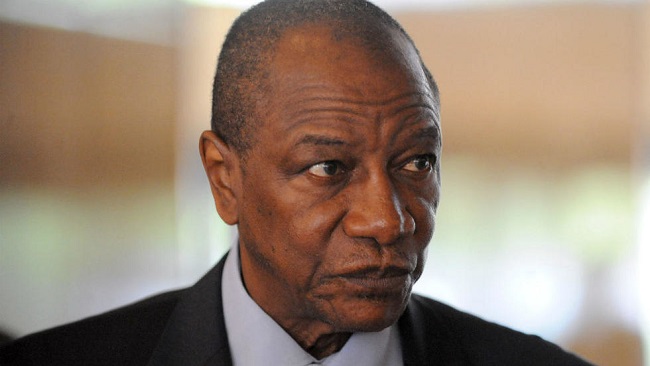
Guinea’s President Alpha Conde announced a “slight postponement” of Sunday’s referendum on whether to adopt a new constitution, following mounting international criticism over the poll’s fairness.
The government argues that the draft constitution would, among other things, codify gender equality and ban female circumcision and underage marriage in the West African state.
But the proposal has sparked huge protests since October over fears that the real motive is to reset presidential term limits — allowing Conde, 81, to run for a third spell in office later this year.
Speaking on national television, the president said on Friday it was “due to our national and regional responsibilities that we have accepted a slight postponement of the date of the elections”.
“This is not a capitulation or a step backwards,” he said, adding that “the people of Guinea will express their choice freely at the referendum”.
While Conde did not publicly announce a date for the new vote, a letter from the leader to the West African bloc ECOWAS, seen by AFP, said the new poll should take place within two weeks.
The poll had been scheduled for Sunday alongside parliamentary elections — also delayed in the poor but mineral-rich country of some 13 million people, which has a legacy of autocratic rule.
The long-running demonstrations over the constitution issue have sometimes turned violent, with at least 30 protesters and one gendarme killed to date.
Conde’s announcement followed criticism of the electoral process from the African Union, European Union and The International Organisation of La Francophonie (OIF), which gathers French-speaking states.
The OIF said this week it had problems with around 2.5 million of the 7.7 million names on the electoral roll, pointing to duplicate registrations and people who had died.
The African Union also cancelled an electoral observation mission to Guinea on Friday, citing a “major controversy” with the roll.
Meanwhile the EU said in a statement that a “lack of inclusiveness and transparency casts doubt on the credibility of the upcoming elections”.
Quiet streets
Sekou Conde, a cadre in the president’s Rally of the Guinean People (RPG) party, said the vote had been postponed purely for technical reasons.
“It has nothing to do with the electoral roll,” he said, adding that people had ransacked voting stations.
A Western diplomat, who declined to be named, said he thought the delay would make no difference anyway.
“This changes nothing,” he said, adding that there would be no credible change to the problems with the electoral roll within two weeks.
The streets of the capital Conakry were quiet on Friday evening after the announcement, despite months of protests.
Ibrahima Diallo, the operations manager for the National Front for the Defence of the Constitution — an alliance of opposition groups behind the protests — said that demonstrations would continue until Conde shelved the referendum.
Although both the current constitution and the proposed new text limit presidential terms to two, critics fear that passing a new constitution would reset presidential term limits to zero.
This would potentially allow Conde to run again when his second term runs out at the end of the year.
Conde was a longtime opposition figure who became the nation’s first democratically elected president in 2010 on promises to fight corruption. He was re-elected in 2015.
Source: AFP
















13, March 2020
Ivory Coast: Prime Minister named ruling party’s presidential candidate 0
Ivory Coast’s ruling party has named the prime minister as its candidate for the October presidential poll, after President Alassane Ouattara ended months of speculation and said he would not seek a controversial third term.
The choice of Amadou Gon Coulibaly, a close friend and confidant of the president, comes ahead of a challenging election for the West African country — the world’s top cocoa producer and home to more than 25 million people.
A 2010 vote ended in violence between rival political factions which left 3,000 people dead.
“I am aware of the magnitude of the responsibility and the magnitude of the burden,” Coulibaly said after being nominated late Thursday by the Rally of Houphouetists for Democracy and Peace, or RHDP.
“I have appealed to all my sisters and brothers to be united,” he added. “We must win these elections in the first round.”
The constitution allows only two presidential terms, but Ouattara, 78, had said he would be able to stand due to a constitutional change in 2016 — a claim rejected by the opposition.
Analysts say it was essential to announce Ouattara’s choice of candidate quickly.
“The RHDP has stepped up the tempo to give Amadou Gon Coulibaly time to campaign and be visible,” said political scientist Jean Alabro.
“From the moment Ouattara was no longer a candidate, he had to readjust the strategy in order to mobilise around the new leader, and to remove any hint of another candidate,” added political scientist Arthur Banga.
– In president’s shadow –
While the choice of Coulibaly was not unexpected, the announcement — made without a vote and a week after Ouattara ruled out running in the October 31 race — came as a surprise.
The 61-year-old has spent his career in the shadow of the president.
“I’ve been learning alongside President Alassane Ouattara for 30 years,” he said Thursday.
He was the president’s secretary general from the time Ouattara came to power in 2010 until his appointment as prime minister in 2017.
Before that he was a senior civil servant and minister of agriculture. He was trained in France and, like Ouattara, has a good grasp of international finance.
“If we want our country to continue to evolve in the spirit of (Ouattara’s) governance, Gon (Coulibaly) is best placed,” said Hamed Bakayoko, the defence minister.
Coulibaly is from a large family in the country’s north and is very influential among traditional chiefs. He was mayor of Ivory Coast’s fourth-largest city, Korhogo, from 2001 to 2018.
Ouattara had kept Ivorians guessing over his political future, saying last year that he could run again if his traditional rivals were candidates.
Since the death of founding President Felix Houphouet-Boigny in 1993, Ivory Coast politics have been dominated by three men: Henri Konan Bedie, Laurent Gbagbo and Ouattara.
Gbagbo, who refused to step down after losing elections in 2010, was acquitted by the International Criminal Court last year on charges relating to the unrest triggered by his bid to cling on to power.
Bedie, who will be 86 during the October election, has not ruled out running.
Source: AFP