21, January 2018
Bundes: SPD to decide on coalition talks with CDU 0
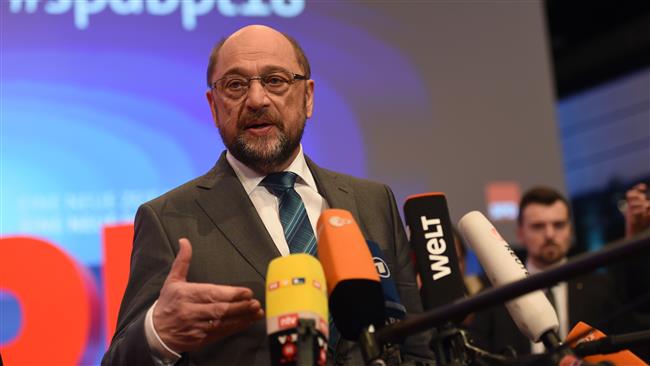
Germany’s Social Democratic (SPD) Party is scheduled to hold a meeting on Sunday to decide whether the center-left party should initiate formal coalition talks with Chancellor Angela Merkel’s conservatives, a decision that may help pull the European country out of a protracted political limbo.
Some 600 delegates from the SPD and its 45-member board would gather for a make-or-break conference in the western German city of Bonn on Sunday to vote on whether to pursue a coalition deal with Merkel’s Christian Democratic Union (CDU) and its Bavarian sister party, the Christian Social Union (CSU).
The meeting marks a crucial moment in the four-month effort to establish a new German government and will also be watched closely elsewhere in Europe, where Germany is the largest economy.
The Sunday vote aims to endorse the conditions of a preliminary deal that was struck between SPD leader Martin Schulz and Merkel’s conservative parties earlier this month, which calls for more concessions on labor, health, and migration policies.
The 28-page agreement demands the abolition of Germany’s dual public-private health insurance system in favor of a single citizen’s insurance, scaling back temporary employment contracts and allowing family reunions for asylum seekers suffering unusual hardship.
A negative vote by the SPD would prolong the political deadlock and leave Merkel with the option of either leading an unstable minority government or facing snap polls.
“Social Democrats in all of Europe are looking at this party conference,” Schulz said on Saturday.

In an interview with German newspaper Welt am Sonntag, SPD parliamentary leader Andrea Nahles said she expected formal talks to happen, stressing, “I ask everyone in my party to take responsibility: Please consider the consequences if this government option fails.”
A leader of Merkel’s Bavarian CSU sister party also said that a “no” vote would be “a political catastrophe” for Germany.
“I can only appeal to everyone to get it together and help bring about a government,” Horst Seehofer said in a recent interview with Bildnewspaper.
Germany has been in political limbo since elections in September last year, which saw heavy losses for the centrist “grand coalition” that has been ruling the country for the past four years.
Merkel, seeking a fourth term in office, has been looking to form a coalition with the Social Democrats after her center-right bloc lost some support to the far right Alternative for Germany (AfD) Party in the elections and her attempts to form a three-way tie-up with the pro-business Free Democrats (FDP) and the Greens failed.
The two mainstream German parties, the CDU and the SPD, fear that a lack of consensus among them could give the far-right nationalist parties more of a say in German politics as the September general elections clearly showed that they are on the rise.
In her annual New Year’s address, Chancellor Merkel said Germans had rarely been so split over the changes taking place in their society, stressing that she was committed to helping tackle the challenges of the future by working rapidly to build a stable government.
The results of a survey, which was conducted by the Forsa polling company last week, found that 61 percent of SPD voters were in favor of moving on to formal coalition talks. The same poll found that the center-left party would score just 18 percent if elections were held now, below the 20.5 percent garnered in September.

















22, January 2018
German chancellor prepares for intense coalition talks after SPD gives go ahead 0
Germany’s center-left Social Democratic Party (SPD) has voted in favor of coalition talks with Chancellor Angela Merkel’s conservative bloc, paving the way for Europe’s top economy to work for the formation of a new government following months of political impasse.
The SPD, which had initially ruled out governing with Merkel in charge again, narrowly voted for coalition negotiations with her center-right Christian Democratic Union (CDU) on Sunday.
Out of the SPD’s 642 delegates, 372 said ‘Yes’ to talks with the CDU during a special party congress in Bonn.
SPD leader Martin Schulz and the leader of Merkel’s Bavarian allies, Horst Seehofer, are scheduled to meet on Monday, but the full formal talks may start as early as Tuesday or Wednesday.
Schulz, possibly the next foreign minister, tweeted on Sunday that the vote for coalition talks handed him a “duty to fight for all those who had voted against. Let us now concretely improve the lives of people in the country.”
The CDU also expressed satisfaction with the vote, with Saxony Minister President Michael Kretschmer, a CDU member, saying the result “is an approval but it is also clearly showing the disunity of the SPD.”
The coalition talks will likely see Merkel return to power again after the chancellor’s CDU suffered heavy losses to the far-right in last September’s inconclusive election, making her unable to form a government with the Bavarian ally, the Christian Social Union (CSU).
The chancellor was further weakened by the collapse in November of three-way coalition talks with other parties.
She now wants the SPD to agree to a re-run of the “grand coalition” between the two biggest parties that has ruled the nation since 2013. The coalition talks, for now, saved Merkl from risking her position by calling for snap elections.
The chancellor, however, is still far from a done deal. Many Social Democrats still blame her for a poor election result in September and there are many inside the party are opposed to another four years of her chancellorship.
A possible SPD/CDU agreement will form a new German government, but failure in coalition talks would likely put the European Union’s most powerful economy on the path towards repeat elections, which would also put the political future of Merkel to question.
Source: Presstv