19, June 2018
British PM hopes lawmakers will back Brexit plan 0
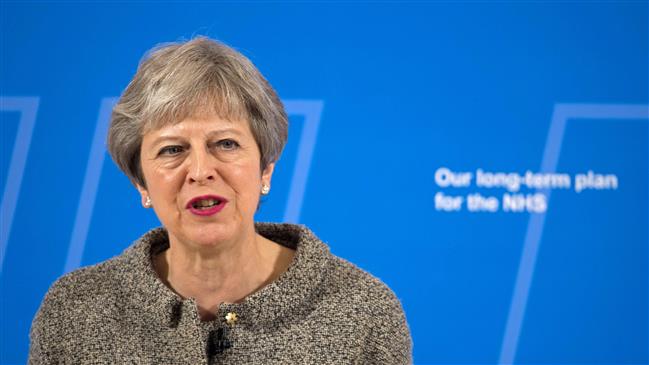
British Prime Minister Theresa May hopes parliamentarians will support her proposal to offer them a say over a Brexit deal, according to her spokesman.
The prime minister cannot accept a competing proposal from Britain’s House of Lords because it would weaken the government’s authority to secure the best possible deal with the EU, the spokesman said on Tuesday, before a showdown in parliament over her plans to leave the European Union.
“We cannot accept the amendment on (a) meaningful vote agreed in the Lords. Agreeing to amendable motions would allow parliament to direct the government on its approach to exiting the EU, binding the prime minister’s hands and making it harder to secure a good deal for the UK,” he told reporters.
May has said that it is essential to ensure that parliament could not block Brexit.
On Sunday, May defended her way of passing the legislation that will pull Britain out of the European Union. On Tuesday, May defused a rebellion in parliament over her Brexit plans after she was forced to compromise and hand lawmakers greater control over Britain’s exit from the bloc.
May held talks with more than 14 Tory rebels in her Commons office that lasted 11 hours, giving them personal assurances that she would agree to the broad thrust of their proposals.
The premier’s concession may mean lawmakers could have more power if she fails to seal a Brexit deal, possibly resulting in a softer approach to Britain’s divorce. However, presently, MPs will not be able to send the government back into negotiations if they refuse to accept an agreement with the bloc.
The British government has faced fierce criticism both at home and by the EU for its lack of clarity on its Brexit strategy.
In Britain’s 2016 referendum, 52 percent, or 17.4 million people, voted to leave the EU while 48 percent, or 16 million, voted to stay.
Source: Presstv
























4, July 2018
Bundes: Merkel reaches deal with rebellious Interior Minister 0
German Chancellor Angela Merkel and her rebellious interior minister have reached a compromise on a refugee dispute that threatened to disintegrate her coalition government.
Interior Minister Horst Seehofer, the leader of Bavaria’s Christian Social Union (CSU), told reporters after five hours of talks on Monday that he would maintain his post, saving Germany’s fragile government coalition.
He had threatened on Sunday to resign if he did not reach a deal with Merkel’s Christian Democrats (CDU) on refugees.
“After intensive discussions between the CDU and CSU, we have reached an agreement on how we can in future prevent illegal immigration on the border between Germany and Austria,” Seehofer said late on Monday evening as he left the CDU’s Berlin headquarters.
Under the compromise, the refugees who have already applied for asylum in other European Union countries will be held in transit centers on the border while Germany negotiates bilateral deals for their return.
Merkel sounded pleased with the compromise.
“The spirit of partnership in the European Union is preserved and at the same time, an important step to order [has been taken],” the German chancellor said.
Merkel’s CDU relies on the CSU to maintain power through a coalition. The CDU/CSU bloc took 33 percent of the votes in September 2017 elections.
In March, Merkel’s conservative alliance (the CDU/CSU bloc) and the Social Democratic Party (SPD) reached a coalition deal after weeks of fierce negotiations that saw Merkel relinquish the key ministry of finance, among other concessions, further weakening her hold on the government.
Both the CDU and SPD performed poorly in the general elections last year. The SPD initially resisted going into a coalition with the CDU but relented after Merkel failed to reach a deal with two lesser-known parties.
Merkel’s 2015 decision to open the doors to over a million refugees, many fleeing war in the Middle East, fueled the rise of anti-immigration parties, including the far-right Alternative for Germany (AfD), which now threatens to unseat the CSU in regional elections scheduled for October.
Europe has faced its worst refugee crisis since World War II. The continent has been hit since 2014 by an unprecedented influx of refugees fleeing conflict-ridden zones in North Africa and the Middle East, in particular Syria.
Source: Presstv