12, September 2021
Bundes: Dr Merkel’s candidate seeks to turn tide in election debate 0
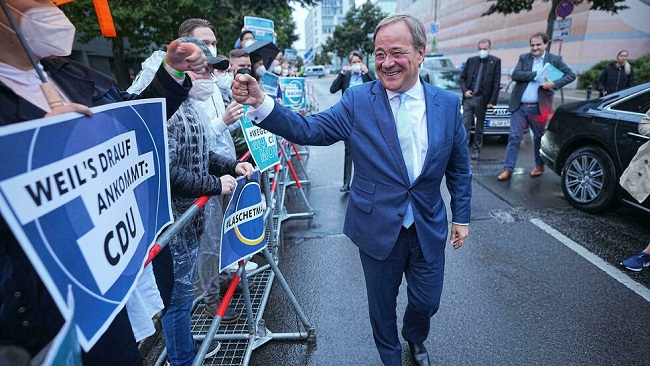
A televised election debate on Sunday marks one of the last chances for Germany’s struggling chancellor candidate Armin Laschet, from Angela Merkel’s conservative camp, to close the gap with his centre-left rival.
Two weeks before voters head to the polls, gaffe-prone Laschet will face off against Finance Minister Olaf Scholz from the Social Democrats (SPD) and Annalena Baerbock from the left-leaning Greens in the second of three primetime debates.
The first general election of the post-Merkel era has become an unexpected nailbiter in Europe’s top economy.

Surveys show support for Merkel’s centre-right CDU/CSU bloc plummeting to historic lows of around 20 percent while the SPD has come from behind to lead at around 26 percent.
With the Greens polling at 15 percent, a number of coalition outcomes are possible — but observers say the chances of one-time frontrunner Laschet taking the crown are fading fast.
Bild newspaper said the debate could be make-or-break for Laschet.
“To turn the tide, he needs a clear success,” it wrote.
Viewers were left unconvinced by Laschet’s performance in the first debate last month, when Scholz was declared the winner.
– ‘Historic debacle’ –
Laschet, the premier of North Rhine-Westphalia state, has been on a downward spiral following a series of missteps, including being caught on camera laughing during a tribute to victims of Germany’s deadly floods in July.
Scholz meanwhile, although often described as wooden and uncharismatic, has run an error-free campaign.

As vice-chancellor and guardian of the nation’s finances, the 63-year-old has positioned himself as the continuity candidate and the natural heir to Merkel’s legacy — despite hailing from a rival party.
The CDU/CSU alliance that has dominated Germany’s post-war politics now faces a “historic debacle” on September 26, Der Spiegel weekly news magazine wrote.
In a sign of growing nervousness, conservatives have gone on the attack against Scholz, accusing him of riding on Merkel’s coat-tails and of trying to steer Germany to the left.
Even Merkel, who is bowing out after 16 years in power and had vowed to stay out of the election battle, has joined the fray.
She visited a flood-hit region with Laschet and used a speech in parliament this week to cast him as the best choice to succeed her, saying he stood for “stability” and “centrism”.
– Comeback king? –
The still immensely popular chancellor also distanced herself from Scholz, criticising him for not unequivocally ruling out a coalition with the radical-left Linke party, which wants to disband NATO.
The Linke is currently polling at six percent and could theoretically be part of a three-way coalition with the SPD and the Greens.
Addressing a congress of the CSU on Saturday, Laschet said such a coalition would lead to “less security” and endanger Germany’s economic growth through higher taxes and more bureaucracy.
Laschet, 60, also courted controversy by saying that the Social Democrats were “on the wrong side” at key moments in Germany’s post-war history.
The remark drew an immediate rebuke from the SPD, which said it revealed Laschet’s “panic” at his slump in the polls.
SPD general-secretary Lars Klingbeil said the CDU/CSU alliance had “lost its dignity under Laschet”, adding: “It belongs in the opposition.”
Laschet has played down the importance of Sunday’s debate, saying the battle for the chancellery would be fought until polling day.
But Laschet’s fate could be sealed sooner, with record numbers expected to vote by post because of the pandemic.
Although Laschet has a track record of snatching unexpected last-minute victories, Spiegel said a typical Laschet comeback “is looking unlikely”.
Source: AFP














24, November 2021
Sweden’s parliament picks Magdalena Andersson as first female PM 0
Sweden’s parliament on Wednesday approved Magdalena Andersson as the country’s first female prime minister, tapping the finance minister who recently became the new leader of the Social Democratic party.
Andersson was tapped to replace Stefan Lofven as party leader and prime minister, roles he relinquished earlier this year.
The development marked a milestone for Sweden, viewed for decades as one of Europe’s most progressive countries when it comes to gender relations, but which had yet to have a woman in the top political post. Lofven’s government has describes itself as “feminist,” putting equality between women and men at the heart of national and international work.
In a speech to parliament, Amineh Kakabaveh, an independent lawmaker who supported Andersson, noted that Sweden is currently celebrating the 100th anniversary of a decision to introduce universal and equal suffrage in the Scandinavian country.
“If women are only allowed to vote but are never elected to the highest office, democracy is not complete,” Kakabaveh who is of Iranian Kurdish descent, said.
“There is something symbolic in this decision,” she added.
In the 349-seat Riksdag, 117 lawmakers voted yes to Andersson, 174 rejected her while 57 abstained and one lawmaker was absent.
In all, the opposition cast 174 votes against Andersson but under the Swedish Constitution, prime ministers can be named and govern as long as a parliamentary majority — a minimum of 175 lawmakers — is not against them.
Lofven has been leading the Swedish government in a caretaking capacity until a new government is formed, something expected Friday. Andersson likely will form a two-party, minority government with her Social Democrats and the Green Party.
Andersson, 54, sought to secure the backing of the two smaller parties that supported Sweden’s previous center-left, minority government led by Lofven — the Left Party and the Center Party. Both abstained from voting against Andersson.
After days of talks, Andersson and the Left Party reached a deal to win the latter’s support. The deal focused on pensions and they on a supplement of of up to 1,000 kronor ($111) for about 700,000 pensioners on low incomes.
Source: AP