
22, September 2025
A nation in agony, a president in absentia: Biya’s Swiss retreat amidst electoral farce and genocide 0
In a move that epitomises a reign defined by staggering detachment and brutal repression, Cameroon’s octogenarian dictator, Paul Biya, is preparing to abscond to the luxurious confines of a Swiss palace, a mere three weeks before a presidential election engineered to grant him an eighth term. This trip, a private vacation to Geneva’s Intercontinental Hotel, is a slap in the face to a nation buckling under the weight of his nearly four decades of misrule, a bloody conflict, and a spiralling humanitarian crisis.
Biya, a leader often criticised as a reclusive and out-of-touch figure, submitted his candidacy on August 25th for an election he has no intention of contesting fairly. Instead of engaging with the electorate, he is scheduled for a ten-day sojourn in Switzerland, a country where historical records from Le Temps newspaper show he has squandered over 55 million Swiss Francs (approximately 34 billion CFA francs) of state funds on extended stays between 1982 and 2009. His return, just days before the campaign’s start on September 22nd, reveals a man confident that the electoral process is a mere formality, to be rigged by his stooges and clansmen while he enjoys European luxury.
A Dirty War and a Daughter’s Damning Indictment
As Biya packs for Switzerland, the military force he commands continues a brutal campaign in the Anglophone regions of Ambazonia, a conflict accurately described as a “dirty war.” As reported by HumAngle Media, this brutal fratricidal conflict has thrown victims into a vortex of trauma, with widespread atrocities, disappearances, and killings occurring under the silent and complicit gaze of the international community. This is not a war but a genocide, state-sponsored terror aimed at subduing a population seeking autonomy.
The damning condemnation of this regime comes not just from external observers but from within the dictator’s own household. His daughter, Brenda Biya, recently broke ranks in a stunning act of defiance, urging Cameroonians to reject her father. “My Father has made a whole nation suffer, don’t vote for him,” she declared, a truth that echoes through the bullet-riddled villages of Ambazonia and the impoverished neighbourhoods of Yaoundé and Douala.
A Nation on the Brink
The security situation remains volatile. Recent attacks, including a deadly roadside ambush claimed by separatists that killed seven soldiers, as reported by CTV News, highlight a conflict with no end in sight. There is a palpable fear that Biya’s absence could trigger a violent power struggle or even a military coup, exposing the fragile and fear-based foundation of his rule. The nation is a tinderbox, and its absent president is playing with matches from a safe distance of 4,000 miles.
A Call to Action: For Justice and Liberation
This cannot stand. The international community, particularly Switzerland and signatories to the Geneva Conventions, must no longer be a haven for a man whose treasury-draining vacations are funded by the misery of his people. We call for the immediate arrest of Paul Biya for crimes against humanity and genocide upon his arrival on Swiss soil. The principle of universal jurisdiction must be invoked to hold this tyrant accountable for the blood spilled in the Cameroons.
We demand the immediate and unconditional release of Dr Cho AYABA held in Norway, Mr Benedict NwanaKuah and Pascal Kikishy Wongbi, held in the United States and all Ambazonian political prisoners held in Cameroonian detention facilities, where torture and inhumane conditions are rampant.
To the brave fighters of the Ambazonia Defenceforces (ADf), we say: Continue your righteous struggle. Continue to protect the citizens of Ambazonia from the genocidal attacks of the Cameroonian military. Continue to inflict painful and heavy losses on the invading forces, particularly the notorious BIR (Rapid Intervention Battalion), the brutal spearhead of Biya’s repression. Your resilience in the face of a monstrous regime is the only shield our people have.
The world must open its eyes to the suffering in the Southern Cameroons (Ambazonia). The time for silent complicity is over. The time for justice, accountability, and the liberation of Ambazonia is now.
By: Dr. Larry AYAMBA,















23, September 2025
Yaoundé: Divided opposition seeks to stop the world’s oldest leader after 43 years in power 0
With weeks to go until an election that could extend the world’s oldest president’s 43 years in power, Cameroon‘s opposition is struggling. Its most popular figure has been barred from running, and the 11 candidates remaining are likely to divide the vote.
At 92, Paul Biya has spent nearly half his years on earth as president and is Africa’s second-longest serving leader, behind only Equatorial Guinea’s Teodoro Obiang Nguema Mbasogo. If he wins an eighth seven-year term in the Oct. 12 vote, he could govern until he’s nearly 100.
During his decades in power, the Central African nation of nearly 30 million people has struggled with challenges from a deadly secessionist movement to chronic corruption that has stifled development despite rich natural resources like oil and minerals. At least 43% of the country’s citizens live in poverty as measured by core living standards such as income, education and health, according to U.N. estimates.
Biya is rarely seen in public and critics say his capacity to govern has been severely limited by his age.
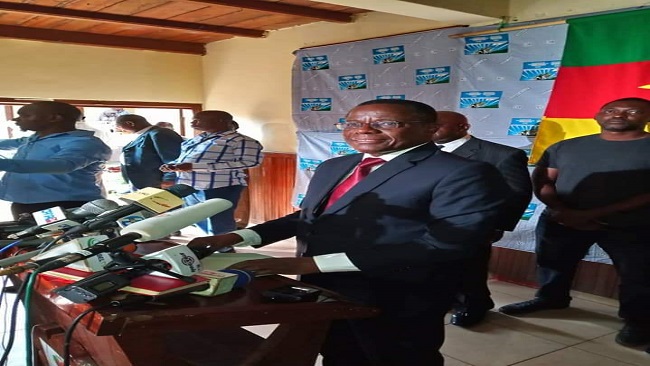
Still, he’s likely to prevail over the 11 other candidates in the race, especially after Biya’s most threatening rival, Maurice Kamto, was barred from running. Katmo ran against Biya in 2018 and won 14% of the vote.
The election commission said it disqualified Kamto from the race because the African Movement for New Independence and Democracy party that sponsored him was also sponsoring another candidate. Kamto’s lawyers and the party’s president denied the claim, calling the decision politically motivated.
Most of Cameroon’s past elections have faced questions of credibility, with election authorities often accused of working in favor of Biya. Some of the election officers previously served in other roles in Biya’s government. A two-term presidential limit was removed through a parliamentary vote in 2008.
In the nation’s capital, Yaounde, Elvis Nghobo, a food vendor, said the election has ended even before it started. “It is needless voting when it is clear that Paul Biya will always be declared winner,” said Nghobo, 34.
Still, a united opposition could have a chance to defeat Biya, analysts say.
The opposition is divided
After a record 83 candidates applied to run, election authorities approved 12, including Biya, to appear on the ballot.
All 11 opposition candidates agree on the need to unite behind a single leader, but they’re struggling to agree on who that should be, with formal campaigning due to start on Sept. 27..
In a recent post on X, Kamto likened the election to a penalty shootout in a soccer match and urged the candidates to find the best kicker.
“Choose from among yourselves, or at least from among the most experienced, the kicker who has the best chance of scoring the liberating goal,” Kamto said.
Issa Tchiroma Bakary, a long-time Biya ally who quit his government post earlier this year to run in the election, was designated as a consensus candidate by the Union for Change 2025, an alliance of at least 20 political parties and several civil society groups.
However, the other candidates have so far either rebuffed or ignored the move.
“We have only one objective: To liberate Cameroon from the system that has strangled it for more than 40 years,” Bakary said at the time.
Tomaino Ndam Njoya, a mayor and only woman in the race, said in a recent statement that she is open to backing a consensus candidate. That would be “the price to pay to finally offer the Cameroonian people the change they expect and deserve,” she said.
Analysts say the opposition is still weak
The candidates appear to be more concerned with “individual political survival than with driving meaningful collective change,” said Munjah Vitalis Fagha, a senior politics lecturer at Cameroon’s University of Buea.
The lack of a key challenger for Biya shows how weak the opposition has been over the years in Cameroon, said Wilson Tamfuh, professor of public and international law at Cameroon’s University of Dschang.
“There would be no need for an opposition consensus if an opposition party had become strong enough in its own right to overcome the ruling party,” Tamfuh said.
Source: AP