28, September 2021
Trump return to White House would be ‘disaster’ 0
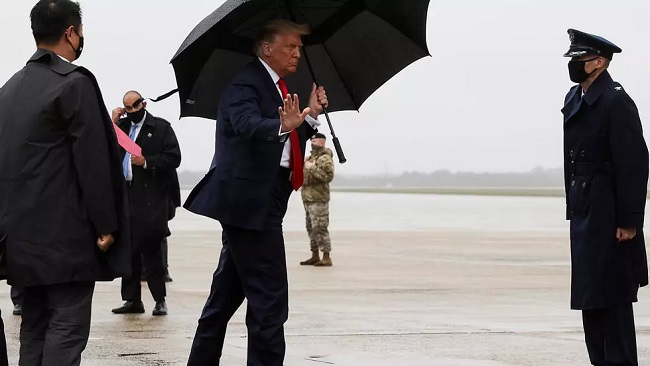
A former senior US Department of Homeland Security official has warned former Republican President Donald Trump’s possible return to the White House would result in “disaster” for the American intelligence community.
“I think it would be a disaster,” Brian Murphy said of Trump’s possible 2024 presidential campaign in an interview on Sunday.
“He puts out disinformation and that’s an existential threat to democracy, and he is one of the best at putting it out and hurting this country,” Murphy said.
He added that such disinformation “polarizes us.”
“Political polarization in this country is at the worst it’s ever been,” Murphy said.
He then went on to say that disinformation and polarization are considered leading threats to the US intelligence community, which is a coalition of 17 agencies and organizations, including the ODNI, and CIA.
This comes despite the fact that Pulitzer Prize winner American investigative journalist Glenn Greenwald has revealed in a recent article that an axis of the CIA, Big Tech and the DNC-allied wing of the corporate media spread an absolute lie in the weeks before the 2020 presidential election.
“Numerous examples of brute and dangerous censorship have emerged: the destruction by Big Tech monopolies of Parler at the behest of Democratic politicians at the time that it was the most-downloaded app in the country; the banning of the sitting president from social media; and the increasingly explicit threats from elected officials in the majority party of legal and regulatory reprisals in the event that tech platforms do not censor more in accordance with their demands,” Greenwald wrote.
“But the most severe episode of all was the joint campaign — in the weeks before the 2020 election — by the CIA, Big Tech, the liberal wing of the corporate media and the Democratic Party to censor and suppress a series of major reports about then-presidential frontrunner Joe Biden,” he added.
Meanwhile, Trump has said that only a doctor’s call could prevent him from participating in the 2024 presidential race.
In an interview on Friday, the 75-year-old businessman said that only “a bad call from a doctor or something” could stop him from running.
“Things happen, through God, they happen,” he said. “But I feel so good.”
Trump has alleged that the 2020 election was “the greatest Election Hoax in history.”
Trump believes that the election was rigged by the Washington establishment in favor of Joe Biden, the current US president.
Source: Presstv

















30, September 2021
Pentagon officials say Afghan govt’s collapse was rooted in 2020 US deal with Taliban 0
Senior Pentagon officials said Wednesday the collapse of the Afghan government and its security forces in August could be traced to the 2020 US agreement with the Taliban signed in Doha that promised a complete troop withdrawal. Joe Biden has faced the biggest crisis of his presidency over the withdrawal in Afghanistan, drawing criticism from Republican US lawmakers.
This week, the US House and Senate started hearings of a congressional review on the troop pull-out in Afghanistan and the war itself. During its second day, General Frank McKenzie, the head of Central Command, told the House Armed Services Committee that once the US troop presence was pushed below 2,500, as part of President Joe Biden’s decision in April to complete a total withdrawal by September, the unravelling of the Washington-backed Afghan government accelerated.
“The signing of the Doha agreement had a really pernicious effect on the government of Afghanistan and on its military – psychological more than anything else, but we set a date-certain for when we were going to leave and when they could expect all assistance to end,” McKenzie said.
On February 29, 2020, the Trump administration signed an agreement with the Taliban in Doha, Qatar, in which the US promised to fully withdraw its troops by May 2021, with the Taliban committing to several conditions, including stopping attacks on American and coalition forces. The stated objective was to promote peace negotiations between the Taliban and the Afghan government in Kabul, but that diplomatic effort never gained traction before Biden took office in January.
McKenzie had believed “for quite a while” that if the United States reduced the number of its military advisers in Afghanistan below 2,500, the Kabul government inevitably would collapse “and that the military would follow.” In addition to the morale-depleting effects of the Doha agreement, the troop reduction ordered by Biden in April was ”the other nail in the coffin” for the 20-year war effort, he added, because it blinded the US military to conditions inside the Afghan army: “our advisers were no longer down there with those units.”
Democrat Biden has faced the biggest crisis of his presidency over the war in Afghanistan, which he argued needed to be brought to a close after 20 years of stalemated fighting that had cost American lives, drained resources and distracted from greater strategic priorities.
Defence Secretary Lloyd Austin, testifying alongside McKenzie, said he agreed with the analysis. The Doha agreement also committed the United States to ending airstrikes against the Taliban, “so the Taliban got stronger, they increased their offensive operations against the Afghan security forces, and the Afghans were losing a lot of people on a weekly basis,” he added.
War in Afghanistan ‘a strategic failure’
Wednesday’s hearing with Pentagon leaders was politically charged. Republicans sought to cast President Biden as wrongheaded on Afghanistan, and Democrats pointed to what they called ill-advised decisions during the Trump years.
The previous day, General Mark Milley, chairman of the Joint Chiefs of Staff, said in a similar hearing in the Senate that the war in Afghanistan was a “strategic failure,” and he repeated that on Wednesday.
When pressed Tuesday, Milley also told the Senate committee that it had been his personal opinion that at least 2,500 American troops were needed to guard against a collapse of the Kabul government and a return to Taliban rule.
Defying US intelligence assessments, the Afghan government and its American-trained army collapsed on August 15, allowing the Taliban to capture Kabul with what Milley described as a couple of hundred men on motorcycles and without firing one shot. That triggered a frantic US effort to evacuate American civilians, Afghan allies and others from Kabul airport.
The Taliban had ruled the country from 1996 to 2001.
‘Plain old politics’
US House and Senate started hearings which could become an extended congressional review of the US failures in Afghanistan. This after years of limited congressional oversight of the war although hundreds of billions of taxpayer dollars were consumed.
“The Republicans’ sudden interest in Afghanistan is plain old politics,” said Sen. Elizabeth Warren, a Massachusetts Democrat, who supported Biden’s decision to end US involvement there.
Tuesday’s hearing also was contentious at times, as Republicans sought to portray Biden as having ignored advice from military officers and mischaracterised the military options with which he was presented last spring and summer.
Republican Senator Tom Cotton (Arkansas) asked why Milley did not choose to resign after his advice was rejected. The general, who was appointed to his position as chairman of the Joint Chiefs of Staff by President Donald Trump and retained by Biden, said it was his responsibility to provide the commander in chief with his best advice.
“The president doesn’t have to agree with that advice,” Milley said. “He doesn’t have to make those decisions just because we are generals. And it would be an incredible act of political defiance for a commissioned officer to resign just because my advice was not taken.”
(FRANCE 24 with AP & REUTERS)