5, May 2021
Southern Cameroons Crisis: US Secretary of State discusses deteriorating situation with French Minister of Foreign Affairs 0
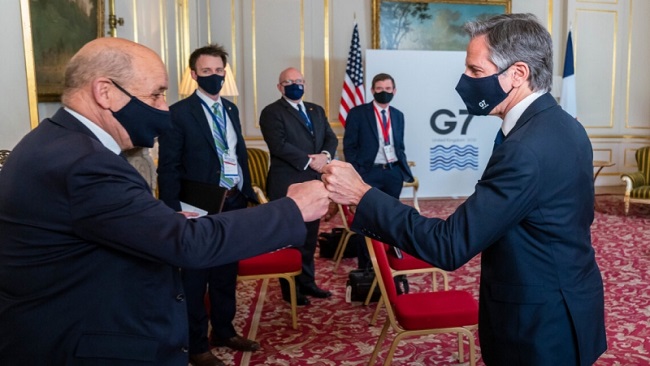
US Secretary of State, Antony Blinken and the French Minister of Foreign Affairs, Jean-Yves Le Drian have reportedly discussed on the sidelines of a G7 meeting in London the crisis in Southern Cameroons.
A press statement made public by the US State Department noted that “the two leaders pledged their support for a peaceful resolution of the conflict in Cameroon and expressed concern about the lack of movement on reforms essential to stability”.
The two top diplomats also reiterated that peace and stability in Africa is a concern for both the United States and France with particular attention to the situation in Southern Cameroons.
It is important to recall that France has always brandished the principle of non-interference in the political affairs of Cameroon to justify its attitude.
President Emmanuel Macron claimed during a visit to Nigeria that he favours the establishment of decentralization and supported this option adopted by the Yaoundé regime in an attempt to resolve the Anglophone problem. But his administration has never pressured the ruling CPDM crime syndicate to accelerate the decentralization process that was agreed and documented in the 1996 Constitution.
Under President Macron’s watchful eyes, the Yaoundé government has been on a home-burning spree over the last four years in Southern Cameroons.
Many Southern Cameroonians have been killed by trigger-happy Yaoundé government soldiers and Paris considered as a major voice in Francophone Africa has never condemned the violent method the Francophone dominated government has been employing to combat Southern Cameroons Self Defense groups, most of who operate in the jungle.
For its part, the American Congress has given the US government the go-ahead to intervene in favour of resolving the conflict. The Foreign Affairs Committee of the United States Congress introduced on 8 September 2020, Resolution 684 on the crisis in the Cameroonian regions of the North-West and South-West and was adopted on 1 January 2021.
Resolution 684 condemned the abuses committed by state security forces and armed groups in the northwest and southwest regions of Cameroon, and affirmed that the United States continues to hold the Government of Cameroon accountable for safeguarding the security and constitutional rights of all its citizens, regardless of region, religion, or political opinion. In addition, it urges all parties to the conflict in Cameroon, the Government of Cameroon, U.S. foreign relations entities, and members of the international community to take specific steps to resolve the ongoing civil conflict in Cameroon.
The U.S. Congress was also critical of France’s action in the conflict. “…France maintains considerable interests in Cameroon, including significant economic and security cooperation, but has not sufficiently used its influence to stem atrocities committed in English-speaking regions or to support stronger international action to seek a resolution to the conflict,” Resolution 684 said.
By Soter Tarh Agbaw-Ebai
















8, May 2021
CPDM Crime Syndicate: Political parties in Cameroon reach 330 as eleven others are legalised 0
Cameroon has created 11 new political parties, bringing the total number of legalised political parties in the Central African country to 330.
Paul Atanga Nji, Cameroon minister for Territorial Administration, announced Wednesday that he has legalised the new political parties “which will enrich political debate and encourage freedom of expression” four years to major elections in the Central African country.
He said the new political parties will “henceforth contribute to the facilitation of a contradictory but constructive political debate” in the country of 26 million people.
One of the newly legalised political parties is the Patriotic and Republican Alliance (APAR) of Celestin Djamen—a former member of the opposition Social Democratic Front (SDF) of Ni John Fru Ndi—and the Cameroon Renaissance Movement (MRC) of Prof Maurice Kamto.
Speaking at a press conference in Douala last month, Mr Djamen said he created the party to fill in a vacuum left by current opposition parties in the country. He said APAR “will be very active in the field.”
He said the political party will never boycott any election in the country, adding that it has great plans for 2025.
President Paul Biya’s current mandate will end in 2025 when the veteran leader will be 92. The mandate of current members of the National Assembly as well as local municipal authorities will also come to an end in the same year.
Mr Djamen, however, did not elaborate on the party’s plan.
But he added that APAR will have a secretariat in charge of cooperation with other political parties with whom they will discuss issues relating to the reform of the electoral law of the country.
President Biya accepted the reintroduction of multiparty politics in the country in the 90’s and in 1992 the country organised its first multi-candidate presidential election which he won and has since remained a serial election winner albeit reports of massive rigging.
Source: The East African