14, April 2020
Coronavirus pandemic offers glimmer of hope for the Southern Cameroons Crisis 0
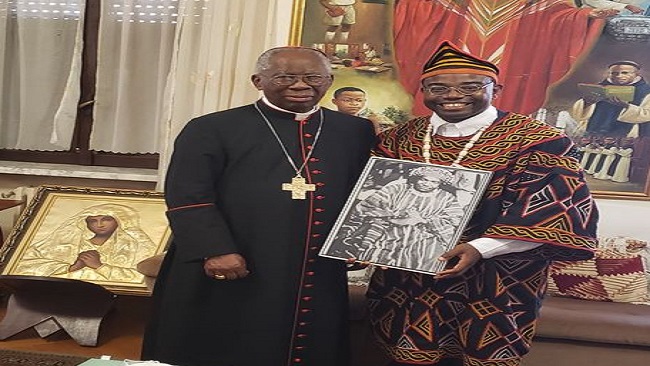
Retired Cameroonian Archbishop Cornelius Fontem Esua of Bamenda says the coronavirus pandemic could also bring about “unexpected positive effects” for the country’s embattled Anglophone regions.
“The spread of the pandemic in Africa is an epoch-making drama, but in some cases, it can also have unexpected positive effects,” the archbishop told the Rome-based Catholic news agency, Fides.
Esua was speaking following the decision by some separatist groups to call for a unilateral ceasefire to enable medical teams and humanitarian assistance to reach the most vulnerable people at risk from the COVID-19 coronavirus.
One of the armed groups, the Southern Cameroons Defence Forces (SOCADEF,) agreed to the United Nations’ call for a worldwide cessation of hostilities during the pandemic.
On March 25, Ebenezer Akwanga, the group’s leader, said that “SOCADEF are prepared to support the ceasefire and will ensure the security and free circulation of international observers and humanitarian organizations in Ambazonia … in accordance with human rights law.”
Ambazonia is the term used by the separatist rebels for the English-speaking regions of the majority French-speaking country. However, no country has recognized Ambazonia’s independence.
The release, addressed to Cameroon’s President Paul Biya, also called on the “authorities and security forces of the Republic of Cameroon to respond to the call made by the secretary-general of the United Nations.”
Akwanga added that “we are ready to meet with representatives designated by the Republic of Cameroon to work out the appropriate implementation of the ceasefire.”
The UN Secretary-General, António Guterres, on March 23 called for an “immediate global ceasefire in all corners of the world” to protect the most vulnerable civilians in conflict-ridden countries from the “fury” of the coronavirus pandemic.
Esua has welcomed the developments, saying that as bad as the coronavirus may be, it might be an agent of peace in Cameroon.
“Here, for example, clashes between the separatists of the Republic of Ambazonia and the army have greatly diminished, if not suspended, and we have had no news of fighting for weeks. A dozen days ago, Samuel Ikome Sako, interim president of the Federal Republic of Ambazonia, announced a total lockdown, with the closure of the borders of the English-speaking regions due to the virus. So far, the separatists are respecting the directive: There is a general calm in the area, there have been no cases of direct confrontation with the military or kidnappings by the ‘Amba Boys’ (the name of the separatist groups in action,” the archbishop said.
However, the peace is not universal, and Bishop George Nkuo told Crux the fighting has not abetted in the Diocese of Kumbo.
“As for the cease fire I am not aware that anything like that had taken place here in Kumbo,” he said.
“I guess those who are calling the shots here are not ready to use the coronavirus to derail their struggle. There is obviously a need to take this virus seriously and it is a common enemy, and in the face of such a war the warring parties need to review their goals. So far, nothing has changed as I see it. I think it is unfortunate because if we don’t fight it together, if it ever reaches Kumbo many people will perish.”
Some armed separatist groups have made it clear that there would be no ceasefire on their part.
On March 27, a statement from Julius Nyiawung, the vice president of the Ambazonia Governing Council – one of several separatist groups claiming to be the legitimate government of the area – said there shall be not be a “unilateral ceasefire in the Ambazonia war of independence because of COVID-19 pandemic.”
The statement explained that “to permit such unilateral action will be to provide Cameroon unhindered access to everywhere in our towns and villages.”
Those fears are not unfounded, since there is no indication that the Cameroonian military is ready to implement a ceasefire.
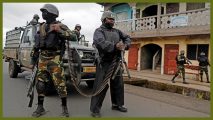
Esua admitted the army “continues to patrol the streets with tanks and in some cases, especially in the villages, there have been ambushes or killings.”
The current conflict began in 2017 after government forces ruthlessly put down strikes organized by Anglophone teachers and lawyers over perceived attempts by the government to destroy the common law and British-style education systems practiced in Anglophone regions. The breakdown in attempts at dialogue resulted in the growth of several separatist movements.
The resulting conflict, now in its fourth year, has killed over 3000 people, with about a million forced from their homes. Esua insists the ceasefire by at least one of the separatist groups offers a lot of hope.
“Overall, we hear fewer gunshots or gunfights here in Bamenda and we really hope that the emergency due to the spread of the virus will lead all actors involved to rethink their strategies and reach an agreement,” the archbishop said.
He added that he believes such a ceasefire could offer a pathway towards a resolution to the Cameroon Anglophone crisis.
Source: Crux


17, May 2020
The Holy Spirit, the Forgotten God 0
Dear Holy People of God,
1. In the Gospel text of this Sunday’s liturgy from John 14:15-21, Jesus promises us, “And I will ask the Father, and he will send you another Advocate to be with you always, the Spirit of truth, whom the world cannot accept, because it neither sees nor knows him. But you know him, because he remains with you, and will be in you. I will not leave you orphans; I will come to you. (John 14:16-17). Many Catholics spontaneously have a relationship with Jesus, perhaps because of the Incarnational principle: The Second Person of the Blessed Trinity became a man in Jesus of Nazareth. We readily identify and relate with Jesus because he was a human being like us in all things except sin, for sin is not what defines humanity, for sin is always a choice, even if often times a very seductive and overpowering one. But regarding the Holy Spirit, the relationship is not so evident and forceful. And if we go by the logic of why we can easily identify with Jesus, then the “distant” or impersonal relationship with the Holy Spirit is understandable: We have never seen the Holy Spirit “in the flesh,” that is, as a person, a unique person in history, a “singular individual”, – to use a Kierkegaardian phrase, walking the dusty paths of Nazareth, going up to the temple, working miracles, being thirty, being hungry, keeping company with friends and with sinners, et cetera. (I have always found it interesting that in the Gospels, one notices that while the sinners loved Jesus and sought his company, the religious people hated Jesus! What is it about religion that easily ferments such hatred for the other, especially those that are not like us? – I am still searching for an answer. Let us return to our topic on the Holy Spirit.)
2. In other words, we do not have a recollection of the Holy Spirit, the Third Person of the Blessed Trinity, like we have of Jesus, the Second Person of the Trinity. This, I believe, helps explain why for many Catholics, the Holy Spirit is the forgotten God, the One we only mention on Pentecost Sunday and when making the Sign of the Cross, perhaps without even thinking about who the Holy Spirit is. Even the institutional Church had to wrestle with understanding who the Holy Spirit is. It took the First Council of Constantinople (AD May – July 381), to articulate a clear understanding of the Divinity of the Holy Spirit, thanks in large part to the contributions from the Cappadocian Fathers, especially the Gregories. Given this obscurity regarding the person and work of the Holy Spirit, I will dedicate this Catechesis to talking about the person of the Holy Spirit, with the hope that knowing more about the Holy Spirit will help us develop a more intimate and personal relationship with the Holy Spirit.
3. Who is the Holy Spirit? In the Nicene Creed we find the most concise definition of the Holy Spirit: “We believe in the Holy Spirit, the Lord and Giver of Life; Who proceeds from the Father and the Son. Together with the Father and the Son, He is worshipped and glorified. It is He who spoke through the prophets.” Yes, the Creed offers us a very Trinitarian theology of the Holy Spirit: the Spirit is with the Father and the Son and Creation, throughout Salvation History, and will be with the Father and the Son at the consummation of History. To ask who and not what is the Holy Spirit, implies that the Holy Spirit is a person and not a thing. He is the Third Person of the Blessed Trinity, distinct from, but coeternal and coequal with the Father and the Son. The Catechism of the Catholic Church tells us that “when he proclaims and promises the coming of the Holy Spirit, Jesus calls him the “Paraclete” …Paraclete is commonly translated as ‘consoler’ and Jesus is the first consoler” (CCC, 692). The same Catechism goes on to tells us the symbols of the Holy Spirit as Water, Fire, Dove and Anointing, all material images meant to help us understand the immaterial or spiritual personhood of the Holy Spirit.
4. Dear Holy People of God, all these various symbols are ways the Holy Spirit manifested himself in the Bible. His manifestations in opposing symbols like “water” and “fire” only go to show that the Holy Spirit is a divine mystery that the human mind cannot fully comprehend, as St. John says in the gospel: “The wind blows where it pleases; you can hear its sound, but you cannot tell where it comes from or where it is going. So, it is with everyone who is born of the Spirit” (John. 3:8). This means that we can hardly fully understand the Holy Spirit but we can and always feel the effects of His actions in our lives. He also gives us gifts which influences the way we act towards others and it is in this context that we talk of the Gifts of the Holy Spirit.
5. Theology makes a distinction between the Sanctification and the Manifestation Gifts of the Holy Spirit. The Sanctification Gifts are the gifts listed in Isaiah 11:2: Wisdom, Understanding, Counsel, Strength, Piety, Fear of the Lord and Knowledge. They are meant to build us up as Christians. They are the gifts of Christian maturation: Wisdom: The Spirit leads us to evaluate all things in the light of the Gospel, helping us to read in our own experiences and in the experiences of the Church the mysterious and loving plan of God. Understanding: The Spirit fosters in us deeper insight into revealed truth, pressing us to proclaim with conviction and power the Good News of salvation. Counsel: The Spirit illuminates the ministry of Christ so that we may direct our activities according to the perspectives of Providence, never allowing ourselves to be swayed by the judgments of the world. Strength/Might: The Spirit enables us to understand and accept sometimes mysterious interweaving of secondary causes with the First Cause in the turn of events in the universe. Piety: The Spirit revives in us the relationship of intimate communion with God and of trusting surrender to his Providence. Fear of the Lord: The Spirit gives us a stronger sense of our own human weakness and of the indispensable role of divine grace, since “neither the one who plants nor the one who waters is anything, but only God who gives growth” (1 Corinthians. 3:7). Knowledge: The Spirit enables us to make a distinction between things of value and things of no substantial value, helping us to set our priorities right. The Manifestation Gifts of the Holy Spirit are those recorded in 1 Corinthians 12:4-11: Service, Faith, Miracles, Healing, Prophecy, Tongues, Interpretation of Tongues, Discernment of spirits, et cetera. These are gifts given by the Holy Spirit to help Christians witness to a hurting world.
6. Dear Holy People of God, the central question to be asked here could be: What gift of the Holy Spirit do I need most in my life in the here and now? The gifts are there. They have already been given by the Spirit. The gifts are not meant for theology text books or specialized academic papers. The gifts of the Holy Spirit are for every day Christian living, meant to help us live out our Christian faith, to support us in the here and now of our Christian existence. The gifts of the Holy Spirit are meant for electricians, plumbers, carpenters, teachers, nurses, doctors, firefighters, police officers, CEOs, restaurant workers, students, musicians, dancers, et cetera. In other words, the gifts of the Holy Spirit are not meant for some specialized Christians. At every point in which we find ourselves, we can make good use of the gifts of the Holy Spirit.
7. You would have noticed that there is one word that is central to the theology of the Holy Spirit, and that is, GIFT. We talk about the “gifts” of the Holy Spirit in Isaiah and in Corinthians. I am tempted to delve into Augustine’s On the Trinity, Aquinas’ tract in the Summa on the Holy Spirit, Athanasius’ Letters to Serapion, and Didymus the Blind’s On the Holy Spirit, to offer you a theology of the Holy Spirit as GIFT. But that might become a lecture, which will imply that Ste Anne’s will charge you a fee. And since I do not want to stress you up financially, given the already stressful situation that we are living under brought about by COVID 19, I will end here, with this simple invitation: What gift of the Holy Spirit do you feel you need now in your life? Do not hesitate to ask the Holy Spirit for the gift. A surprise awaits you if you do! The Holy Spirit loves you all, and may the Holy Spirit liberate and heal our world! Come O Holy Spirit!
By Fr Maurice Agbaw-Ebai
Roman Catholic Archdiocese of Boston