28, April 2023
Pope Francis warns of rising nationalism, calls for accepting migrants on Hungary visit 0
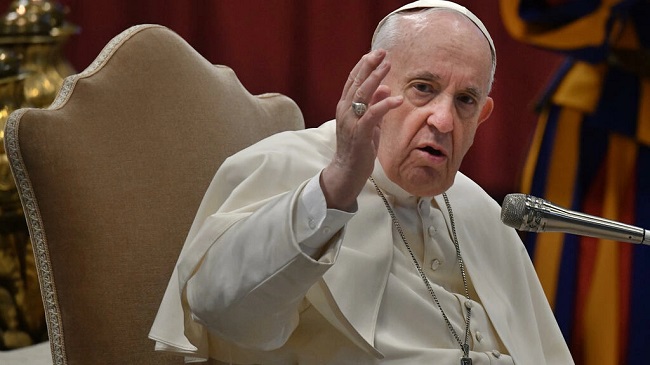
Pope Francis, starting a trip to Hungary, on Friday pointedly warned of the dangers of rising nationalism in Europe and told the Budapest government that accepting migrants along with the rest of the continent would be a true sign of Christianity.
In a hard-hitting speech to government leaders including Prime Minister Viktor Orban, who has had a series of run-ins with the European Union, Francis also urged a rejection of “self-referential forms of populism” and strictly nationalist interests.
He called for a return to the “European spirit” envisioned by the founders of modern Europe after World War Two, saying nations had to “look beyond national boundaries”.
Speaking on the day that Russia hit Ukraine with the first large-scale air strikes in nearly two months, Francis made another appeal for an end to the war there, calling for “creative efforts for peace” to drown out those he called “soloists of war”.
The three-day visit is his first trip since he was admitted to hospital for bronchitis in March.
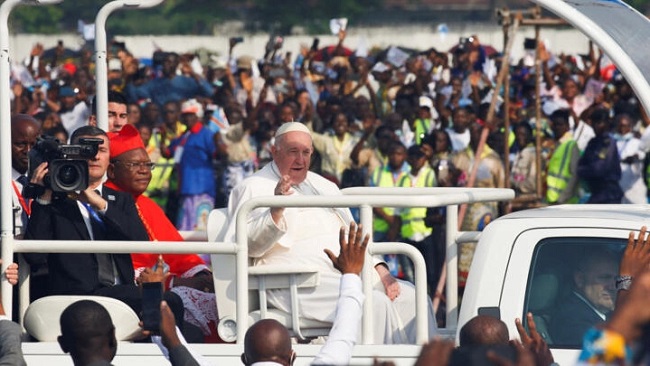
Looking cheerful, Francis, who has a knee ailment, used a cane to walk by welcoming dignitaries and children in national dress at the airport. In recent arrivals, he used a wheelchair.
Asked by reporters about his health on the flight from Rome, the pope joked, saying “I’m still alive” and “stubborn weeds never die”.
He also walked with a cane to greet journalists individually in their section of the plane whereas on some recent trips he remained seated and the journalists went to him.
Francis is keeping a promise of an official visit to Hungary after a stop of only seven hours to close a Church congress in Budapest in 2021 on his way to Slovakia left many feeling slighted.
Orban 59, and the pope have differing views on handling migration from the Middle East and Africa to Europe, with Francis believing migrants fleeing poverty should be welcomed.
Orban, whose government built a steel fence on the border with Serbia to keep out migrants, has refused to let Hungary be transformed into an “immigrant country” like he says others in Europe have become.
He asked Francis in 2021, during the pope’s last visit, “not to let Christian Hungary perish”.
In his speech in the presidential palace overlooking the River Danube, Francis quoted St Stephen, the 11th century founder of Christian Hungary.
“Those who profess themselves Christian, in the company of the witnesses of faith, are called to bear witness to and to join forces with everyone in cultivating a humanism inspired by the Gospel and moving along two fundamental tracks: acknowledging ourselves to be beloved children of the Father and loving one another as brothers and sisters,” Francis said.
“In this regard, Saint Stephen bequeathed to his son extraordinary words of fraternity when he told him that those who arrive with different languages and customs ‘adorn the country,'”, Francis said, quoting the saint’s command to ‘welcome strangers with benevolence and to hold them in esteem’.
Source: Reuters














26, May 2023
Pope Francis has fever, clears his schedule 0
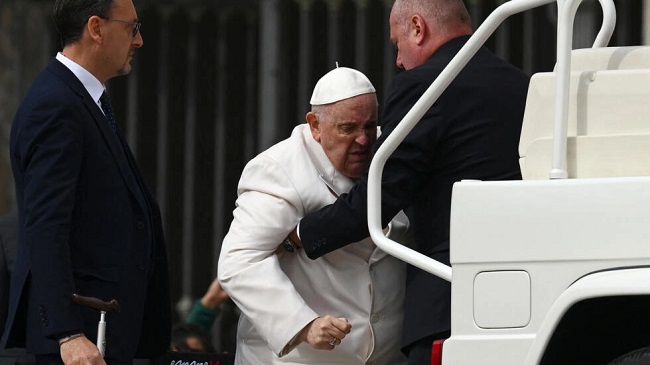
Pope Francis has a fever that caused him to clear his schedule on Friday morning, the Vatican said, nearly two months after the 86-year-old pontiff was hospitalised with bronchitis.
“Due to a feverish state, Pope Francis did not receive an audience this morning,” said Vatican spokesman Matteo Bruni, without giving more details.
It was unclear who the pope had been expected to meet with, as his agenda was not made public on Friday, as is customary.
The pope’s morning audiences are usually reserved for heads of states, associations and clerics, while his afternoons are devoted to work and private meetings.
On Thursday, he had eight meetings on his published schedule.
Francis, who has been the leader of the world’s 1.3 billion Catholics for a decade, has suffered increasing health issues over the past year, from persistent knee pain to his recent hospital stay for bronchitis.
The episodes have sparked widespread concern and fuelled speculation that he might choose to retire rather than stay in the job for life, a choice made by his predecessor, Benedict XVI.
In late March, Francis was admitted to hospital in Rome after having breathing difficulties, and stayed for three nights.
He was treated with antibiotics for bronchitis.
As he left the Gemelli Hospital on April 1, the pope smiled and joked with well-wishers, quipping: “I am still alive!”
He went on to participate in Holy Week and Easter services, the most important week in the Christian calendar.
Good days, bad days
For about a year, the pope has had to rely on a wheelchair due to recurring pain in his knee that he has said cannot be treated through surgery.
Asked about his health in an interview with US Spanish-language network Telemundo broadcast on Thursday, Francis said it was “much better”.
“I can walk now. My knee has been mending. I could hardly walk beforehand, now I can. Some days are more painful than others, like today,” the pope said.
Francis added that doctors had caught his bronchitis infection just in time.
“If we’d waited a few more hours, it would’ve been much more serious. But I was out (of the hospital) in four days,” he said.
Despite his health issues, Francis continues to travel widely, and concluded a three-day visit to Hungary earlier this month.
His next planned trip is to Lisbon from August 2-6 to attend World Youth Day, the Vatican announced on Monday.
The pope acknowledged last July, however, that he needed to slow down.
“At my age and with this limitation, I have to save myself a little bit to be able to serve the Church,” he said then.
“Or, alternatively, to think about the possibility of stepping aside.”
In March, however, he insisted that he had no current plans to quit.
Benedict XVI, who died on December 31 aged 95, surprised the world in 2013 when he announced he was stepping down, a radical move not seen since the Middle Ages.
Source: AFP