21, August 2022
The Holy Father Pope Francis ‘concerned’ after Nicaraguan bishop detained 0
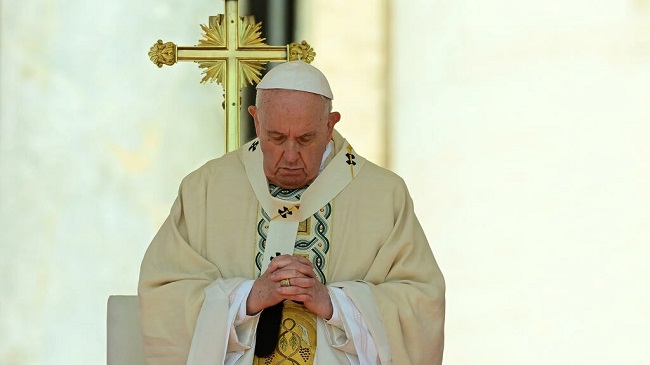
Pope Francis said Sunday he was “concerned” by rising tensions between the state and the Catholic Church in Nicaragua, two days after bishop and regime critic Rolando Alvarez was detained.
Francis said he was following “closely with concern and sorrow” the situation in Nicaragua, amid a worsening standoff between the Church and a government accused of increasing authoritarianism.
“I would like to express my conviction and hope that through open and sincere dialogue, the basis for respectful and peaceful coexistence can still be found,” the head of the world’s 1.2 billion Catholics said after the Angelus prayer.
A spokeswoman for the European Union’s foreign policy chief Josep Borrell said the EU was “following closely the situation with concern”.
She repeated Brussel’s position that “Nicaraguans have to find a peaceful and democratic solution to their political crisis through dialogue”.
The Catholic Church in Nicaragua has been under increasing government pressure since opposition protests in 2018 were met with a crackdown that left hundreds dead.
President Daniel Ortega maintains the protests were part of a Washington-backed opposition plot to unseat him, and accuses bishops of complicity.
The Vatican has said Nicaragua expelled its ambassador to the country in March.
Taken ‘with violence’
Alvarez was detained Friday for “destabilizing and provocative” activities aimed at destabilizing the Central American country.
His detention followed two weeks under police siege at his official residence in Matagalpa, central Nicaragua, after he criticized the closure of Church radio stations and news channels.
Supporters said Alvarez was taken “with violence” to an unknown location, prompting the United Nations and Organization of American States (OAS) to express concern.
Eight others, including five priests, who had been holed up with Alvarez were taken to Managua with him, according to the Latin American Bishops Conference (CELAM), and were all under investigation.
Later, the church said Alvarez was being held at his “family home” where Cardinal Lepoldo Brenes was allowed to visit him.
Brenes reported the bishop’s “physical condition has deteriorated” but his “spirit is strong”, the archdiocese of Managua said in a statement.
The other eight were being held at El Chipote prison, according to the Nicaraguan Center for Human Rights (Cenidh). El Chipote is a notorious lockup for government critics.
According to the European Union, Nicaragua has more than 180 “political prisoners”.
In the first half of 2022, the bloc says, Nicaraguan authorities closed down over 1,200 civil society organizations.
Earlier this month, Borrell’s office called for the liberation of Nicaragua’s political prisoners, denouncing the government crackdown on opposition activists.
Source: AFP








27, August 2022
Pope Francis expands ranks of cardinals in charge of electing new church leader 0
Pope Francis elevated 20 more churchmen to the rank of cardinal on Saturday, formally expanding those now eligible to vote for his successor in case he dies or resigns — the latter a step he has said he’d consider if the need arises.
Of the churchmen being named new cardinals in the consistory ceremony in St. Peter’s Basilica, 16 are younger than 80 and thus eligible to participate in a conclave — the ritual-shrouded, locked-door assembly of cardinals who cast paper ballots to elect a new pontiff.
The 85-year-old Francis has now named 83 of the 132 cardinals currently young enough to join a conclave. The others were appointed by the previous two popes, St. John Paul II and Benedict XVI, whose unexpected retirement in 2013 paved the way for Francis to be elected.
With the eight batches of cardinals Francis has named, prospects are boosted that whoever becomes the next pontiff will share his vision for the future of the church.
Francis reminded the cardinals of their mission, which he said includes “an openness to all peoples, to the horizons of the world, to the peripheries as yet unknown.”
Underlining Francis’ attention to those on society’s margins, among the new cardinals is Archbishop Anthony Poola of Hyderabad, India. The prelate, 60, is the first member of the Dalit community, considered the lowest rung of India’s caste system, to become a cardinal.
One by one, the newest cardinals, whose red cassocks and headgear symbolizes the blood they must be prepared to shed if necessary in their mission, knelt before Francis, who placed on their head the prestigious biretta, as the three-peaked hat is known.
That intimate moment was a chance to exchange a few words with Francis, who smiled to put them at ease. At times, the seated Francis, himself hobbled by mobility problems, lent his own arms to help kneeling cardinals stand up.
In choosing San Diego Bishop Robert Walter McElroy, Francis passed over U.S. churchmen leading traditionally more prestigious dioceses, including San Francisco Archbishop Salvatore Cordileone.
McElroy has been among a minority of American bishops who opposed to a campaign to deny Communion to Catholic politicians who support abortion rights. Cordileone has said he’d no long allow U.S. House Speaker Nancy Pelosi to receive Communion for her defense of abortion rights.
While staunchly against abortion as a grave sin, Francis has also decried what he calls the weaponization of Communion.
McElroy last year was also among a small group of U.S. bishops signing a statement denouncing the bullying that is often directed at LGBTQ youth.
Francis has tried to make gay Catholics feel welcome in the church, whose teaching holds that same-sex intercourse is a sin.
Among the newest cardinals is Bishop Richard Kuuia Baawobr from Wa, Ghana, who has spoken out against LGBTQ rights. The African prelate felt ill when he arrived in Rome on Friday and was hospitalized for a heart problem, the pope told the other cardinals, asking them to pray “for this brother who should have been here.”
Asked by The Associated Press about such contrasting views among church leaders, McElroy replied that “there are always cultural differences within the life of the church as there is within in the human family. And different cultures approach these questions in different ways.”
McElroy added: “My own view is that we have an obligation in the church to make the LGBT persons feel equally welcome in the life of the church, as everyone else.”
With electing future pontiffs a key role for cardinals, McElroy, 68, was asked what he thought of Francis’ saying that resignation for popes is a valid option.
“In principle, I think it is a good idea at a particular moment when they feel they can no longer carry the burdens of that office, but I think this pope is far from that moment,” the U.S. prelate said. “I believe he sees himself as far from that moment. What he has is a mobility issue, but it has not affected his mind. I can tell you he is still on top of things.”
Archbishop Ulrich Steiner of Manaus, Brazil, became the first cardinal from the Amazon, the vast, environmentally-vulnerable region in South America on the Argentine-born pontiff’s home continent. In remarks to The AP, Steiner expressed concern about increasing violence in the Amazon.
“But this violence was not born there, it came from outside,” Steiner, 71, said. ”It is always violence related to money. Concessions, deforestation, also with the mines, also with the fishing.”
At 48, the youngest member among the cardinals’ ranks is an Italian missionary in Mongolia, where Catholics number some 1,300. Francis “knows how important it is supporting these little communities,” said the new cardinal, Giorgio Marengo.
Originally, the pope had picked 21 new cardinals. But retired Belgian Bishop Luc Van Looy declined the honor, citing his own inadequate handling of cases of sexually abusive priests while he led the Ghent diocese from 2004-2020.
Source: AP