2, November 2018
The Killing of an American missionary: Yaounde is under pressure 0
The pressure on Yaoundé regarding the killing of an American missionary is increasing by the day. Charles Trumann Wesco, 44, a clergyman from Indiana, died on October 30, barely two weeks after arriving in Bambili in the Northwest region of the country where a growing insurgency in the English-speaking regions has reduced government authority in that part of the country.
The American missionary who was being driven to a market by another missionary, together with his wife and a son, was caught in a crossfire between Ambazonian Restoration Forces and government soldiers near the city of Bamenda. He took two shots to the head when two bullets struck his car’s windshield. He was rushed to a hospital in Bamenda, but did not survive as the hospital lacked the appropriate equipment to handle such situations.
Speaking after the missionary passed away, Kingue Njie, Director of the Bamenda Regional Hospital, said “We tried in vain to save his life,” adding that Wesco’s wife and children, who were with him in the vehicle were unharmed and these people have been talking. They have already spoken to American officials on the ground, some of whom are CIA agents and they hold that ballistic tests will produce incontrovertible evidence regarding which weapon fired the bullet that cut short the missionary’s life and this is causing government officials to lose sleep.
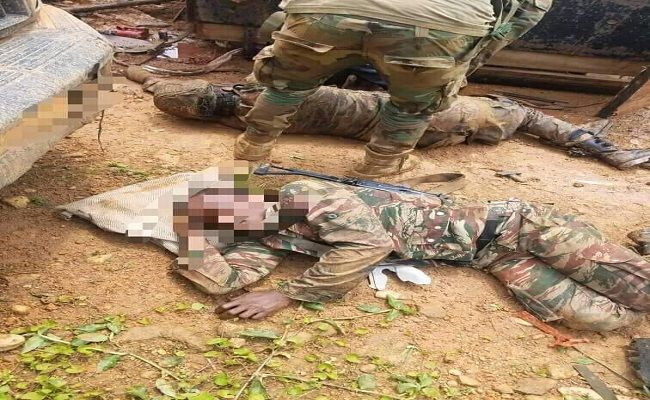
Faithful to its gospel of falsehood and manipulation, the Biya regime through its defense minister, Joseph Beti Assomo, promptly pointed a finger at Southern Cameroonian fighters whom he considers as terrorists. He said the “separatists” who had taken cover, shot and killed the U.S. citizen, adding that the army swiftly riposted and four separatists were gunned down, while a student and soldier were wounded. He warned all foreigners in the country to always inform the country’s authorities and security forces of their movement in the north-west and south-west regions due to the actions of terrorist groups, ignoring the fact that the government had killed other men of God in that region in suspicious circumstances.
Father Alexandre Sob Nougi, 42, pastor of the parish of the Sacred Heart in Bomaka, in the Cameroonian Roman Catholic diocese of Buea, was killed on the 20th of July by government soldiers and the regime has not expressed any remorse, nor has it apologized for the killing of a priest who had nothing to do with the fighting that is playing out in the two English-speaking regions of the country. Not even an investigation has been opened, maybe because the priest is Cameroonian and the clergy has openly criticized the government for its poor handling of the crisis in the region.
This serious incident occurred on the road between Buea and Muyuka, 25 km northeast of Buea, which is the capital of the English-speaking region in the southwest region of the country. The priest, who was also known because he was a diocesan secretary for Catholic education, was shot point blank by government forces.
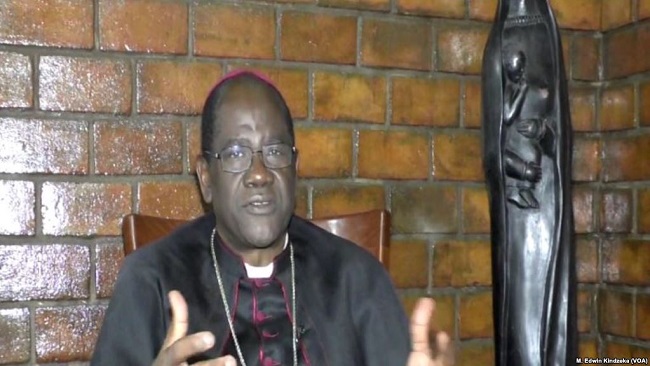
During his funeral, the Bishop of Buea did not mince his words. He knew who the killer was. Speaking during another event in the northwest, Archbishop Cornelius Fontem Esua of Bamenda said the seminarian shot by Cameroonian soldiers was a “martyr of the Anglophone crisis”. He used the phrase at the October 16, 2018, funeral of 19-year-old Gérard Anjiangwe, who was killed on October 4, 2018, in front of the Santa Teresa Church in the village of Bamessing, in the northwest region of the country.
The armed separatist fighters blamed government forces for killing the missionary in a crossfire, but Assomo has denied the allegations. The Yaounde government is not known for taking responsibility for its actions. When it was accused of flagrant human rights abuses in the northern part of the country, it refused that the incident had taken place in Cameroon. It claimed the incident had taken place in Mali, oblivious of the fact that modern technology could help expose its lies. And this lies were laid bare by Amnesty International and other rights groups which made the most of U.S. satellite images and other technologies to arrive at a convincing conclusion that the incident had actually taken place in Cameroon.
In a fast response to the criticism, the government said it had arrested those identified in the video, including one of the soldiers who had even died a year earlier. This is a government that has a track record of arresting dead people. It will be hard to believe any story from any of the government officials and the government is noted for telling lies and seeking to manipulate international and national public opinion.
The American missionary is not the first to be killed by reckless Cameroonian soldiers who hold that they can put an end to the insurgency by killing any and everything in the two English-speaking regions of the country. Not long ago, government forces killed a Ghanaian pastor whose mission in Cameroon was to spread the word of God. Apostle Isaac Attoh who is survived by a young widow and a two-month old baby boy was shot dead in the troubled town of Batibo in Cameroon. The deceased was dressed in his religious garb at the time of his death.
It was confirmed that Apostle Attoh was killed alongside two other Ghanaians who were in the country for religious purposes. The government’s arrogance was clearly on display when efforts by some Ghanaian pastors and friends in Cameroon to retrieve the body of the deceased were frustrated by the military which was unwilling to release the body to anyone. Due to these frustrations, the Apostle’s family urged the Ghanaian government and the International community to intervene for them to get his remains to Ghana for burial.
As American officials become aware of the incident, the Yaounde government is once more at its antics. It has recruited a Washington DC-based communications firm, Glover Park Group, to inform U.S. and international reporters that the country’s authorities are urgently looking into the matter. The government is already trying to pin the killing on separatists, claiming that the weapon used in killing the U.S. citizen was a shotgun which was commonly used by separatists.
But the government’s gimmicks may not produce the desired results this time around. It might have succeeded to cover up the killing of the Cameroonian seminarian and the Ghanaian pastor, but it will have to work extra hard to convince Americans who are already breathing down its throat that it is not responsible for the killing of the missionary. Ghana, another African country, might not want to embarrass Cameroon, but Americans who are not in the business of hiding the truth, will surely publish their own findings and will want their fellow citizens to know the truth surrounding the killing of one of theirs who was in Cameroon just to spread the word of God.
Wesco’s brother, Timothy Wesco, told ABC News recently that their family believed the killing was targeted “quite probable because he was a white, English-speaking American.” He, however, did not specify which party perpetrated the “targeted” killing, but initial forensic evidence indicate that there were pellets in the victim and this could only come from weapons used by army soldiers. This initial forensic analysis is already pointing a finger of accusation to the Yaounde government that was prompt at accusing the separatists. The government’s charade will surely not last for a long time as CIA agents have already gathered a lot of evidence and their conclusion will be known in the days ahead.
This situation could jeopardize bilateral relations between the U.S and Cameroon under the country’s long-serving dictator. In recent times, the U.S has increasingly given military assistance to Cameroon particularly in its battle with Boko Haram terrorists; providing training to the country’s elite military unit—the Rapid Intervention Battalion (BIR)—which has been deployed to the north-west and south-west regions. But that may change as the Cameroonian military has been racking up a record of human rights abuses.
In May, the US ambassador, Peter Barlerin, had accused government forces of ‘targeted killings’ and abuses in the fight against Southern Cameroons separatists. This, coupled with the human rights abuses in the northern path of the country, has resulted in the U.S. putting an end to its military cooperation with the Yaounde government in the fight against Boko Haram.
The tragic death has sparked outrage on Capitol Hill. Sen. Bob Menendez of New Jersey, a senior member of the U.S. Senate Foreign Relations Committee, has called on Cameroonian authorities to ensure transparency and thoroughness in the investigation, adding that the Yaounde government must strictly adhere to the legal process for swiftly bringing those implicated to justice.
The U.S. lawmaker wants the Yaounde government to get to the bottom of the matter. “I am deeply saddened to learn of the death of an American missionary who sacrificed his life working to improve the lives of the people of Cameroon. As we wait for the details surrounding his death, I extend my heartfelt condolences to his family and friends during these difficult moments,” he said.
“I understand Cameroonian officials have opened an inquiry into this tragic incident. I call upon them to publicly release the findings of their investigation to ensure transparency and thoroughness, and to strictly adhere to the legal process for swiftly bringing those implicated to justice,” he added.
He pointed out that “Reports of increasing violence in the Anglophone region of Cameroon are alarming, as are allegations of human rights abuses by armed actors. I urge all actors on the ground to engage in dialogue to resolve political disputes, and to refrain from violence against civilians. I also call on the Trump Administration to provide appropriate services to the victim’s family, and urge State Department leadership in Washington to engage the Cameroonian government at the highest levels to find a peaceful solution to the Anglophone crisis.”
Cameroon government officials are losing sleep. Their reckless military policies are gradually coming back to bite them in a big way. It is wrong to be shooting down ordinary citizens and it is even unacceptable for army soldiers to be firing at anything that walks. The American missionary is simply a victim of these policies and this mishap may be that trigger that might bring the stubborn Yaounde government to the negotiating table for that much-talked about inclusive dialogue.
Americans will not let the government off the hook. Their ambassador had clearly advised Mr. Biya, the country’s president, not to run for re-election. But Mr. Biya and his collaborators clearly ignored his advice. The killing of the missionary could be that much-needed opportunity that will enable Americans to take their pound of flesh. The pressure is on and the Yaounde government is already feeling the heat.
By Kingsey Betek and Soter Tarh Agbaw-Ebai
Now that you are here
The Cameroon Concord News Group Board wishes to inform its faithful readers that for more than a decade, it has been providing world-class reports of the situation in Southern Cameroons. The Board has been priding itself on its reports which have helped the world to gain a greater understanding of the crisis playing out in Southern Cameroons. It hails its reporters who have also helped the readers to have a broader perspective of the political situation in Cameroon.
The Board wishes to thank its readers who have continued to trust Southern Cameroon’s leading news platform. It is therefore using this opportunity to state that its reporters are willing to provide more quality information to the readers. However, due to the changing global financial context, the Board is urging its readers to play a significant role in the financing of the news organization. It is therefore calling on its faithful readers to make whatever financial contribution they can to ensure they get the latest developments in their native Southern Cameroons, in particular, and Cameroon in general.
Bank transaction: Soter Tarh Agbaw-Ebai
Banking IBAN: GB51 BARC 2049 1103 9130 15
Swift BIC BARC GB22XX
SORT CODE 20-49-11, ACCOUNT NUMBER – 03913015 Barclay PLC, UK
The Board looks forward to hearing from the readers.
Signed by the Group Chairman on behalf of the Board of Directors
Soter Tarh Agbaw-Ebai
Email: soteragbawebai@gmail.com


2, November 2018
Growing Instability in Cameroon Raises Fundamental Questions about the State 0
Cameroon faces a poignant irony. It has just held a presidential election, yet the process has been largely overshadowed both by the lack of suspense in its outcome and the growing unrest gripping the country’s Anglophone Northwest and Southwest provinces.
Since 2016, these two provinces, representing roughly 20 percent of Cameroon’s 25 million citizens, have been shaken by a campaign against the discriminatory treatment of Anglophones. The protests began in October 2016 when peaceful demonstrations were organized by lawyers and teachers unions who demanded the right to teach in English, have access to Cameroonian legal texts in English, and interact with English-speaking state representatives. In the process, some participants chanted independence slogans, and the Cameroonian flag was burned.
Feeling threatened, the Cameroonian government responded repressively to this movement, repelling demonstrators with tear gas and live ammunition. More than 80 journalists, lawyers, and ordinary protesters have been detained. And the government suspended the Internet in the two Anglophone provinces from January to April 2017, fueling more protests and raising concern within the international community.
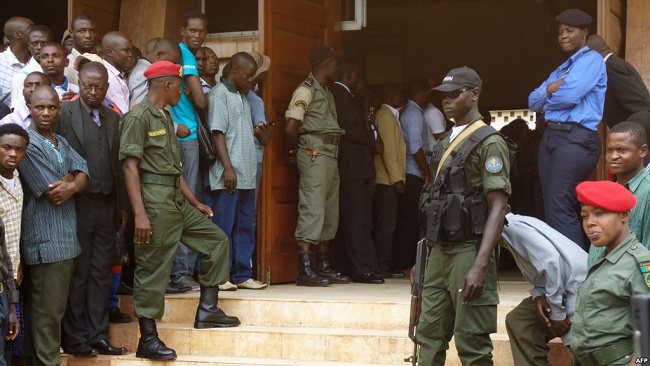
The government also labeled all protesters as radical separatists and mobilized elements of the Rapid Intervention Battalion (BIR), the elite unit of the Cameroonian army known for its aggressive methods. Cameroonian soldiers have responded to attacks from separatists with brutal retaliation, burning down entire villages and indiscriminately killing, arresting, and torturing dozens of people within the Anglophone regions, as well as in Nigeria. On October 1, 2018, the anniversary of Cameroon’s unification as a single state, the government imposed a number of restrictive measures aimed at preventing further demonstrations in the Anglophone provinces: suspending public transportation, closing businesses and public places, and banning gatherings of over four people, among other measures.
At least 420 civilians have already lost their lives in the ensuing conflict, while nearly 200,000 people have fled their homes to the bush or Francophone areas. Another 40,000 have found refuge in Nigeria. The exodus has accelerated with the increase of violence. The instability has also affected food security in the Anglophone areas, with nearly a half million people facing a food crisis.
In response, some elements of the protest movement have radicalized, turning to armed struggle and calling for secession. Further expanding their movement, they have called on residents in Anglophone areas to avoid urban centers on designated “ville morte” days, threatening violence against any who disobeyed. Several dozen schools, buildings, and administrative vehicles were burned. On October 1, 2017, leaders of the protest proclaimed the independence of the “Republic of Ambazonia” for the Northwest and Southwest provinces, marking a point of no return in the nascent conflict. While traditionally marked with festivities throughout the country, the 46th National Day of Cameroon, May 20, 2018, was boycotted in the English-speaking provinces.
The government labeled all protesters as radical separatists
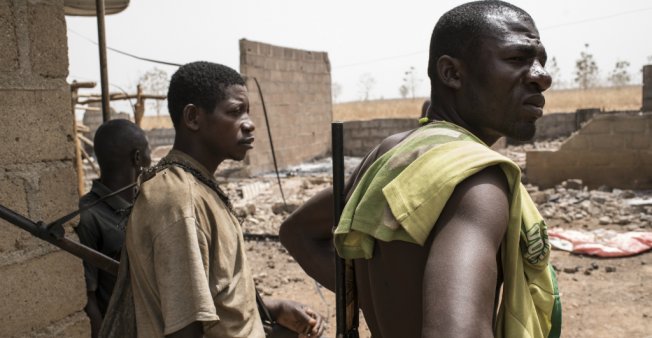
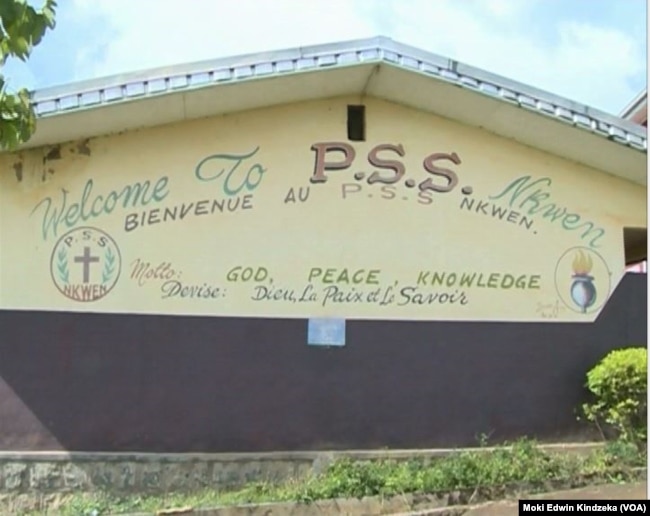
Armed groups claiming to be part of the new Anglophone state have emerged, such as the Ambazonian Defense Forces, the Southern Cameroon Defense Forces, the Ambazonia Restoration Army, and several other smaller groups. Altogether the armed separatists are estimated to comprise a few hundred combatants. Since the summer of 2017, at least 170 members of the security forces have been killed, and numerous Cameroonian state officials have been abducted. In September 2018, a group of armed men attacked a school near Buea in the southwest, injuring more than 20 people, including children. Threats by separatists to prevent voting in the presidential election in the Anglophones provinces further suppressed turnout to an estimated 5 percent of eligible voters. The armed separatists have also threatened to attack the country’s most populated urban areas, such as Douala and Yaoundé, in the Francophone regions.
In a report released in July 2018, Human Rights Watch accused both Cameroonian security forces and separatist fighters of serious human rights violations on civilians in both provinces. Despite repeated requests, the United Nations has not been allowed to visit the area. In July 2018, former UN High Commissioner for Human Rights Zeid Raad Al-Hussein expressed concern, citing reports of “kidnappings, targeted killings of police and local authorities, the destruction of schools by armed elements,” and “killings, excessive use of force, burning down of houses, arbitrary detentions and torture” by government forces. But the government has not yet acted upon his appeal to launch independent investigations into human rights violations.
In an attempt to maintain the illusion of normality, Cameroonian authorities have tried to stem the outflow of residents from the English-speaking provinces by demanding a “reason” why citizens are trying to flee into the French-speaking regions. However, the displacement speaks for itself. Violence in the Anglophone provinces continues to escalate with an ever-increasing number of civilian victims. Today, the country faces a serious risk of conflagration.
A Crisis That Has Been Building for Some Time
Cameroon is an example of a conflict that could have been avoided. As Dr. Christopher Fomunyoh has observed, this is an entirely “man-made crisis.” English-speaking Cameroonians have long expressed their frustrations toward the discrimination their community faces and the perception of institutional marginalization. It is the failure to take these concerns seriously that has brought the country to the current juncture.
The roots of the crisis also trace back to the country’s origins. The territory that is now Cameroon became a German colony in 1884. Following World War I, Germany lost all of its overseas colonies, leaving most of the territory to be administrated by the French and the western provinces overseen by the United Kingdom. In 1960, a year before Cameroon gained its independence, the two Anglophone provinces voted to join their French-speaking counterparts in what became “the federal Republic of Cameroon.” This federal arrangement was intended to establish a framework where Anglophones and Francophones had the same rights and where their differences would be respected and represented within Cameroonian institutions.
But things soon took a different turn. In May 1972, a referendum was held that led to the approval of the new name of the “United Republic of Cameroon.” Subsequent constitutional reforms started to blur the bilingual and bicultural features of the country. This trend continued with Paul Biya’s accession to the presidency in 1982. He systematically pursued measures that promoted the centralization of the country. The following year, the English-speaking region was divided into two provinces, Northwest and Southwest. In 1984, Biya abandoned the term “united,” the country became the “Republic of Cameroon,” and the second star on the flag, representing the English-speaking region, was removed.
Over the years, centralization has been progressively reinforced, along with the inexorable shrinking of democratic space and individual freedoms. Despite the emergence of Anglophone political movements, the predominance of French and Francophone cultural references became widespread, contributing to the growing sense among Anglophones of a steady loss of culture and a dilution of their identity. They have repeatedly tried to protest against this drift, but the government has generally been resistant to their claims. For many years, Anglophones held out hope for change—until it became clear that the Biya government had no intention of altering the status quo. In 2017, out of 36 ministers, only one was Anglophone. In 2018, the president of the Senate, the president of the National Assembly, the first president of the Supreme Court, and the president of the Constitutional Council were all French-speaking. This has fueled a growing resentment among the youth in the English-speaking regions, who have become increasingly sensitized to the issue and found global resonance for their grievances through social media. It is the combination of this lack of representation along with the exasperation of the Anglophone youth in the face of government indifference that eventually provoked the protests of 2016.
Fear that Autonomy for Anglophones May Lead to Demands for Democracy Nationally
Even though Biya has said repeatedly that he is “ready for dialogue,” the government has failed to offer a sincere and concrete path out of the crisis. Calling the separatists “terrorists” and violently repressing peaceful demonstrations has contributed to the escalation and strengthened the hand of the most radical separatist actors. Moreover, with the support of a highly engaged and resourced Cameroonian diaspora, armed separatists have firmly established themselves. Despite the many casualties within the separatists’ ranks, the harsh and indiscriminate tactics of the Cameroonian security forces have strengthened the fighters’ determination.
Cameroonian authorities, meanwhile, have sought to enforce the status quo at all costs. This strategy is based on the fear that giving more autonomy to Anglophones would in turn galvanize demands for greater democratic openness and respect for human rights among the general population. But this calculation has led to a political and military impasse, placing the future of Cameroon as a unitary nation under threat. The country now faces the risk of a prolonged civil war whose consequences may go far beyond what Cameroonian officials have imagined.
The Rise of the Hardliners
It is becoming increasingly clear that Biya is no longer the only captain steering the Cameroonian ship of state. Aged 85, he travels abroad so frequently that he has been nicknamed “the absent president” by some critics. His prolonged absences and his faltering health have resulted in the transfer of the management of most important portfolios to senior aides. These ministers and members of the administration, all French-speaking, have adopted particularly uncompromising positions in the face of the separatist challenge. Accordingly, Foumane Akame, head of the judiciary in Cameroon for almost 20 years and legal adviser to the head of state; Laurent Esso, Minister of Justice and friend of the president; Edgard Alain Mebe Ngo’o, Minister of Transportation and former Director of Cabinet; and the Minister of Defense, Joseph Beti Assomo, have played increasingly leading roles in Cameroonian politics.
Toward a Resolution to the Conflict
Ordinarily, neighboring countries could be expected to be actively involved in finding a mediated solution to such a political crisis. However, in the case of Cameroon, regional bodies and neighboring countries have remained remarkably discreet. Economic Community of Central African States (ECCAS) leaders have largely refrained from commenting on the situation, in part, due to other crises in the region. Nigeria shares a common border with the English-speaking provinces and is therefore the neighboring country most directly affected by the crisis. However, Nigerian officials apparently want to avoid any suggestion that they are aiding the Cameroonian separatists. Indeed, to prove its good faith, Abuja not only arrested Sisiku Ayuk Tabe, an English-speaking separatist leader, and 46 of his executives in January 2018, but also extradited them to Yaoundé. Nigeria has also allowed Cameroonian troops to conduct operations on Nigerian territory in order to repel the separatists.
The need for an inclusive dialogue, initiated by a neutral third party, remains crucial, however. From this perspective, the silence of African regional organizations is problematic. ECCAS, the African Union, and the United Nations Office for Central Africa (UNOCA) all have key roles to play. ECCAS could propose a high-level mediator—for example, a former African head of state or an African personality known for a commitment to peace—who would be seen as an honest broker by both parties and capable of negotiating a cessation of hostilities. At the same time, civilian access to humanitarian aid and safe areas should be guaranteed.
Ultimately, it is up to the Cameroonian actors to work out a resolution to this conflict. Events have clearly shown that the recourse to violence by both sides has only empowered the hardliners in each camp and made the process of finding solutions more difficult. In this regard, the strategy adopted by some of the separatists toward their fellow citizens—forcing families to stop sending their children to school and threatening reprisals against those who vote—is as damaging to peace and restoring trust among citizens as the government’s heavy-handed tactics.
Governance deficiencies have also fueled the resentment of the larger Cameroonian population, beyond the English-speaking regions.
In the end, it will be necessary for all conflict stakeholders to sit down at the negotiating table to address the grievances of Anglophones in the broadest possible way. This dialogue should include the major political actors but also representatives of civil society. As important as any particular prescription will be that mediators take the necessary steps to demonstrate to Anglophones that their grievances are understood and that there is a commitment to ending the discrimination they face. This dialogue could ultimately redefine the principles of a unitary and peaceful Cameroon, where the rights of all citizens are effectively respected and taken into account.
Beyond the question of the treatment of Anglophones, the nature of the regime must be examined. Inequitable access to government services, widespread corruption, and discrimination have created a fertile ground for the emergence and violent radicalization of those with grievances. These governance deficiencies have also fueled the resentment of the larger Cameroonian population, beyond the English-speaking regions. This majority is demanding a profound change in the way the country is run. Despite Biya’s impressive longevity, the country will sooner or later have to choose a new leader. In order to deal with this scenario when it arrives, it would be useful to launch a sincere and in-depth examination of the reforms needed to move the country forward. While those around Biya may believe they can continue the same governance style after him, they underestimate the depth of the desire for change in the country, especially among youth. Rather, Cameroonian leaders will best protect their interests by initiating an ambitious reform process proactively. Time is of the essence. Experience elsewhere in Africa shows that once the dynamics of a conflict take hold, politics becomes increasingly difficult, and the consequences heavier and longer lasting.
Source: Africa Center For Strategic Studies
Now that you are here
The Cameroon Concord News Group Board wishes to inform its faithful readers that for more than a decade, it has been providing world-class reports of the situation in Southern Cameroons. The Board has been priding itself on its reports which have helped the world to gain a greater understanding of the crisis playing out in Southern Cameroons. It hails its reporters who have also helped the readers to have a broader perspective of the political situation in Cameroon.
The Board wishes to thank its readers who have continued to trust Southern Cameroon’s leading news platform. It is therefore using this opportunity to state that its reporters are willing to provide more quality information to the readers. However, due to the changing global financial context, the Board is urging its readers to play a significant role in the financing of the news organization. It is therefore calling on its faithful readers to make whatever financial contribution they can to ensure they get the latest developments in their native Southern Cameroons, in particular, and Cameroon in general.
Bank transaction: Soter Tarh Agbaw-Ebai
Banking IBAN: GB51 BARC 2049 1103 9130 15
Swift BIC BARC GB22XX
SORT CODE 20-49-11, ACCOUNT NUMBER – 03913015 Barclay PLC, UK
The Board looks forward to hearing from the readers.
Signed by the Group Chairman on behalf of the Board of Directors
Soter Tarh Agbaw-Ebai
Email: soteragbawebai@gmail.com