6, April 2018
Did Gadaffi fund Ukraine opposition leader’s failed presidential bid? 0
Corruption investigators in Ukraine are looking into allegations that late Libyan leader Muammar Gaddafi gave a multi-million euro donation to the presidential campaign of Yulia Tymoshenko in 2010, Ukrainian MP Volodymyr Ariev said.
Tymoshenko denies the claims, but reports of past illicit campaign financing could damage the Ukrainian opposition leader, who is currently beating President Petro Poroshenko in opinion polls ahead of next year’s presidential vote.
Ariev, who is a member of Poroshenko’s ruling BPP faction, said he and other MPs had formally asked the National Anti-corruption Bureau of Ukraine (NABU) look into the allegations published by pan-Arab newspaper Asharq al-Awsat in February.
As soon as this information appeared in the newspaper, three MPs sent a request to NABU with a request to verify this information.
According to Asharq al-Awsat, a Gaddafi representative flew by private jet to Kiev to deliver a briefcase with 4 million euros ($4.9 million) in cash to help finance Tymoshenko’s ultimately unsuccessful 2010 presidential bid.
“As soon as this information appeared in the newspaper, three MPs sent a request to NABU with a request to verify this information,” Ariev told Reuters after he posted a photo on Facebook of NABU’s alleged written acceptance of the request.
Under Ukrainian law, state bodies must investigate any claims if requested by members of parliament. No criminal case has been launched.
Asked to comment on the allegations, the press service of Tymoshenko’s Fatherland party said: “It is nonsense. The information is not correct.”
NABU did not immediately respond to a request for comment.
Gadaffi’s financing of foreign elections
The case threatens to draw Tymoshenko into a broader scandal surrounding Gaddafi’s alleged bankrolling of foreign elections.
France is investigating whether former President Nicolas Sarkozy received 5 million euros of Libyan cash to finance his 2007 election campaign.
Tymoshenko has been prime minister twice and was imprisoned by former president Viktor Yanukovich in a case condemned by Western leaders as selective justice.
Known for her trademark braided hairstyle, Tymoshenko lost the 2014 presidential race, but the latest poll by Rating shows her ahead of Poroshenko with 18.7 percent support versus 15.6 percent for the incumbent president.
The next presidential election is slated for March 2019.
While Tymoshenko served as prime minister in 2007-2010, Kiev and Tripoli agreed a number of commercial deals including a plan for Libya to grow wheat on 100,000 hectares of Ukrainian land.
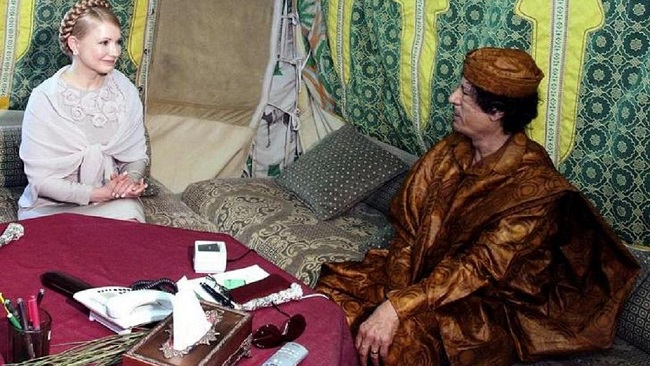
Gaddafi visited Kiev during a tour of ex-Soviet states in 2008, three years before he was overthrown and killed by rebels. He hosted Tymoshenko in a Bedouin-style tent that he had pitched in central Kiev as was his habit on official trips.
REUTERS












6, April 2018
Southern Cameroons Genocide Cover Up: Yaounde arrest Rwanda genocide suspect wanted in France 0
A former Rwandan policeman has been arrested in Cameroon on suspicion of involvement in the 1994 Rwandan genocide, a judicial source in France, where he is wanted over the killings, said.
Philippe Hategekimana was arrested in Yaounde, Cameroon’s capital, on March 30 under an international warrant issued by French magistrates specialising in crimes against humanity.
France is expected to request his extradition to face charges of organising and participating in multiple atrocities in southern Rwanda in April 1994, including the assassination of a mayor.
France, which had initially dragged its heels on prosecuting suspected perpetrators of the genocide of about 800,000 people, mostly minority Tutsis, has picked up the pace in recent years.
The first French trial over the genocide was in 2014 when former Rwandan spy chief Pascal Simbikangwa was sentenced to 25 years imprisonment for genocide and complicity in crimes against humanity.
Two years later, a Paris court sentenced two former Rwandan mayors to life in prison for their participation in a massacre at a church, where some 2,000 people seeking refuge were bludgeoned and hacked to death.
All three men were arrested in France.
Hategekimana also fled to France after the genocide, settling in the western city of Rennes where he changed his name to Philippe Manier and obtained French citizenship.
But he recently left for Cameroon.
The investigation against him was opened in Paris in September 2015 after a complaint from the Collective of Civil Parties for Rwanda (CPCR), a group set up by a Rwandan-born relative of genocide victims and her husband.
The genocide has caused two decades of tension between France and Rwanda, with the latter accusing Paris of complicity in the killings through its support and military training for the ethnic Hutu forces who carried out most of the slaughter.
Source: The Nation