Cameroon Concord News
You Are What You Read
  • Home
  • News
    • Cameroon
    • Nigeria
    • Africa
    • Europe
    • World
  • Politics
    • Cameroon
    • Nigeria
    • Africa
    • Europe
    • World
  • Sports
    • Cameroon
    • Africa
    • Europe
    • World
  • Business
    • Africa
    • World
  • Life
    • Education
    • Health
    • Fashion
    • Entertainment
  • Religion
    • Cameroon
    • World
  • Contact
    • Online
    • Phone
    • Email
  • About
    • Us
    • Our Services
    • Advertising with Us

Categories

Recent Posts

  • Yaoundé earns CFA15 billion from Chad Oil Pipeline transit fees in 5 months
  • Most stocks rise, oil flat following peace deal-fuelled rally
  • Iran deal: the cards are now in Tehran’s favour
  • American musician Oliver Tree killed in mid-air helicopter collision in Brazil
  • Cameroon looks to Tunisia’s textile model to develop its cotton value chain

Archives

  • June 2026
  • May 2026
  • April 2026
  • March 2026
  • February 2026
  • January 2026
  • December 2025
  • November 2025
  • October 2025
  • September 2025
  • August 2025
  • July 2025
  • June 2025
  • May 2025
  • April 2025
  • March 2025
  • February 2025
  • January 2025
  • December 2024
  • November 2024
  • October 2024
  • September 2024
  • August 2024
  • July 2024
  • June 2024
  • May 2024
  • April 2024
  • March 2024
  • February 2024
  • January 2024
  • December 2023
  • November 2023
  • October 2023
  • September 2023
  • August 2023
  • July 2023
  • June 2023
  • May 2023
  • April 2023
  • March 2023
  • February 2023
  • January 2023
  • December 2022
  • November 2022
  • October 2022
  • September 2022
  • August 2022
  • July 2022
  • June 2022
  • May 2022
  • April 2022
  • March 2022
  • February 2022
  • January 2022
  • December 2021
  • November 2021
  • October 2021
  • September 2021
  • August 2021
  • July 2021
  • June 2021
  • May 2021
  • April 2021
  • March 2021
  • February 2021
  • January 2021
  • December 2020
  • November 2020
  • October 2020
  • September 2020
  • August 2020
  • July 2020
  • June 2020
  • May 2020
  • April 2020
  • March 2020
  • February 2020
  • January 2020
  • December 2019
  • November 2019
  • October 2019
  • September 2019
  • August 2019
  • July 2019
  • June 2019
  • May 2019
  • April 2019
  • March 2019
  • February 2019
  • January 2019
  • December 2018
  • November 2018
  • October 2018
  • September 2018
  • August 2018
  • July 2018
  • June 2018
  • May 2018
  • April 2018
  • March 2018
  • February 2018
  • January 2018
  • December 2017
  • November 2017
  • October 2017
  • September 2017
  • August 2017
  • July 2017
  • June 2017
  • May 2017
  • April 2017
  • March 2017
  • February 2017
  • January 2017
  • December 2016
  • November 2016
  • October 2016
  • September 2016
  • August 2016
  • July 2016
  • June 2016
French Cameroun:  Boko Haram kills 4 in the Far North

30, May 2023

French Cameroun:  Boko Haram kills 4 in the Far North 0

The attack has not been claimed, but authorities in the Far North region believe the assailants to be fighters from the Boko Haram terrorist group.

Heavily armed and unidentified individuals attacked a mixed checkpoint at the entrance to the town of Mora and killed four Cameroon servicemen.

The Senior Divisional Officer for Mayo Sava Division Ngbwa Ludovic Etienne contacted by Cameroon Concord News confirmed the attack and added that two customs officers, a policeman and a soldier were among the casualties.

The assailants made away with two weapons according to the Mayo Sava gendarmerie company commander.

By Fung Achuo in Maroua

Southern Cameroons Crisis: “Victims of genocide and perpetrators cannot live together”

30, May 2023

Southern Cameroons Crisis: “Victims of genocide and perpetrators cannot live together” 0

The Vice President of the Ambazonia Interim Government has said that the Biya French Cameroun regime is the promoter and justifier of genocide throughout Southern Cameroons territory.

Dabney Yerima made the comment during a press briefing in Holland on Monday observing that Ambazonians as victims of the Biya imposed war, cannot sit together with its perpetrators.

The exiled Southern Cameroons leader was reacting to a statement from Yaoundé that the Biya Francophone regime was already implementing the so-called special status for the people of Southern Cameroons.

Comrade Dabney Yerima furthered that the leader of the Ambazonia resistance President Sisiku Ayuk Tabe wants no Southern Cameroonian citizen to be a victim of La Republique du Cameroun’s terror acts. “Every Southern Cameroonian has to fight French Cameroun agents as one, if we remain separate, we will continue to be victims of their occupying military.”

The Biya Francophone regime regularly attributes Ambazonia attacks against the Francophone dominated Cameroon government army to suspected separatists.

By Chi Prudence Asong with additional editing from Isong Asu
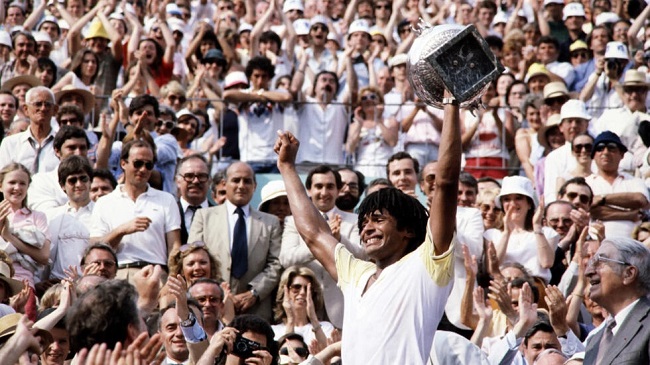
Franco-Cameroun relations: No Frenchman has won a Grand Slam title since Yannick Noah in 1983

30, May 2023

Franco-Cameroun relations: No Frenchman has won a Grand Slam title since Yannick Noah in 1983 0

With no Frenchmen seeded in singles at Roland Garros this year, the home country is unlikely to see its first male champion since Yannick Noah’s lone win back in 1983. But as one generation of nearly-men bows out, there are signs a new one is readying to take up the challenge.

No Frenchman has won a Grand Slam title since Yannick Noah’s French Open triumph in 1983.

It’s been 40 years since a Frenchman last won a singles Grand Slam title – and marking the anniversary of Noah’s famous win has become a nostalgic ritual for a nation starved of success.

The former tennis-champ-turned-pop-star was back on the French Open stage at the weekend for a celebration of his 1983 title, this time holding a mic instead of a racket. He strode barefoot on the famous red clay of Court Philippe Chatrier and performed a dozen songs – joined on stage by his opponent from 40 years ago, Matts Wilander.

Asked why no other Frenchman had emulated his success since then, he joked: “Because I’m not coaching anymore.”

Noah, who captained France to victory in both the Davis Cup and Fed Cup, later had a stark piece of advice for French youngsters hoping for a breakthrough: to pack their bags and travel abroad.

“You have to go and nourish yourself elsewhere, because we’re used to losing at all levels,” he told reporters. “All coaches have lost. None of them have won. So you’re surrounded by people who have all lost.”

‘As if Real Madrid had won nothing’

Look abroad is precisely what the French Tennis Federation (FFT) has done, tapping Croatia’s Ivan Ljubicic, the former player and coach who was credited with improving Roger Federer’s game in his twilight years, guiding the Swiss to three more Grand Slam titles.

A former world number three, Ljubicic was put in charge of a programme dubbed Ambition 2024, aimed at improving French tennis and nurturing a new generation of champions. As he took on the job in December, the towering Croat expressed bafflement at the dearth of tennis success in France.

“Non-French people are always puzzled by tennis in your country,” he told French reporters. “It’s as if Real Madrid had won nothing for a long time.”

Switzerland’s Stan Wawrinka, the 2015 French Open champion, made blunter comments at a tournament in Marseille earlier this year, saying it was “sad” not to see better players in a country “with a Grand Slam tournament and ample resources to invest in the future of tennis”.

 Self-flagellation has been a recurrent theme at the French Open, particularly on anniversary years. In 2018, as organisers marked 30 years since the last time a Frenchman – Henri Leconte – reached the final, the 1988 runner-up blasted the players’ lack of dedication and mental toughness.

“They don’t train on clay as much as we used to,” said the flamboyant Leconte. “They are afraid to play at the French Open. They are always coming with an excuse, saying, ‘Oh, I have a bad back or elbow’.”

The harsh assessment was shared by some fans at Roland Garros, who flagged the home players’ inability to cope with expectations.

“The French have great courts and great players, but at this level in tennis it’s the mental strength that makes the difference,” said Marcus from Denmark, sheltering from the sun that has blessed the tournament’s opening days. He drew a parallel with the former world number one Andy Murray, who finally ended Britain’s decades-long wait for a male Grand Slam title “despite facing even greater pressure at Wimbledon”.

Murray, who lost eight of his 11 Grand Slam finals, all of them against either Djokovic or Federer, would certainly have seen more success had he not landed in the era of the “Big Three”. It’s a point Marion Bartoli, the last French player to win a major in 2013, also raised in the run-up to the French Open, stressing that the likes of Jo-Wilfried Tsonga and Gaël Monfils were equally unfortunate to have faced such formidable opponents throughout their careers.

Culled from France 24

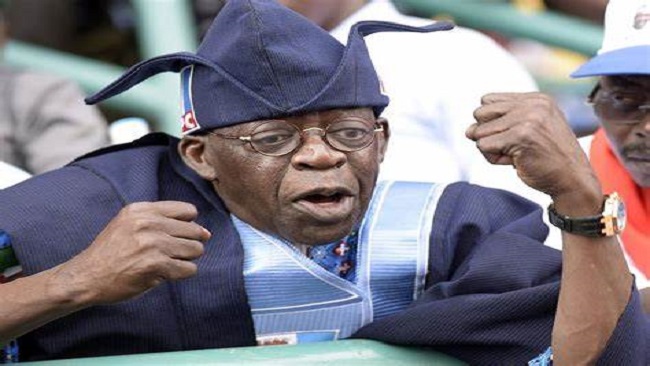
Nigeria’s political ‘godfather’ Bola Tinubu sworn in as president

29, May 2023

Nigeria’s political ‘godfather’ Bola Tinubu sworn in as president 0

The 71-year-old southerner took over from a 80-year-old northerner as Africa’s most populous nation faces a sea of economic troubles and security challenges.

“As president of the Federal Republic of Nigeria I will discharge my duties and perform my functions honestly to the best of my ability, faithfully and in accordance with the constitution,” Tinubu said in a live broadcast from the capital Abuja’s Eagle Square.

Foreign leaders and representatives present at the ceremony included presidents Cyril Ramaphosa of South Africa, Paul Kagame of Rwanda and Nana Akufo-Addo of Ghana as well as delegations from the US, Britain and China.

Kashim Shettima was sworn in as vice president, taking over from Yemi Osinbajo.

The ruling party duo were declared winners of the February 25 election, gaining the highest number of votes — 8.8 million — and picking up the required number of ballots across two-thirds of Nigeria’s states.

But Tinubu only garnered just over a third of the total vote, leaving him with a weak mandate, some analysts say.

The poor showing reflects “widespread disenchantment with his party’s record… along with misgivings about his personal eligibility for the office,” the International Crisis Group (ICG) think tank said in a note.

Dubbed a political “godfather,” Tinubu campaigned on the slogan “it’s my turn” to govern the country, Africa’s biggest economy.

He has touted his experience as Lagos governor from 1999 to 2007 — a period that, supporters say, modernised Lagos, Nigeria’s commercial hub.

But the new president also faces corruption allegations, which he denies, and questions over his health.

Opposition leaders Atiku Abubakar, who came second, and Peter Obi, who was third, are contesting election results in court, claiming fraud.

The electoral commission acknowledged “glitches” during the vote but dismissed claims that the process was not free and fair.

Continuation

Buhari had promised to tackle graft and insecurity but disappointed many.

He bequeaths his successor mounting debt and inflation, as well as deepening concern over attacks and kidnappings by armed groups.

His presidency showed “it is possible for an individual believed by many to be personally incorruptible to preside over an administration that is nonetheless defined by corruption and rank incompetence,” said Ebenezer Obadare of the Council on Foreign Relations, a Washington-based think tank.

“Nigerians will soon find out whether a leader widely seen as corrupt can preside over a relatively malfeasance-free and reasonably competent administration,” Obadare wrote in a blog.

 Buhari is expected to leave Abuja on Monday to spend time at his farm in Daura, in Katsina State, near the border with Niger.

The two men might be different in style and reputation, but they also have key similarities.

They both adhere to Islam and are of an advanced age, in a country divided between Christians and Muslims and where the median age is 18.

Buhari made repeated medical trips to the UK when he was president, while Tinubu spent time abroad during the campaign and between the election and inauguration.

Speculation about Tinubu’s health is widespread, prompting attention to turn to his deputy Shettima, a 56-year-old former governor of the northern state of Borno.

Debt, insecurity

The new government faces a mountain of urgent work, starting with the economy.

One of the main challenges for oil-rich Nigeria is that it swaps crude worth billions of dollars for gasoline that it then subsidises for its domestic market.

This has caused a huge drain on revenue and foreign exchange, contributing to ballooning debt.

More than 80 million of the country’s estimated 210 million people live below the poverty line, according to the World Bank, and the UN has warned that over of a quarter of those are facing acute hunger this year.

Despite thriving tech and entertainment sectors, many middle-class Nigerians are moving abroad hoping for a brighter future.

 Another priority for the incoming government will be to address insecurity, which has spread like wildfire in recent years.

Troops are battling gangs of heavily armed criminals and kidnappers in central and northwestern states, oil thieves, pirates and separatists in the southeast, and a 14-year-old jihadist insurgency in the northeast.

Complicating matters, national assembly elections produced greater political plurality this year, with seven parties represented in the incoming senate and eight in the next house of representatives.

“The next administration will need to work overtime to garner consensus on the legislative agenda,” said Afolabi Adekaiyaoja in a report for the Abuja-based Centre for Democracy and Development.

Governors, who also wield substantial power in Nigeria, were also being sworn in on Monday.

Source: AFP with additional reporting by Engelis Okesack Besong

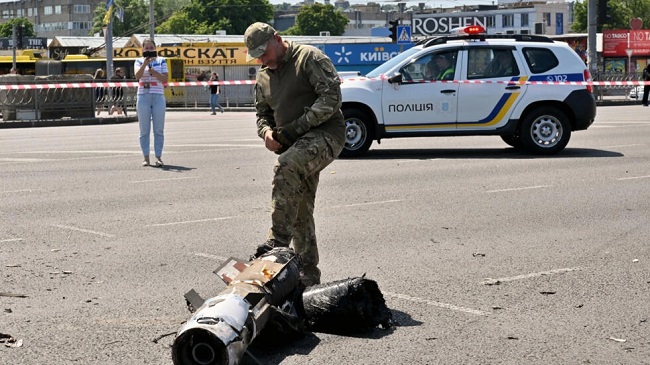
Russia fires missiles on Kyiv in rare daytime attack

29, May 2023

Russia fires missiles on Kyiv in rare daytime attack 0

A series of explosions rang out in Kyiv on Monday as Russia targeted the city for the second time in 24 hours.

The latest barrages hit the pro-Western country as the Ukrainian capital was still recovering from an overnight Saturday drone attack, the biggest since Russia’s invasion began in February last year.

AFP journalists heard at least 10 explosions from around 11:10 am local time (0810 GMT) in Kyiv, starting just a few minutes after an air raid warning sounded.

Authorities later said Ukrainian air defences had downed all the Russian missiles launched against the Kyiv region.

One injured man was hospitalised, they said.

“A total of 11 missiles were fired: ‘Iskander-M’ and ‘Iskander-K’ from a northerly direction,” Ukraine’s armed forces chief Valery Zaluzhny said.

“All the targets were destroyed by air defences.”

Sergiy Popko, head of Kyiv’s city administration, said that Russians struck in the morning when “most residents were at work and on the streets”.

Source: AFP

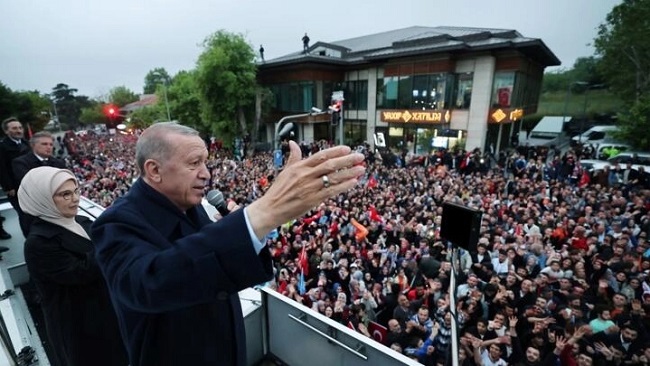
Turkey: Identity politics, media crackdown help propel Erdogan to victory

29, May 2023

Turkey: Identity politics, media crackdown help propel Erdogan to victory 0

President Recep Tayyip Erdogan defeated opposition challenger Kemal Kilicdaroglu in Sunday’s Turkish presidential election runoff – a victory analysts ascribe to Erdogan’s focus on identity issues and use of the government’s resources, as well as Kilicdaroglu’s tepid leadership of a precarious coalition.

The first round was a shock to many Western observers who thought they might finally see the back of Erdogan. But after the Turkish president came within a whisker of re-election in that ballot, his second-round victory surprised no one. He defeated opposition challenger Kemal Kilicdaroglu with 52.1 percent of the vote.

“I will be here until I’m in the grave,” Erdogan said as he addressed jubilant supporters from an open-top bus in Istanbul.

These polls belied the Western cliché that elections are about “the economy, stupid”. Along with his much-criticised response to February’s devastating earthquakes, Turkey’s economic woes looked like a big weakness for Erdogan at the outset of the campaign.

While growth remains robust, five years of an inflation and currency crisis has seen the cost of living soar for many Turks – a major reversal after the abundant economic gains after Erdogan first took power in 2003. Experts blame this crisis on Erdogan’s unorthodox belief that cutting interest rates helps reduce inflation while all mainstream economic theories hold that higher interest rates are required to calm rampant inflation in an economy.

Identity politics

But culture war has been at the heart of Turkish politics ever since Mustafa Kemal Ataturk made the country a modern nation-state in 1923, introducing strict secularism as he transformed Turkey along Westernising lines. Erdogan’s traditional constituency of socially conservative Muslim voters in the Anatolian heartland have always seen him as their champion in this culture war. A gifted orator and political strategist, Erdogan has already gone down in history as the leader who smashed secular Kemalism’s long hegemony over Turkish politics.

“Erdogan won primarily because he was once again able to shift the focus from socio-economic issues to identity issues,” said Ozgur Unluhisarcikli, director of the German Marshall Fund’s Ankara bureau.

Erdogan also instrumentalised Turkey’s long fight against Kurdish militant group the PKK, which has waged a guerrilla war against the Turkish state punctuated by ceasefires since 1984 and is classified as a terrorist group by the EU and the US as well as Turkey.

Kilicdaroglu won the support of the pro-Kurdish People’s Democratic Party (HDP). Erdogan then accused the opposition of having links to terrorism, saying opposition leaders went into “dark rooms to sit and bargain” with militants.

“He was particularly successful in directing the anger of Turkish society towards the PKK [against] the opposition,” Unluhisarcikli noted.

Meanwhile, Kilicdaroglu’s big-tent approach was always going to be a tremendous challenge. The opposition contender had to juggle the Nation Alliance – the heterogenous six-party coalition behind his candidacy, which included the nationalist Good Party – with the HDP’s endorsement of his candidacy.

After Kilicdaroglu’s disappointing first-round performance, he won the support of the nationalist Victory Party’s Umit Ozdag and adopted his hard line on the Kurdish issue – which evidently risked alienating the millions of Kurdish voters Kilicdaroglu needed.

“The diversity of the opposition alliance was both an advantage and a disadvantage,” Unluhisarcikli observed. “It was an advantage because it made it possible for Kilicdaroglu to address a wider audience. It was a disadvantage because it led to an image of dysfunctionality. Moreover, while most voters could find an element they could identify with in the opposition alliance, they could also find one that they could not tolerate.”

When he was performing well in opinion polls ahead of the first round, Kilicdaroglu’s unassuming, professorial demeanour looked like a potential boon after two decades of Erdogan’s often mercurial style. But in reality Kilicdaroglu’s image was that of a “lacklustre candidate” backed by a “wobbly coalition”, said Howard Eissenstat, a Turkey specialist at St. Lawrence University and the Middle East Institute in Washington DC.

‘Authoritarian reasons’

Beyond the issues and personalities, Erdogan was able to mobilise resources surpassing the typical advantages of incumbency. He made lavish offers to voters using the state’s largesse, notably promising discounted gas bills for a year. Erdogan’s presidential power was helpful to his campaign in other ways, as the government controls 90% of the national media and has effectively curtailed the power of the independent press, seeing Turkey fall to 165 out of 180 in the World Press Freedom Index.

Highlighting restrictions on press freedom, observers from the Organisation for Security and Co-operation in Europe found during the campaign that the polls were “marked by an unlevel playing field” even if they were “still competitive”.

“There are electoral reasons why Erdogan won and there are authoritarian reasons why he won,” Eissenstat said, emphasising that both sides of this equation are crucial.

“Given Erdogan’s gross mismanagement of the economy, his electoral skills would mean little without the authoritarian components: his control of 90% of the media, his use of the courts to limit the opposition, his use of government resources to support his own campaign,” Eissenstat continued. “As the saying goes, ‘only amateurs try to steal elections on election day’: Erdogan is no amateur. Election day had some irregularities, but nothing wildly out of the ordinary. Erdogan controlled every aspect of how the election was [run] and that is the key explanation for why he won.”

All that said, Kilicdaroglu came closer to defeating Erdogan than any previous opposition standard-bearer. In the 2018 presidential elections many Western observers thought Muharrem Ince had a decent chance of winning. But Erdogan clinched re-election in the first round, despite a lively campaign from the candidate representing Kilicdaroglu’s Republican People’s Party.

“The second round was closer than I thought it would be,” Eissenstat said. “The opposition did very well given the limits it was working under, and the voter turnout was higher than I expected.”

“I am in Turkey right now and my sense from conversations before the run-off [was] that opposition voters were demoralised and that many would stay home,” Eissenstat continued. “In the event, the Turkish electorate’s belief in the moral importance of voting trumped their hopelessness. The exception was the Kurdish vote, which clearly was dampened by Kilicdaroglu’s swerve to the right in the second round.”

Potential successors?

But there is no mistaking the sense of jubilation among Erdogan and his supporters as he enters his third decade in power. This year is symbolic, too, as Turkey is marking a century since Ataturk made it a nation-state.

Beneath the congratulations pouring in from Washington to Moscow, there is a clear divide between the perspectives of Western governments and those of Turkey’s geopolitical partners, pre-eminently Russia. After the Western commentariat hailed Erdogan as a reformer in the 2000s, their attitudes soured during the following decade, as he ramped up an assertive foreign policy amid his turn towards illiberal democracy at home.

How the West, Russia see Turkey’s presidential elections

Russia will “celebrate” Erdogan’s victory as Moscow sees his “transactionalism as convenient” – while “for the West, he will continue to be a challenge, but they will try to make the best of it”, Eissenstat said. “They won’t be happy, but in the end, they want to work with Turkey and Erdogan is its president.”

On foreign and domestic policy alike, Eissenstat expects Erdogan is unlikely to make any major changes during this new presidential term.

“He will likely make some half-hearted nods at a reset with some Western powers and with the markets to try to help stabilise the economy, but I think the general trajectory of his rule is set,” Eissenstat said. “I don’t expect him to become wildly more repressive and I certainly don’t expect him to liberalise.”  

Nevertheless, both analysts foresee one key difference in the 69-year-old Erdogan’s third term: he’s likely to hand-pick his political successor.

Source: AFP

King Salman Humanitarian Aid: Over 500 patients examined in voluntary surgical program in Cameroon

29, May 2023

King Salman Humanitarian Aid: Over 500 patients examined in voluntary surgical program in Cameroon 0

The King Salman Humanitarian Aid and Relief Center (KSrelief) continued to implement a voluntary surgical program in Cameroon, which has so far examined more than 500 cases in different clinics.

The campaign runs from May 20 to May 31, 2023, in cooperation with Al-Baslam International Organization. Since the start of the campaign, the volunteer medical team of the KSrelief has examined 532 cases in different clinics.

KSrelief also hosted in Riyadh on Sunday the European Union Special Representative for the Horn of Africa, Annette Weber, and her accompanying delegation.

During the meeting they discussed concerns related to humanitarian and relief affairs. They also discussed ways to support humanitarian work in the Horn of Africa region.

Elsewhere, KSrelief continued implementing a project to enhance health care services for Syrian refugees and the host communities in Akkar Governorate, Lebanon.

During April 2023, 822 patients were received, and 1,464 services were provided across various clinics.

In Tajikistan, shelter aid, including blankets, heating coal and water heaters in the districts of Temurmalik, Baljuvon, Khatlon and Tojikopod, benefiting 330 individuals from the neediest groups.

Source: Arab News

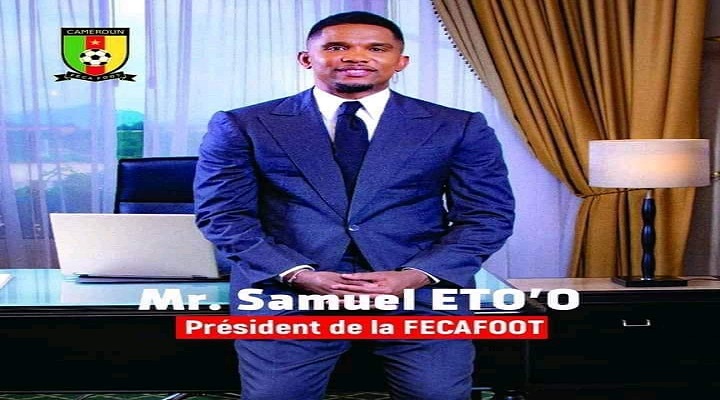
FECAFOOT: FIFA against changing Eto’o’s term of office

29, May 2023

FECAFOOT: FIFA against changing Eto’o’s term of office 0

Football’s world governing body is not in favour of extending the current term of office of Cameroon Football Federation president Samuel Eto’o from 4 to 7 years.

Less than a year after the election of Samuel Eto’o, the Cameroon Football Federation (Fécafoot) has amended the term of office of the association’s president. This has now been extended from 4 to 7 years, with the term renewable only once. But it will take much longer for this provision, adopted at the General Assembly on 27 August 2022, to come into force.

Sport News Africa has learned that FIFA has not approved the new version of Fécafoot’s statutes. “FIFA secretary general Fatma Samoura wrote to the president of Fécafoot several months ago,” reports an informed source. “In her letter, she invited the Cameroonian leader to convene a new General Assembly before the end of May 2023. The aim was to cancel the point concerning the modification of the term of office of the president of Fécafoot and return it to 4 years”. As requested by FIFA, the Fécafoot General Assembly took place in Yaounde on Saturday 27 May 2023. The big news is that there is no mandate extension for Eto’o.

Tailor-made texts

Article 37 of Fécafoot’s new statutes, relating to the modification of the president’s term of office, is not the only “innovation” of the Eto’o era. Several provisions have been tailored to the needs of the governing body. Article 36, relating to the general conditions of eligibility, stipulates in paragraph 1.b that any candidate for an elective post must not have “been sentenced to a final custodial sentence accompanied by a detention order”. In other words, any individual who has been convicted by the courts may stand as a candidate in an election, as long as he or she has not been sent to prison.

According to Cameroonian analysts contacted by Sport News Africa, the aim of this new provision is to allow Samuel Eto’o to remain in office until the end of his term, and then stand again, even though he was found guilty of tax fraud and sentenced to 22 months in prison by the Spanish courts in June 2022. “Paragraph 1.d of article 36 of the old statutes disqualified him and stripped him of his status as president of Fécafoot. This stipulated that any citizen who had been sentenced to a final custodial sentence with a simple suspended sentence or with probation of more than six months could not be a candidate”, a journalist explains.

Source: Sports News Africa

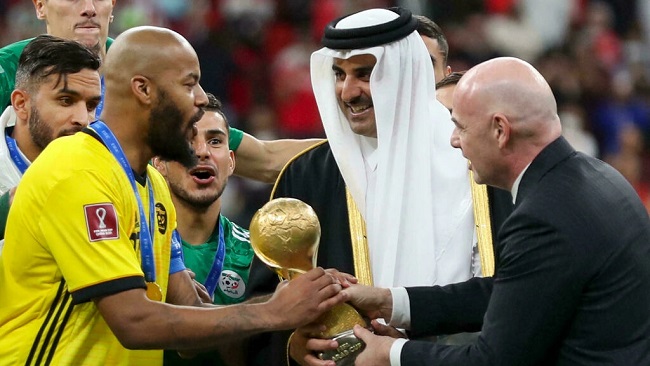
French prosecutors charge ex-FIFA vice president with corruption in Qatar World Cup probe

27, May 2023

French prosecutors charge ex-FIFA vice president with corruption in Qatar World Cup probe 0

FIFA’s disgraced former vice-president Reynald Temarii of Tahiti has been charged with corruption by French prosecutors probing Qatar’s 2022 World Cup bid process.

The French National Financial Prosecutor’s Office in 2016 launched preliminary anti-corruption investigations regarding the conditions under which the 2022 Football World Cup was awarded to Qatar.

The charge, the first to emerge from the years-long investigation, is for passive corruption and was confirmed by France’s financial crimes prosecutors (PNF).

Temarii is a former president of the Oceania Football Confederation (OFC).

But he was forced out in 2010 after being implicated in a vote-selling scandal during an undercover newspaper sting before the controversial awarding to Qatar of last year’s football showpiece.

Temarii was banned for a year by FIFA on November 17, 2010, ruling him out of the infamous December 2 vote at FIFA’s headquarters in Zurich.

The OFC were entitled to organise someone to vote in his place, with the first of their votes designated for Australia then if necessary to the United States, the favourites for the 2022 staging rights over Qatar.

But Temarii appealed his ban on the night of November 30, having initially accepted his suspension.

His appeal, as per FIFA rules, deprived the OFC of a vote on December 2, with Qatar eventually winning the ballot over the USA 14-8.

The French investigation, set up in 2019, was particularly interested in a meeting at the Elysee Palace in Paris on November 23, 2010, just over a week before the vote, between then French President Nicolas Sarkozy, Qatari prince Tamim ben Hamad al-Thani — who became Emir in 2013 — and UEFA president at the time Michel Platini who subsequently voted for Qatar.

Temarii was hit with a separate eight year ban in 2015 for receiving 300,000 euros to cover his legal expenses for his 2010 appeal from former FIFA executive member Mohamed bin Hammam, a key player in securing the World Cup for his home country, Qatar.

Bin Hammam was banned for life from football in 2012.

Source: AFP

How abductions finance separatists in Southern Cameroons

27, May 2023

How abductions finance separatists in Southern Cameroons 0

Abductions are a new fundraising method used by separatists, analysts say. More than 30 women were taken last week for “allowing themselves to be manipulated by Cameroon’s government,” according to the insurgents.

The latest abduction of over 30 women by separatists has caused uproar across Cameroon.

According to reports, they were forcibly taken from the village of Big Babanki, located about 25 kilometers (15 miles) west of Bamenda in the northwest of the country. Some were said to have been “severely tortured.”

The separatist gangs responsible for these kinds of abductions are all part of a moblike structure running the region, where insurgents are waging attacks against the government: They impose illegal taxes on locals, which they collect monthly from women, men and even children.

They also demand taxes from unmarried couples, and even force families to pay the equivalent of about €1,000 ($1,070) to bury their deceased relatives.

But dissent against the dissidents is growing: Ordinary citizens and civil society groups in Cameroon have expressed anger over the arbitrary way that separatists choose to run the region.

When residents refuse to be silenced, their leaders opt for violence, as was the case with the latest abductions: The women had reportedly refused to pay the illegal taxes imposed by the separatists and rejected a curfew imposed on them.

During the attack on the villagers, several of the women were reportedly injured; there were reports of violence and torture against them. Relatives of those who were abducted said they were anxious about their return.

Silencing women activists – for a reason

Ngongba Assumpta Lum, the founder of the Centre for Advocacy in Gender Equality and Action for Development, told DW that the kidnappings were deliberately aimed at trying to silence women in particular, as they are the ones who usually play a crucial role in crisis resolution in traditional and tribal societies in Cameroon.

“The kidnapping of these women in Babanki is a serious blow to us as civil society actors, especially as women-led organizations, peace advocates and organizations fighting for peace to return to the regions,” she said, adding that she feared that this surge in abductions over the past five years would yet get worse.

“I think as mothers, we are greatly touched because this situation is going overboard,” Lum added.

No trust in the government

Cameroon’s government said on Wednesday that a special military operation to rescue the women was underway. However, locals aren’t confident of a success, as it is the same government that these separatists are fighting.

Some of them had said the women were abducted for “allowing themselves to be manipulated by Cameroon’s government.”

But Sally Mbumien, a community leader in Bamenda, believes the actions of the fighters are an attempt to erode the power of women in Cameroon: “Not only is this politicizing our traditional institutions of women’s power, it is also an insult to womanhood, to motherhood and also it sets the wrong precedence,” he told DW, adding that this was “the worst thing that can happen.”

Yvonne Muma, a resident of Bamenda, said she felt angered by the kidnappings, telling DW that the abduction was tantamount to a sacrilege: “These boys have just raised the wrath of God by touching our mothers. They will have no peace until they confess,” Muma said.

Kidnappings: a new way of financing separatism

Cameroon has been plagued by fighting since English-speaking separatists launched a rebellion against the government in 2017. The dissidents say they want the region to secede from the area dominated by the French-speaking majority, and creating an independent, English-speaking state.

But the conflict has claimed more than 6,000 lives to date and has forced more than 1 million people to flee their homes.

With insurgents running out of funds to continue with their campaign — even despite collecting illegal taxes — analysts believe that resorting to abductions appears to be an attractive way to finance their operations.

“Now we have cases of mass kidnappings. Initially, there would be one or two individuals being kidnapped and ransom being asked,” human rights lawyer Agbor Balla told DW, adding that the number of abductions is skyrocketing.

According to Balla, tighter government controls on money laundering and the flow of illicitly obtained money have crippled the activities of the separatists.

“As government tightens financial flows, separatist leaders and sympathizers abroad … it becomes difficult to get the necessary financial support to fund” their activities, he said, adding that endeavors in certain Western countries in the fight against terrorism and its funding had also helped bleed the pockets of separatists dry.

Few rogue elements ‘abducting’ anglophone cause

Meanwhile, the concerns expressed by such separatist groups are regarded as valid: They allege that Anglophone speakers suffer political marginalization in Cameroon and lack the recognition of their cultural identity.

However, the more violent their methods become, the less sympathy they are likely to garner from outside observers — and perhaps also from their own people, even if these kidnappings and other violent acts are only carried out by a few rogue figures in their midst.

Balla said their campaign against the government is also plagued by infighting and fragmentation, making it difficult for separatists to show an organized, united front, which he argues is exactly what allows fringe elements to resort to kidnapping and abusing civilians.

“Because there is no central command and control, most of the leaders of the fighters on the ground are just made of a few persons or groups, and they need to fund their own struggles in their own communities,” he said.

With citizens in the separatist-held regions losing faith in the leadership of the fighters and refusing to pay their bogus taxes that help fund their operations, analysts like Balla fear the number of abductions could surge drastically in the coming months.

Culled from DW

«< 253 254 255 256 257 >»

Featured

  • Iran deal: the cards are now in Tehran’s favourIran deal: the cards are now in Tehran’s favour
  • Exam leaks in CPDM Cameroon: A symptom of a deeper corruption crisisExam leaks in CPDM Cameroon: A symptom of a deeper corruption crisis
  • Biya is already in Hell as Yaoundé unravelsBiya is already in Hell as Yaoundé unravels
  • What does President Biya really want? Money, women or cigarettes?What does President Biya really want? Money, women or cigarettes?
  • Biya, how long must the nation wait for the government it was promised?Biya, how long must the nation wait for the government it was promised?

Most Commented Posts

  • 4 Anglophone detainees killed in Yaounde4 Anglophone detainees killed in Yaounde
    18 comments
  • Chantal Biya says she will return to Cameroon if General Ivo Yenwo, Martin Belinga Eboutou and Ferdinand Ngoh Ngoh are sackedChantal Biya says she will return to Cameroon if General Ivo Yenwo, Martin Belinga Eboutou and Ferdinand Ngoh Ngoh are sacked
    13 comments
  • The Anglophone Problem – When Facts don’t LieThe Anglophone Problem – When Facts don’t Lie
    12 comments
  • Anglophone Nationalism: Barrister Eyambe says “hidden plans are at work”Anglophone Nationalism: Barrister Eyambe says “hidden plans are at work”
    12 comments
  • Largest wave of arrest by BIR in BamendaLargest wave of arrest by BIR in Bamenda
    10 comments

Latest Tweets

→ Follow me

Featured

  • Yaoundé earns CFA15 billion from Chad Oil Pipeline transit fees in 5 months

    Yaoundé earns CFA15 billion from Chad Oil Pipeline transit fees in 5 months

  • Most stocks rise, oil flat following peace deal-fuelled rally

    Most stocks rise, oil flat following peace deal-fuelled rally

  • Iran deal: the cards are now in Tehran’s favour

    Iran deal: the cards are now in Tehran’s favour

  • American musician Oliver Tree killed in mid-air helicopter collision in Brazil

    American musician Oliver Tree killed in mid-air helicopter collision in Brazil

  • Cameroon looks to Tunisia’s textile model to develop its cotton value chain

    Cameroon looks to Tunisia’s textile model to develop its cotton value chain

  • Trump marks 80th birthday with White House UFC spectacle

    Trump marks 80th birthday with White House UFC spectacle

  • Ex-Israeli PM Ehud Barak says Netanyahu must be removed ‘with sticks and stones’

    Ex-Israeli PM Ehud Barak says Netanyahu must be removed ‘with sticks and stones’

Log In

  • Register
  • Log in
  • Entries feed
  • Comments feed
  • WordPress.org
© Cameroon Concord News 2026

We are using cookies to give you the best experience on our website.

You can find out more about which cookies we are using or switch them off in .

Powered by  GDPR Cookie Compliance
Privacy Overview

This website uses cookies so that we can provide you with the best user experience possible. Cookie information is stored in your browser and performs functions such as recognising you when you return to our website and helping our team to understand which sections of the website you find most interesting and useful.

Strictly Necessary Cookies

Strictly Necessary Cookie should be enabled at all times so that we can save your preferences for cookie settings.

3rd Party Cookies

This website uses Google Analytics to collect anonymous information such as the number of visitors to the site, and the most popular pages.

Keeping this cookie enabled helps us to improve our website.

Cookie Policy

More information about our Cookie Policy