
3, October 2018
French Cameroun Counterfeit Presidential Election: Biya still frontrunner despite crises 0
More than 6.5 million Cameroonians will elect their next head of state this week but Paul Biya, president for 35 years, remains the front-runner despite a raging anglophone insurgency and jihadist threats. The central African nation of 25 million people has never staged polls amid insecurity so serious that the military is currently deployed to three of ten regions.
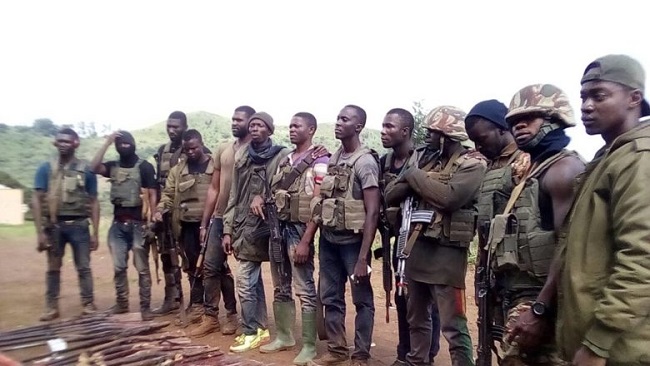
In the far north, soldiers are tackling the Nigeria-based jihadist group Boko Haram, while in the two anglophone regions its mission is to suppress a nascent secessionist insurgency. The separatists have threatened to disrupt voting in the areas where they operate, prompting security forces to fan out across those regions ahead of Sunday’s presidential election.
Yaounde has been adamant that polling will go ahead across the whole country, according to a minister, while Biya has downplayed the conflicts are mere “trouble”.
Violence in the English-speaking regions has flared since the beginning of the crisis at the end of 2016 while security forces have responded to protest action with heavy handed tactics and waves of arrests.
The unrest has killed more than 400 people this year, according to the International Crisis Group think-tank, and there has been an exodus from these regions ahead of the vote.
What began as a limited movement calling for greater economic opportunities and recognition of the English language quickly snowballed into a deadly fight between Cameroon’s military and heavily-armed separatists.
Attacks on symbols of Cameroonian authority including police killings and kidnappings of civil servants have mounted while some local officials have fled anglophone areas, fearing for their lives.
‘The force of experience’
Officials at the Elecam electoral commission have said that some polling stations will be “relocated” to ensure the integrity of the vote.
Despite the challenges facing the nation, Biya has drawn upon a vast network of support to ensure the ubiquity of his campaign.
Towns across the country are dotted with billboards emblazoned with Biya’s face, proclaiming him to be the “force of experience”.
At his first and so far only campaign stop, in Maroua in the far north at the weekend, Biya was feted by ministers, party flunkies and traditional leaders. His supporters appear on television daily to proclaim his accomplishments and to defend his record.
Biya’s vision for Cameroon, first published in book form in 1987, was reissued in September in time for the polls. Biya, who typically keeps a low profile, said at the Maroua campaign meeting that he would use “a firm hand and dialogue” to resolve the crisis in the anglophone region.
Eight opposition candidates will face off against Biya on Sunday – but all will confront an uphill struggle with at least one candidate accusing the incumbent of having an unfair advantage.
Unlike the three previous elections where veteran opposition chief Ni John Fru Ndi stood, the field of opposing candidates this year is wide open.
Dislodge ‘the Sphinx’
“It’s the first time in Cameroon’s history that there are opposition candidates with such clearly differentiated, truly different policies,” said Fred Eboko, a Cameroonian analyst at the French Research Institute for Development (IRD).
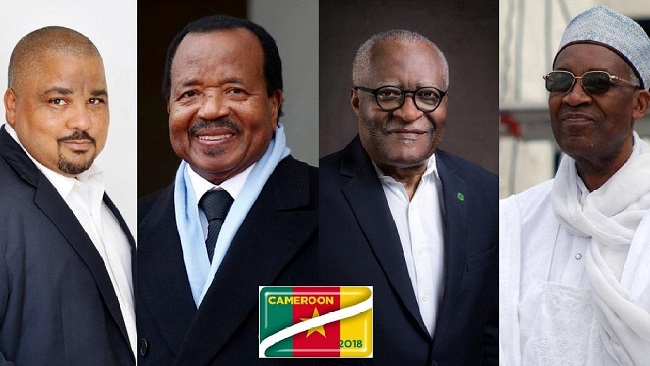
The candidate for the main opposition Social Democratic Front (SDF) party Joshua Osih is the contender carrying the torch for Ndi. Maurice Kamto is the insurgent candidate who has never before sought elected office and could benefit if the SDF struggles to mobilise its largely anglophone base in the conflict torn English-speaking regions.
Akere Muna, a renowned lawyer, benefits from strong overseas contacts and could benefit from protest votes cast against his better-known rivals.
No opposition coalition emerged ahead of campaigning for Sunday’s polls meaning that each of the eight challengers to Biya’s 35-year rule will have a herculean task to secure the numbers required to dislodge the leader known as “the Sphinx”.
As in 2011, an opposition upset victory looks highly unlikely. In that vote, Biya won 77.98% with both Washington and Paris warning that there were “numerous irregularities” in the conduct of the polls. The opposition, the Catholic church and a number of action groups have said they will deploy observers to deter and detect vote fraud.
Whoever wins at the ballot box, the victor will face immense challenges. Just 10% of working age people are in formal employment, one-third of Cameroonians live on less than $2.30 a day, and three in four people have only known Biya as their leader.
Source: News 24















3, October 2018
Cameroon: a diverse country in central Africa 0
Diverse and football-mad Cameroon is Central Africa’s biggest economy but troubled by mounting unrest in its disgruntled English-speaking regions, where there is a push to break away.
Here is some background about the mainly francophone country ahead of October 7 elections in which President Paul Biya — the second-longest serving leader in Africa — is seeking a seventh term.
– ‘Africa in miniature’ –
The Atlantic Ocean nation, which sits just above the Equator, has this nickname because its many ethnic groups and diverse geographic and climatic zones are said to make it representative of the continent.
At the end of World War I, the German protectorate of Kamerun split into French- and British-mandated regions. The French section became independent as Cameroon in 1960 and was later joined by a part of the British area, the remainder of which chose to unite with Nigeria.
The country’s name comes from that of one of its main rivers, which 15th century Portuguese explorers called the Rio dos Camaroes, or River of Prawns, and is today the Wouri.
Francophones are in a majority while anglophones represent around a fifth of its more than 23 million people.
The population is young: three-quarters were aged less than 25 in 2014, according to a census that year.
– Biya, 36 years at the top –
In 1982 Cameroon’s ailing founding president, Ahmadou Ahidjo, stepped down in favour of his prime minister, Paul Biya. Nearly 36 years later, Biya is still in the job.
Aged in his mid-80s, he has a reputation for being tightly in control behind a smooth and discreet exterior.
He was able to extend his rule via a controversial 2008 constitutional revision that did away with limits on the number of terms a president can serve.
In Africa only Equatorial Guinea’s Teodoro Obiang Nguema has been in power for longer, since 1979.
– Anglophones seek secession –
Cameroon’s English-speaking Northwest Region and Southwest Region have been in deep crisis since late 2016 as a secessionist movement pushes for independence.
It started with demonstrations, encouraged by English-speaking lawyers and teachers, to protest against perceived discrimination by the francophone majority.
Clashes between troops and separatists take place on an almost daily basis and have led to dozens of deaths and the displacement of nearly 200,000 people.
In October 2017 separatist leaders issued a symbolic declaration of independence for a new republic called “Ambazonia”.
Cameroon has also been confronted since 2009 with attacks in the far north by jihadists from Nigeria’s Boko Haram, but these have diminished over the past months.
– Economy diverse, too –
Cameroon has abundant commodities like oil, high value timber, minerals, coffee, cotton, cocoa and cassava.
It is the largest economy in the six-nation Central African Economic and Monetary Community (CEMAC).
In 2017 growth slowed to around 3.7 percent, due to the maturity of the main oil fields and to an avian flu epidemic, according to the World Bank.
It is expected to pick up in 2018 with new gasfields in operation and construction for its hosting of the 2019 Africa Cup of Nations.
Poverty is however rising, including because of rapid population growth, climbing by 12 percent between 2007 and 2014 to affect 8.1 million people, according to the World Bank.
Only one in 10 of the working population has an official job and a third of inhabitants live on less than two euros a day.
China is its biggest trading partner and foreign investor.
– Football felines –
Football is a near religion in Cameroon with the national team, Les Lions Indomptables (The Indomitable Lions), considered among the best on the continent and winning the Africa Cup of Nations five times, including in 2017.
However its hosting of the 2019 tournament is in doubt because of delays in infrastructure construction, with a final decision due in November.
AFP