
23, October 2018
CNN: Quest celebrates Kenya ahead of inaugural direct flight to US 0
Celebrated international journalist Richard Quest has shared a stunning review of Kenya’s capital city, Nairobi, describing it as ‘gorgeous, genteel and genteel’.
Quest, who hosts CNN’s signature business show, is in the country to screen the launch of the much anticipated direct flight between Kenya and the United States.
He will join passengers on the inaugural Kenya Airways flight from Nairobi to New York on October 28.

Cutting the flight time between the two countries from 22 to 15 hours, this direct flight is being touted as a game-changer for Kenya’s tourism industry.
Kenya’s tourism minister Najib Balala adds that it will have a direct impact on the Kenyan economy through job creation and facilitation of cargo shipment of Kenya’s exports such as its flowers, tea, and coffee, directly to the US market.
The United States is Kenya’s leading tourism source market with a share of 11.8 per cent as of December 2017.
Quest in Nairobi
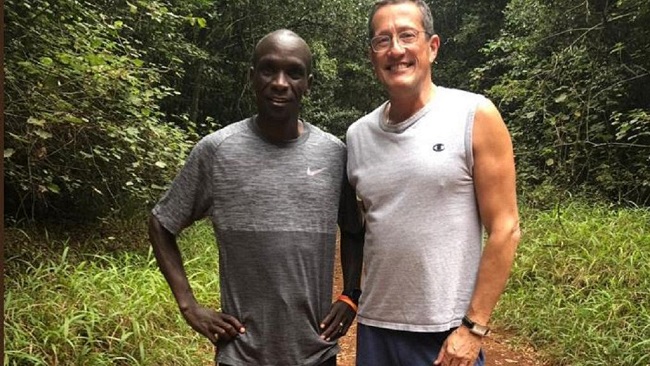
Visiting the country for th first time, Quest’s first activity was a run through Nairobi’s Karura Forest with Kenya’s top athlete, Eliud Kipchoge.
Kipchoge broke the world record in the Berlin Marathon in September this year clocking 2 hours, 01 minute and 39 seconds.
Quest was ‘more than impressed’ with the forest, describing it as a park that rivals New York’s Central Park, London’s Hyde Park, or Sydney’s botanic gardens.
‘‘We spent the afternoon in Karura Forest. If you wanted something to underscore this sense of pride you would be hard pushed to find a more pristine example,’‘ said Quest.
Karura forests, which sits on 1,000 hectares of land is one of the country’s few remaining indigenous forests.
Source: Africa News



















24, October 2018
UK: First black female history prof, Olivette Otele, has Cameroon origins 0
The United Kingdom just had its first black female history professor thanks to the Bath Spa University whose main campus is located at the Newton Park on Duchy of Cornwall land.
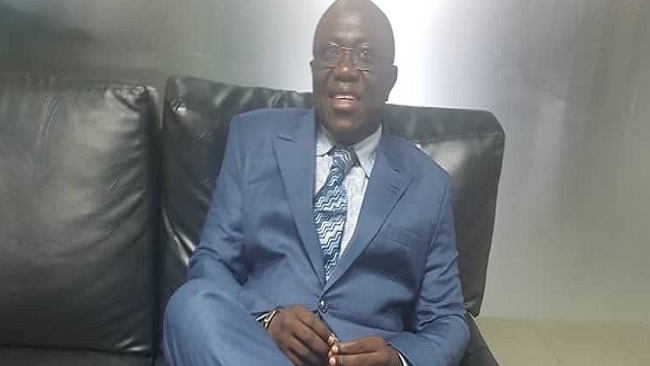
The glass ceiling breaker in this regard is historian Olivette Otele who has Cameroonian origins according to the History Today news portal. The BBC describes her as a Cameroon-born academic who schooled in France but is currently teaching in the UK.
Her Twitter bio reads: “Historian: British-French Empires-Slavery, Memory Legacies-African Diaspora (incl. North Africa).”
In announcing the big news of her professorship she wrote: “BIG NEWS: my people, @BathSpaUni has awarded me a professorship and a chair in history.
“May this open the door 2many v (to many very) hard working women, especially WoC (women of colour), even + specifically Black women, in academia in general & in History in particular. In strength, peace and love my ppl (people),” she wrote.
The university’s page on Olivette shows that she is largely a student of the famed French institution, Universite La Sorbonne, Paris where she received her first degree in Literature and History two decades ago.
She went on to do her masters in history two years later, a Master of Advanced Studies or Master of Advanced Study, DEA in 2002 and her PhD in 2005.
She currently holds professional membership of amongst others: Fellow of the Royal Historical Society (FRHistS), Executive board member, The British Society for the Eighteenth-Century Studies and Board member, Historians Against Slavery.
She has co-authored a book and has a series of publications to her credit. Her personal statement on the university’s website reads in part: “Dr Otele holds a PhD in History from Universite La Sorbonne, France. Her doctoral area of specialisation was European colonial and post-colonial History.
“It included examining questions related to the transatlantic slave trade, slave societies, identities and post-colonial societies in the Atlantic world. Her BA and MA trainings were grounded in British and American Literature and History.
“Her current research centres around transnational history and in particular the link between history, collective memory and geopolitics in relation to British and French colonial pasts.
“She charts and analyses the ways in which Britain and France have been addressing questions of citizenship, race and identity through the politics of remembrance. She also enquires into the value of public gestures, the meaning of public history and the impact of cultural memory.”
Culled from Africa News