
21, March 2023
Cameroon a dangerous place to be a journalist 0
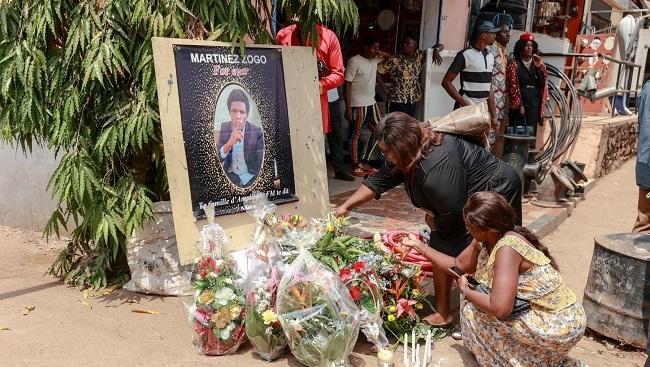
In Cameroon, one of the most popular radio talk shows is Embouteillage, aired on the private radio station Amplitude FM, whose anchor was Mbani Zogo Arsène Salomon, better known as Martinez Zogo or “Le Maestro”.
On 17 January, reports started trickling in of Zogo’s kidnapping. He was missing for five days before his naked body was discovered on the outskirts of the capital Yaoundé.
Rene Emmanuel Sadi, Cameroon’s communications minister, said Zogo’s corpse showed signs of torture. Autopsy results provided by his family show the extent of his injuries, including a broken leg and missing fingers.
Zogo had a reputation as an outspoken critic of private and public sector malfeasance. At the time of his death he was investigating business tycoon and media guru Jean Pierre Amougou Belinga.
In one of his last broadcasts, Zogo claimed to have incriminating evidence detailing how Belinga and his allies in the government had allegedly syphoned billions of CFA francs from the state’s coffers. This was not the first time that Zogo had upset powerful people. He had previously been suspended from the air and imprisoned as a result of his critical comments.
Another journalist, Samuel Wazizi, was arrested and detained in August 2019 for criticising the government’s handling of a separatist revolt in the country’s English-speaking northwest and southwest regions. He was later reported to have died in custody, but his family has yet to see his body.
“Press freedom in Cameroon is controversial,” said Charlie Aimé Tchouemou, editor-in-chief of Amplitude FM.
President Paul Biya set up a commission to investigate the murder. According to the secretary general at the presidency, Ferdinand Ngoh Ngoh, it has led to some arrests and many others are still being sought. Their identities have not been made public.
Reporters Without Borders revealed the arrests of about 20 members of Cameroon’s General Directorate for External Investigation, including its boss, Maxime Eko Eko, and its special operations director, Justin Danwe. Belinga, who owns the newspaper L’Anecdote and the TV channel Vision 4, and his wife were also arrested.
‘Killed like a pig’
Zogo’s wife Diane has written a letter to Biya and other world leaders demanding justice and protection for her family. “My husband was killed like a pig, let justice take its course.” Zogo’s family has declined to receive his body until after the killers have been arraigned in court.
For close to a month before he was killed, Zogo had become increasingly aware that his life was in peril, but had vowed to expose those “killing” the state. His sister Moungou Crespence said he “used to tell us that he will die for his people”.
Zogo’s colleagues are hopeful that because the investigations were ordered by the president, his killers will be brought to justice. But the commission has an arduous task ahead of it, amid accusations that senior government officials were complicit in the murder.
On 4 March, the state prosecutor presented to some of the suspects the charges levelled against them, and placed them in pre-trial detention in the Kondengui maximum security prison in Yaoundé. The key detainees are Maxine Eko Eko, Justin Danwe and Jean Pierre Amougou Belinga. The charges range from kidnapping and torture to complicity in kidnapping and torture, but none of them has been charged with murder.
Since Zogo’s death, Equinoxe Television, a private TV station in Cameroon, has begun its 8pm show with a tribute to him.
Source: Mail/Guardian















21, March 2023
Water turmoil in Douala casts shadow over precious resource 0
Dawn breaks in Cameroon’s economic hub, the seething metropolis of Douala, and a crowd gathers at the water spigots by the Guinness brewery in the run-down district of Bassa.
They fill up jerrycans and canisters from the only dependable local source of water — a borehole installed by the brewery itself in the absence of a reliable state supplier.
People load up car trunks, motorcycle taxi luggage racks or else balance containers on their heads.
The hole is one of a huge number of privately-owned wells which dip into the water table in this region of four million people.
But lack of regulation has led to chaos, raising questions as to whether the precious resource can be sustained or remain drinkable.
Overconsumption and pollution of the planet’s limited supplies of freshwater lie at the core of a three-day UN Water Conference opening in New York on Wednesday.
Boreholes everywhere
Cameroon’s water problems are clearly big, according to anecdotal evidence, but there are few figures to give statistical depth.
The government says the public water utility Camwater serves a “majority” of households — but does not offer figures, or even an estimate.
Not far from Bassa, in the PK12 district, two machines are hammering away on a corner of land wedged between buildings, making the ground shake.
Boring into the ground to reach the aquifer requires copious amounts of lubricant, in the form of water pumped in by teams at the surface and a chemical additive called Polyfor.
Care has to be taken to avoid polluting the supply, said Serge Diffo, who runs the small drilling company, Hydyam.
But, he said, “you see septic tanks right next to boreholes in residential blocks.”
Wells drilled for individual use do not need any prior authorisation, a practice that verges on heresy in typical urban planning.
Hygiene fear
“Every person, in line with what he can afford, simply drills one or more wells without bothering to pay attention to anyone,” said Firmin Bon, a professor of hydrology at Maroua University.
A borehole typically costs at least a million CFA francs (around $1,600) in a country where the minimum wage is 36,000 francs.
“The density can come close to 100 boreholes per square kilometre (250 per square mile),” said Bon.
“They are sometimes in contact with sources of pollution, latrines and sewage.”
He predicted, at best, a rise in cases of gastroenteritis or, at worst, cholera — and, in the long term, cancer.
In the nearby but better-off valley of Logbessou, villas are fitted out as far as the eye can see with water tanks in the form of massive but unsightly black, grey or blue plastic water butts which store water from boreholes.
A study published by the Pan African Medical Journal found that in 2018, two-thirds of households in Doula’s fifth district were consuming water drawn from boreholes. Half of the households were more than a 15-minute walk from a source.
The country’s deputy minister for water, Hamadou Youssoufa, described the situation in Douala as “a concern,” and blamed it on runaway urban development and a population explosion.
He said the ministry was carrying out a study into the hygiene of the boreholes, which “will be useful for requiring consumers to uphold the standards.”
Skepticism
President Paul Biya, Cameroon’s iron-fisted ruler for the past four decades, acknowledged in his New Year’s address that the water problem in Douala was one of his “main concerns.”
He said the government had been asked to launch a “mega-project” this year to supply drinking water to the city and its environs.
But Francois Songue, a 75-year-old pensioner, has grown tired of such promises over the years.
“In my part of town you have to wait for water from Camwater until two in the morning — and it doesn’t come!
“I’ve travelled more than 10 kilometres here to get drinking water for my wife, my children and myself,” he said as he stood in line at the Guinness site.
Jodelle Foguem, a young housewife, said she trusted the water that came from the brewery’s taps.
“The water is not drinkable in our parts of town. We prefer to come and get it here,” she said.
Source: AFP