
28, December 2021
Yaounde: Military Tribunal jails 47 opposition activists for ‘rebellion’ 0
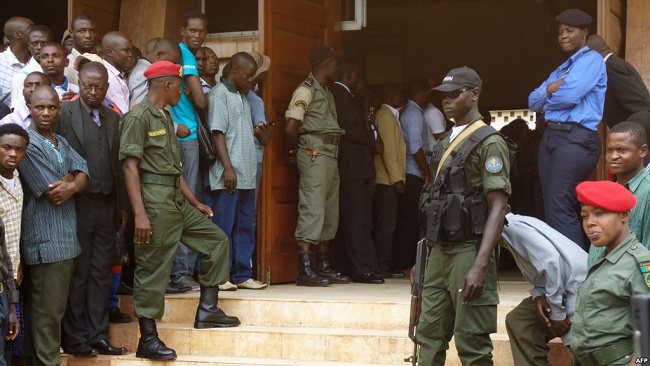
A military tribunal in Cameroon has jailed dozens of opposition supporters for terms of up to seven years for “rebellion”, their party’s deputy secretary-general said Monday.
The 47 defendants were arrested in September 2020 as Maurice Kamto’s Movement for the Rebirth of Cameroon and several other parties planned protests against the government of Paul Biya, in power for nearly 40 years in the central African country.
Police dispersed hundreds of protesters in the economic capital Douala and made more than 500 arrests across the country. Of those, 124 remain in detention, according to the MRC.
The military tribunal in the capital Yaounde sentenced 47 activists, with Kamto’s spokesman Olivier Bibou Nissack and the party’s treasurer Alain Fogue getting seven-year terms, Roger Noah told AFP.
The rest were given terms of between one and five years, he said.
The charges included “rebellion” and “attempted insurrection”, according to MRC vice president Emmanuel Simh.
In September, a group of around 50 lawyers said they would not mount a defence for around 100 detained opposition members, denouncing what they described as the arbitrary and illegal nature of their detention.
Kamto — runner-up to Biya in a 2018 presidential election — was imprisoned in January 2019 following a march protesting the vote during which he presented himself as “president-elect”.
Following international pressure, Biya ordered him freed nine months.
The government has said that those held since September 2020 face charges of “attempted insurrection” or “revolution”.nSome have already been convicted.
Two months after their arrest, Amnesty International accused the Biya government of “relentless repression of opposition” members characterised by “arbitrary arrests and detentions”.
Source: AFP












28, December 2021
Ambazonia Crisis: Doctors Without Borders clarifies incident in transporting wounded patient in Manyu 0
On Saturday, 25 December, the emergency call centre of the humanitarian medical organisation Doctors Without Borders/Médecins Sans Frontières (MSF) received a call related to a wounded person in need of urgent assistance in the Tinto health area. One of our ambulances managed to pick the patient up the next morning at Ashum area. Given his severe condition, he had to be transferred to Mutengene via Kumba for surgical attention.
As agreed and regularly done, MSF had contacted the local military authorities beforehand, informed them about the transfer of a wounded patient to Mutengene and shared the patient’s age and gender as requested. The ambulance was however stopped by Cameroonian security forces at the Nguti check point and forced to return to Mamfe, where the patient had to be treated and stabilised.
Since then, to avoid further incidents with our ambulances, we have been in touch with the authorities to understand the reason for the miscommunication with this reference.
Regarding this incident and the allegations published in some media, MSF reminds all relevant parties that:
1. In our work in Cameroon, and elsewhere in the world, MSF treats people based on medical need, regardless of their background or affiliations. This impartial and neutral medical humanitarian work is notably protected by the Geneva Conventions, which specify that persons taking no active part in the hostilities, including members of armed forces who have laid down their arms and those placed hors de combat by sickness, wounds, detention, or any other cause, shall in all circumstances be treated humanely, without any adverse distinction founded on race, colour, religion or faith, sex, birth or wealth, or any other similar criteria.
2. Hindering and obstructing our work puts patients’ lives at risk.
3. Allegations of complicity with any actor in a conflict puts patients and MSF staff in grave and immediate danger.
4. We appeal to everyone to be responsible in their statements and publications relating to our humanitarian action in the country. In an already very sensitive context, the spread of information that damages our reputation as a neutral, impartial and independent humanitarian organisation puts the lives of our teams and patients in danger.