
28, August 2020
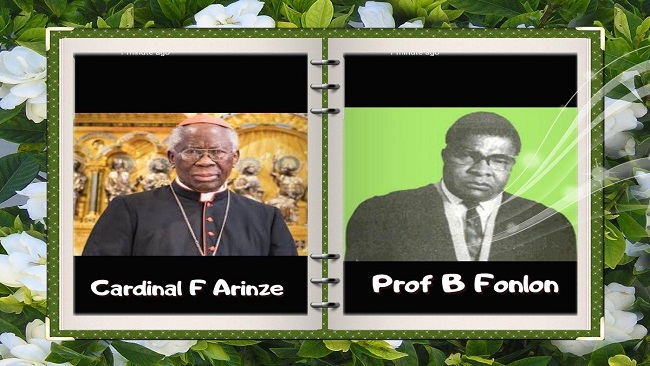
Cardinal Arinze says cause of beatification of Dr. Bernard Nsokika Fonlon could be introduced 0
UNFORGOTTEN
I hold Dr. Bernard Nsokika FONLON in very high regard.
I first got to know him in Bigard Memorial Seminary, Enugu, Nigeria, in the years 1953 and 1954. He was in second year theology when I entered that Major Seminary in September 1953. When he and his classmates were due to be ordained subdeacons in December 1954, the Seminary authorities and his Bishop decided not to admit him to major orders.
As a seminarian, I saw Bernard as a learned seminarian. I still remember how with lustre he sang “Audi Benigne Conditor” during Vespers in Lent. He took no breakfast. When other seminarians were at breakfast, he was studying, we believed he was at Latin and Greek!
During holidays and in the years after he had to leave Bigard Memorial Seminary, he used to visit one of the Nigerian priests, Monsignor Peter Meze-Idigo who was very kind to him, as he also was to seminarians in general. Once during those visits by Fonlon to Monsignor Meze at Dunukofia, my parish, I took Bernard to visit my parents at Eziowelle and my father, a good wine tapper, gave him good palm wine which he took gladly. I still remember that my mother tried to converse with him in Igbo and was surprised that Fonlon did not know how to speak Igbo. I had to inform my innocent mother that Igbo is not the only language spoken in Africa!
I lost track of Fonlon in the years when he worked for a Doctorate in Ireland and another Doctorate in France. The next time I met him was during the Nigeria-Biafra war, probably in 1968 or 1969. It was a quick meeting because we were both passengers in Air France flying to Paris from Douala. At that time, Dr Fonlon was Minister of Communications in the Camerun and I was Archbishop of Onitsha.
After that Nigerian civil war, I visited Dr Fonlon in Yaounde. It may have been around the year 1972. I first visited Archbishop Paul Verdzekov in Bamenda. Then I flew from Buea to Yaounde. Fonlon met me at the airport. I stayed about two days with him. I then learned that he was no longer Minister in the Government because President Ahidjo called him and explained: Bernad, I regret that we can no longer retain you in the cabinet because you put the rest of us ministers to shame, because you are your own driver and you drive an old car.
My unforgettable memory of my stay with Fonlon in his flat was that one day his sister prepared a fou-fou lunch for both of us. During lunch, Dr. Fonlon was so absorbed in our conversation (which was more me listening to his wisdom) that I finished my lunch; he then put together his fork and knife, put his plate aside and continued his learned discourse. He forgot that he had not eaten anything yet! I have never in my life of 87 years reached that level of detachment from creatures.
Dr Bernard Nsokika Fonlon was a man of high ideals. He prayed. He said the Latin Breviary daily. He loved the Church. He was not bitter that he was not ordained a priest. In my view, it was an administrative mistake of his superiors that he was not ordained. It seems to me that they did not understand enough. He was the type of professional intellectual who may seem not the routine parish priest. As a university priest, he could have answered many needs of the Church. However, as a lay person, he also did much good. The Camerounians are the best placed to make a judgement on this. He lived a celibate life. When I visited him in 1972, I saw that he loved the Breviary.
In my view, the Cause of Beatification of Dr. Bernard Nsokika Fonlon could be introduced. I am happy to be writing these lines on his anniversary of his death.
May he rest in the peace of Christ.
+ Francis Card. Arinze
Vatican City, 26 August, 2020.




















28, August 2020
Biya regime is not learning the governance lessons offered by Covid-19 0
One might suppose the coronavirus pandemic has given African leaders an opportunity to rethink their approach to governance. This particularly holds true for Cameroon, which appears to have suffered the brunt of the virus in Central Africa, registering close to half of all 1 025 fatalities in Central Africa as of Monday. By this same date, the country had 18 762 confirmed cases, surpassing its neighbours Chad, Congo, the Central African Republic and Gabon combined.
But with the coronavirus, the more things seem to have changed, the more they seem to have remained the same. Despite the free lessons offered by the pandemic, Cameroonian officials appear not to have learned to build on public trust to better prepare for future crises like the climate crisis, which is slowly grinding, but devastating in its effects.
For any response to a crisis of the magnitude and complexity of the coronavirus to succeed, it will largely depend on the contribution and collaboration of the masses. President Paul Biya, 87, presumably understands this, which is why, when he managed to address his compatriots on the coronavirus for the first time on May 19, he called on them to remain united, supportive and disciplined.
“I, therefore, call on Cameroonians to have trust in public authorities,” Biya said. But Biya himself has not earned the trust he is requiring of citizens; because of that, the country’s citizens have not made “a lot of effort” to fight Covid-19, as he implored them to.
As part of measures to contain the coronavirus in Cameroon, the government made the wearing of face masks in public mandatory; limited gatherings to 50 people; and closed all land, air and sea borders. But the president has, on several occasions, appeared in public without a mask. Other public authorities, such as MPs, have flouted the restriction on gatherings, and the country’s airspace was opened to Air France to run commercial passenger flights from France — a high-risk country at the time.
Such behaviour by public authorities during a pandemic nips public trust in the bud. It means people are less likely to trust the same public officials asking them to make sacrifices by giving up certain rights and privileges for the sake of the nation.
It is, therefore, not surprising to see Cameroonians ignoring the preventive measures put in place by public authorities. Many citizens have become carefree. They no longer put on face masks in public, nor observe the hygiene and physical distancing measures set out by the government. The outcome is that the contagion keeps rising and there are no indications when the curve will flatten. Manaouda Malachie, the minister of public health, recently warned of a second wave of the coronavirus in the country if strong action is not taken.
In future, this lack of public trust is going to frustrate responses to potential crises, should the tide not be reversed. People who mistrust their leaders in ordinary times can’t trust them one bit in extraordinary times.
In addition, the government has not been proactive in shining a light on the management of resources contributed by the public to help fight the coronavirus, putting its transparency in handling the pandemic in question.
In July, some citizens took to social media to question the whereabouts of about 4 000 bags of rice that had been donated in March by Orca, a home goods retail store. It was only then that the minister of public health communicated information about the donation. Yet the minister only shifted the burden of clarification from himself to the 10 regional governors: he said the bags of rice had been dispatched to the regions for further distribution. How or whether the bags of rice got to the intended beneficiaries is still unclear.
The health minister also offered an explanation of how about 21-billion CFA francs ($38-million) of funds designated for the Covid-19 response had been spent only a few days after an opposition MP raised an alarm over suspicions of corruption. Jean-Michel Nintcheu of the Social Democratic Front had expressed concerns that the money — contributed by the public through a national solidarity fund — had been subject to corruption, citing overbilling and conflicts of interests within the public health ministry and among its officials.
Cameroon has a longstanding problem of corruption. It has emerged as the world’s most-corrupt country on two occasions, according to Transparency International’s Corruption Perception Index. Systematic corruption continues to be a problem. It would have, therefore, been surprising if the coronavirus didn’t come up against the all-pervasive corruption in the country.
The public health minister created a commission to investigate corruption in relation to the Covid-19 response, even though several anti-graft structures already exist in the country. But this doesn’t translate to a serious intent to fight corruption when a lack of transparency in the management of public funds leaves a perception of corruption in the minds of the people.
Giving room to citizens to perceive corruption in the response to a pandemic is exactly how not to handle a crisis. It will certainly affect future handling of crises. It is apparent that there is no one to compel these public officials to be transparent at all stages in their management of the current crisis — and their own consciences don’t appear to be sufficient.
Culled from mg.co.za