

14, November 2019
The cry of Southern Cameroonians 0
Before Cameroon gained political independence from France and Britain in 1960 and 1961 respectively, it was governed as two separate entities by the erstwhile colonial masters. When the Anglophone Cameroon gained independence in 1961, there was a referendum that was conducted to determine whether it was to remain with Nigeria where it had been before independence or to join the Francophone Cameroon. We recall that the second broad spread political party in Nigeria was named the National Council for Nigeria and the Cameroons before its renaming to the National Council for Nigerian Citizens. The Anglophone speaking Cameroon opted not to remain with Nigeria and instead joined their francophone brothers.
The country became bilingual as a result of the newly found amalgamation and a regional form of government was adopted by then Presidency of Ahmadou Ahidjo to cater to the diverse interests of the different territorial regions. Regionalism was necessary in view of the fact that the Francophone speaking part of the country had much more territories and a population advantage and so it was imperative to protect the yearnings and aspirations of the minority Anglophone speaking part.
This initial arrangement worked well under Ahidjo as there was relative peace in the country. The cracks started when the present Paul Biya came to power in 1982 after Ahidjo’s sudden resignation which was not in the character of the typical sit tight African leader.
Biya, a brutal dictator who has ruled the country with a tight fist for over thirty-seven years ensured that power was centralized and there was an imposition of the francophone way of life on the Anglophone. The legal system, education and all other facets of life bore a francophone colouration.
Politicians and activists from the Anglophone Cameroon fiercely fought back and ensured that the constitutional amendment in 1996 provided for a decentralization of the government. This was all on paper as Biya continued with his unitary style system of government.
Things got to a head in 2016 when a separatist Anglophone movement was formed which led to secessionist agitations for the creation of an independent state of Ambazonia. Sorrow, tears and blood freely flowed as thousands were brutally hacked to death by the francophone government forces with millions internally displaced which saw many of them flee from the country.
On September 10 this year, President Biya started a national dialogue with the aim of permanently resolving the lingering crisis. He went ahead to appoint English speaking Joseph Dion Ngute as the country’s Prime Minister in a bid to pacify the Anglophone speakers who make up about one fifth of the total population. This move sadly backfired as most Anglophones do not trust Ngute whom they view as elitist and aloof as he has never really identified with their plight. He is seen as a Francophone stooge who will only do the bidding of his masters in Yaounde.
Human rights attorney Felix Agbor Balla, one of the masterminds of the 2016 protests, told DW, “there must be possibilities of a federal state: “The crisis began with the demand for decentralization. Without talking about the state, we will not find a solution.”
Presbyterian cleric Samuel Fonki, one of the mediators in the crisis, criticizes the government for ignoring the conflict for too long. “Now, after pressure from outside, they want to show the world that they are doing something: ‘Look, we’re making dialogue.’ As if to underscore what a minister said behind closed doors about the “big show.” A gala is planned for the last day of the dialogue. Fonki, however, is certain: “If there are no external observers, the facts will not come to the table.” But the said minister refuses: No, one only wants to speak from brother to brother, without interference from outside.
Whether and how the “Ambazonians” will be represented remains unclear: the government has sent invitations to separatist leaders abroad. But many reject the dialogue they dubbed “Biyalog”, which they say is a “waste of time and taxpayers’ money,” as separatist leader Mark Bareta wrote on his Facebook page. He went on to say that the government knew what the Anglophones wanted, so no one needed to come to Cameroon extra.
The crisis may get further exacerbated with the controversial re-election of Biya which may lead the protesters to go back to the trenches.
The bloodshed is too much and it must stop if the country is to make any meaningful progress. There is the need for the Biya led government to include trusted Anglophone leaders who genuinely represent the interests of their people rather than the government allies among the Anglophones. The demands of the Anglophone protesters especially that of regionalism, decentralization and greater devolution of powers must be met by the central government for lasting peace to reign.
This peace protest must be autochthonous and devoid of any form of interference from Paris. It is high time African leaders solve their internal problems with home grown solutions rather than permanently outsourcing their thinking caps to the uncaring west who will only give them mere placebos at best.
Source: The Nigerian Voice















14, November 2019
Biya has recipe for ethnic cleansing of Southern Cameroonians 0
For 37 years, the French Cameroun head of state Paul Biya has demonstrated that his CPDM regime has a long-term plan for the ethnic cleansing of the people of Southern Cameroonians.
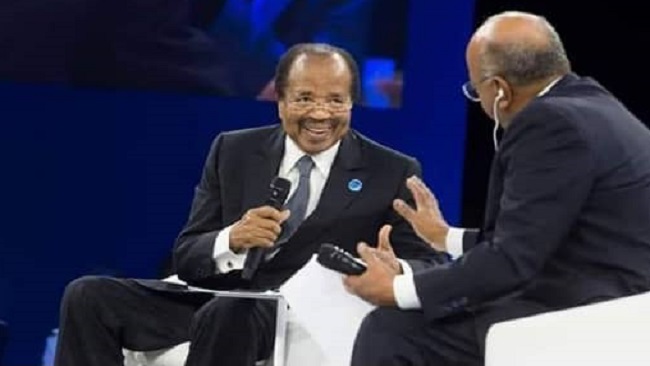
A Southern Cameroonian commenting on Mr Biya’s recent outing in France opined that during the Conference, Biya said German Kamerun was his country that was divided into the British and French trusteeships.
The 86 year old dictator furthered that he has tried to assimilate and dissolve the English 20% into the French 80% but failed and wants to give a special status to the English 20%, but keep them within one country.
It is based on this claim to German Kamerun being Biya’s country, that Southern Cameroonians think, the French Cameroun leader believes he has a duty to kill Ambazonians to force them to belong to his vision of a one and indivisible Cameroun.
Southern Cameroons political analyst Denis Atemnkeng observed that Biya’s take on the crisis in Ambazonia is the most outrageous and dangerous statement from a man sitting in a peace conference.
A cream of Ambazonia political elites in the United Kingdom observed on Wednesday in London that the French Cameroun regime backed by France is moving toward a greater plan which is a kind of scorch-the-earth policy.
Troops loyal to the Biya regime in Yaoundé have burnt down more than 280 Southern Cameroons villages with Biya claiming that the soldiers were fighting Ambazonia separatists operating in those areas.
An estimated 20,000 Southern Cameroonians have been killed, over 120,000 are seeking refuge in Nigeria and, over 1million people are internally displaced or living in bushes and over 3,000 persons incarcerated in prisons and detention facilities. It is also reported that over 4.5. Million people are at risk of famine. This is indeed a recipe for endless war and the ethnic cleansing of Southern Cameroons.
Biya’s special status plan for Ambazonians is pushing the two Cameroons towards endless crisis; and if true, the least the international community can do is to respond to this by saying no and support the Ambazonia nation.
By Soter Tarh Agbaw-Ebai