19, February 2024
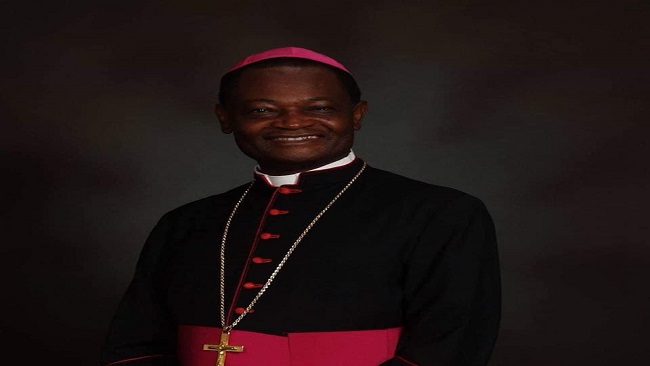
Southern Cameroons Crisis: Bishop George Nkuo says God is ‘close to the broken–hearted’ 0
In a heartfelt homily on Sunday, Bishop George Nkuo of Kumbo in Cameroon reminded the faithful of God’s constant presence and care in times of trouble amid a new spat of violence.
He urged all parties to renounce violence and seek peace in the Anglophone regions of Cameroon, where a secessionist uprising has claimed thousands of lives and displaced millions since 2017.
“No more bloodshed in our land. No more violence in our land. No more hatred in our land,” the bishop said.
His message on February 18 came in the wake of attacks on February 11, Cameroon’s National Youth Day. Suspected separatists carried out these attacks on students in Nkambe, leaving one student dead and over 40 wounded.
They detonated an improvised explosive device as students marched past, killing 14-year-old Cherish and injuring several others. Armed men, also suspected to be separatists, marched into a Catholic Church in Jakiri, in the Kumbo Diocese. They ordered Christians out of Mass, accusing them of using a church service to celebrate Youth Day.
February 11 is celebrated in Cameroon as a Youth Day. However, historically it is the day Cameroon’s Anglophones – the part of Cameroon initially administered by the British before independence – voted in a 1961 plebiscite to gain independence by joining the already independent Republic of Cameroon, which is the part of the country initially administered by the French. The two entities then formed a Federal Republic of Cameroon, which only lasted for a decade.
The federal system was dissolved in favor of a unitary state. The Anglophone minority has long felt marginalized and subjugated by the Francophone-dominated administration in Yaoundé. Therefore, Feb. 11 has been a date that separatists love to hate. As one separatist put it, it was the day Anglophones were “packaged, sold and delivered.”
Impeding the celebration of that day in Cameroon’s English-speaking regions is part of a larger strategy for separatists to undermine state sovereignty as they seek separation from the country and the creation of a new state called Ambazonia. The fighting, now in its seventh year, has resulted in the loss of at least 6,000 lives, according to the International Crisis Group. Over a million people have been forced to flee from their homes.
Nkuo said that despite the escalating violence, God remains a permanent presence in the lives of the people.
“God is close to His people, He is close to the broken-hearted especially in times of difficulty,” the bishop said.
“We worship a God who is close to those who are weak. We worship a God of Peace, a God who does not tolerate any form of violence, a God who has called us to have deep respect for the dignity of every human person. It is a God who has ‘conquered every form of darkness with the light of the risen Christ,” he said.
Lemnyuy Cherish Bongeh, the lone-girl killed in the Nkambe blast, had initially escaped fighting in her native Kumbo to the economic capital Douala, where she continued schooling. However, her father preferred that she return and relocate to the relatively peaceful Nkambe. The Feb. 11 attack would shatter that peace.
“What has happened cuts a deep wound into my heart,” Cherish’s father said, asking that his name not be used.
The murdered girl’s classmate gave one of the bidding prayers, painting a gory picture of what has been going on in the two English-speaking regions.
“Merciful Lord, for over seven years now, we have known no peace. The blood of the innocent, especially young people, has been shed in many places in our country. You are our only hope. Hear our prayer and grant us peace,” the student said.
“Show compassion to the people of Nkambe in their sorrow,” Nkuo said.
In a February 14 statement, the bishop condemned “in the strongest terms” the Youth Day attacks.
“We strongly condemn and denounce any form of violence perpetrated during public and spiritual gatherings and within the sacred spaces of Churches and Hospitals,” Nkuo said. “We condemn in the strongest terms this heinous and senseless attack on innocent civilians during the Youth Day celebration in Nkambe.”
The bishop said the violence meted out on innocent civilians “shatters the very core of our moral fabric and calls for our collective condemnation.”
He said disrupting a Eucharistic celebration “not only violates the sanctity of these institutions but also undermines the values of compassion, empathy, and respect that lie at the core of our faith.”
“The Mass is a sacred and solemn occasion where the faithful gather to worship, seek spiritual nourishment, and strengthen their relationship with God. Such disruptions not only disrespect the sanctity of the Mass but also infringe upon the rights and freedom of religious expression,” Nkuo said.
“God’s house should be a haven of peace, where all can come together in reverence and unity,” he said.
The bishop cited international humanitarian law, which makes places of worship and other religious sites “sanctuaries where worshippers feel safe to practice their faith, sanctuaries of peace, healing, and solace for all individuals seeking comfort and divine intervention.”
He called on Cameroonians to stand united “against this brutality and affirm our commitment to peace, justice, and compassion.”
“We must stand together in denouncing such atrocities and demand that every child be granted the right to live in safety, peace, and dignity,” he said.
Nkuo appealed to the warring parties to “give peace a chance” by engaging in sincere dialogue.
“Let us pray for the victims and their loved ones, offering solace, support, and strength during this difficult time,” the bishop said.
Source: Crux










28, March 2024
South Africa: Jacob Zuma barred from running in May general election 0
Former President Jacob Zuma has been barred from running in South Africa’s general election in May.
The country’s electoral commission, or IEC, has not given a reason.
However, his 2021 conviction, and jailing, for contempt of court would appear to disqualify him.
His backing of the new uMkhonto we Sizwe (MK) party has been seen as a possible threat to the governing African National Congress (ANC), which has suspended Mr Zuma.
The 81-year-old served as president from 2009 until 2018, when he had to step down because of corruption allegations.
Mr Zuma’s new party is named after the ANC’s former military wing, and he sees himself as the true heir to the governing party’s revolutionary roots.
The ANC had wanted South Africa’s electoral body to deregister MK but this request was rejected on Tuesday.
Mr Zuma has been leading the MK party’s campaign and was the first name on their candidate list, but the electoral commission received objections to him potentially becoming a member of the National Assembly.
Rather than voting directly for a president, South Africans elect members of the National Assembly. The head of whichever party gains a majority then becomes the country’s leader.
“In the case of former President Zuma, yes, we did receive an objection, which has been upheld,” said electoral commission head Mosotho Moepya on Thursday.
“The party that has nominated him has been informed,” Mr Moepya told journalists.
Mr Zuma has until 2 April to appeal against the decision.
The former president received a 15-month prison sentence in 2021 for contempt of court and the constitution says anyone who has had a prison sentence of longer than 12 months is not eligible to run for election.
Mr Zuma is also facing charges of corruption over a multi-billion dollar arms deal from the 1990s, when he was vice-president.
The IEC said that the ruling did not prevent the MK party from taking part in the 29 May poll, News24 reports.
For the first time since the start of the democratic era in 1994, the ANC’s vote share could fall below 50%, according to several opinion polls. The MK party is seen as popular in Mr Zuma’s home region of KwaZulu-Natal.
Source: BBC