9, June 2024
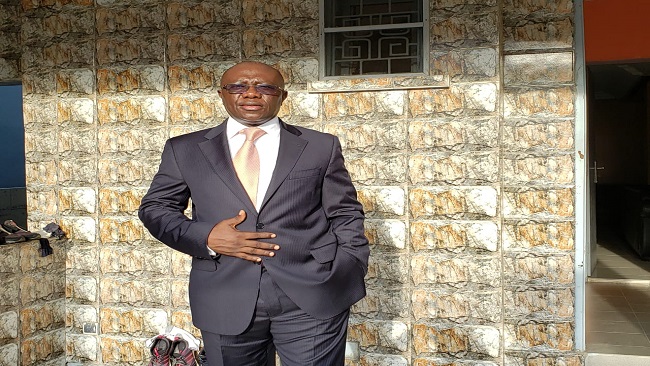
Exclusive: Dr Joachim Arrey speaks of Biya, Manyu politics and Cameroon in 2025 0
“Manyu needs a new generation of politicians if it must be relevant in Cameroon’s new political landscape as elections approach. Our past politicians like Samson Georges, Emmanuel Tabi Egbe, Michael Kima Tabong, W.N.O Effiom etc. were men of unparalleled integrity and wisdom. They inspired many of us in more ways than one and young people of Manyu descent should be engaging in politics to make Manyu great again,” says Dr. Joachim Arrey of the Global Think Tank for Africa.
Cameroon Concord News: It is always a pleasure talking with you. I have been reading your articles on many sites and you have been writing a lot about 2025 which is an important year in Cameroon’s political history. There will be presidential, parliamentary, senatorial and municipal elections in 2025 and many people around the world are hoping for the best for Cameroon. In which direction do you think these elections will take the country?
Dr Joachim Arrey: Thanks for granting me the opportunity to share my thoughts with you on what is happening in Cameroon. Cameroon is an important country in the Central African region and what happens in Cameroon could have a huge impact on the other Central African countries. That is why there is a lot of interest in what is playing out in the country. 2025 will really be a crucial year. There will be presidential elections and many people are wondering if the country’s current president will still be a candidate given his age. He is almost 92 and the burden of responsibility as well as the passage of time has taken a toll on him and his health. Very few people of his age are in good health and carrying such a burden again for the next seven years and given his current health may not be good for the country.
If I were to advise him, I would urge him to take a deserved rest. After 42 years as a president, it is obvious that he is tired. He should stop thinking that he is indispensable. Cemeteries around the world are full of people who once thought they were indispensable. I have seen him in public a couple of times, especially in the last couple of years, and I can say without fear of contradiction that he is not the vibrant person I knew when he came to office in 1982. Aging is a natural process, and it is the way of every flesh, and it is necessary for him to leave the stage when the ovation is still loud. At his age, there is no way he can be actively involved in the country’s economic and political efforts, and he cannot be abreast of what is happening around the world, especially as technological advancement has triggered significant transformations in the way young people think. Young people make up about 70% of the country’s population and engineering the type of economic and political transformation that will trigger change to meet the needs of this young population cannot be an old man’s job. Changing demographics must also imply a change in leadership.
For parliamentary and senatorial elections, they are as important as the presidential elections. The ruling party will have to work hard to keep its majority in both chambers, and this will require injecting new blood and people of integrity into the party. The CPDM has a tough battle on its hands, and old tricks might not deliver the results they have always had. The country is now like a keg of gun powder and any mistake could cause the country to go up in smoke. Cameroonians are angry and only new and reassuring faces can calm down our young people whose frustration is already reaching boiling point. Many young Cameroonians hold that the ruling party, the CPDM, is to blame for their problems, especially unemployment which is sucking life out of them. It will be important for the ruling party just like the opposition parties, to incorporate young, dynamic and politically conscious men and women into their political plans. Young people should be the leaders of our country and not old people whose future is clearly behind them. I would like to use this opportunity to urge young Cameroonians to engage in politics. As their grandfathers exit the stage due to old age and death, they should be ready to take over the mantle of leadership. However, they must understand that nobody grants you power on a platter of gold. Joining a political party very early in life will help our young men and women to learn the ropes.
Cameroon Concord News: Would you like to run for any of these positions in your native Manyu as you are urging dynamic and politically conscious people to engage in politics?
Dr Joachim Arrey: I am a bona fide Manyu son who has proven that he loves his people through my humanitarian actions. I am driven by a passion to make Cameroon a better place than I met it. Our people in Manyu Division are suffering and they are looking for people with fresh ideas to lead them both economically and politically down a different path. The Division needs new leaders who can take it down a different and prosperous path. Our people are intelligent, but they have been strapped to poverty for decades because they do not have the right people to teach them how to activate the code of financial success that is embedded in their minds. This is an area that is of interest to me. Manyu needs to create its own millionaires, and this is a job I would like to undertake sometime in my life. Money is the easiest thing to get but it takes Soviet-style discipline and the right mindset to keep it. Discipline and not desire determines our destiny. Our people must be taught how to sacrifice the present to build that bright future they are all hankering after for themselves and their children. They must shed their cargo-cult mentality if they must see the hope on the horizon. Financial success is a dividend of sweat and sacrifice, and fortune only favors the brave. This is the message I want to deliver to my people. Someone needs to bring this secret wisdom to our people to help them out of their grinding and humiliating poverty.
Regarding politics, Manyu needs a new generation of politicians if it must be relevant in Cameroon’s new political landscape as elections approach. Our past politicians like Samson Georges, Emmanuel Tabi Egbe, Michael Kima Tabong, W.N.O Effiom etc. were men of unparalleled integrity and wisdom. They inspired many of us in more ways than one and young people of Manyu descent should be engaging in politics to make Manyu great again. They can belong to any party of their choice, but they must know that Manyu development is the reason for their political engagement. As you know, many Cameroonians keep on complaining about the political decay in their country, but very few are thinking of throwing their hats into the ring. I don’t want to be part of that crowd which complains and does not take any action. Man is by nature a political animal. Like Plato, I hold that one of the penalties of refusing to participate in politics is that you end up being governed by your inferiors. I am inching closer to retirement, and it is becoming obvious that my political input in Cameroon’s political debate is important. I am weighing my options, and I will see where I will be more effective if I throw my hat into the ring. It is always good to look before you leap.
However, be advised that Manyu has many young men who can play key roles in Cameroon’s politics. Many may not show any interest in politics due to their financial circumstances. Poverty has a way of caging people in silence, and this may be why many of our young men are distancing themselves from politics. I do not have such a problem. If I opt to join politics, it will not be because of money. I have already had more than my fair share of life. I have already worked for decades both in Cameroon and abroad and being an international civil servant and an investor, I think politics is not a good place for me to seek wealth. I know where and how to make money.
Cameroon Concord News: But many Cameroonians hold that the Cameroon political landscape is replete with tensions and unnecessary headaches. Do you think you can cope in such an environment?
Dr Joachim Arrey: Mr. Editor, I was born with fire in my stomach, and I grew up in a blast furnace. I am blessed with the determination of a honey-badger, and I am endowed with a very strong coping mechanism which has stood the test of time. I never throw in the towel, and I never lose my focus. My dad of blessed memory taught me how to cope in tough situations and despite my age, I still have a stomach for a fight. Age and wisdom are on my side, and they are key tools which have enabled me to navigate even the murkiest waters on earth. However, be advised that if I must join politics, it will not be to fight but to see how we can build consensus around those issues which could be so dear to the minds of our fellow Cameroonians. Politics is not about fighting; it is about addressing those issues which are constraining the efforts of our people. It is also about leaving an enduring legacy to future generations and there is no legacy greater than honesty, especially political honesty. If politics is considered a fight, then it should be a fight to bring the greatest happiness to the greatest number, if not, those in the political arena are clearly fighting the wrong fight. Such politicians have a hidden agenda which is predicated upon financial gain. Politics was never designed for anybody to be rich. Politics is service to the people. Anybody in politics who wants to be rich is not in the right place. The business sector is where rich people are made. Similarly, politics requires a lot of flexibility and sometimes you must yield to the will of the majority. When that happens, it must not be seen as a weakness or an act of betrayal. I have learned over the years, and I hold that I should put that sound knowledge to the service of my beloved Cameroon. We cannot all be on the sidelines, hoping that a miracle will one day happen for our country to make giant strides forward.
Cameroon Concord News: If you make up your mind to jump into the fray, will you join the opposition or the ruling party?
Dr Joachim Arrey: There are many political parties in Cameroon and the one that will require new and innovative ideas will be attractive. There is no political party that is bad. It is the party members who make the parties bad. The ruling party has been tagged as a party that is not working for the country and its long stay in power makes it unattractive to many Cameroonians. However, I still believe that internal revolutions do occur and there are people within that party who have the intension of making things better but the hawks in the party and regime are those who are hell bent on keeping things the way they are. If the CPDM wants to attract new and meaningful members, it must reinvent itself. It must package itself as a party which works for the people. The opposition, for its part, also needs to work hard to attract more people. The objective of every political party is to win elections and Cameroon’s opposition parties must package themselves differently. Instead of bashing Biya every day, opposition parties should tell the people how they will be different if they win elections. How do they want to put an end to the corruption that has become the country’s hallmark? How do they intend to promote human and women’s rights in a country wherein laws are not respected, and law enforcement agencies are used to adopting autocratic enforcement methods. It does not just suffice to point out that there are no roads in Cameroon. It is not enough to shout on rooftops that there is corruption in Cameroon.
Opposition parties must let the electorate know how they will do better. Coming out with a clear plan on how to check corruption will go a long way in making opposition parties more attractive. Where will opposition parties get the funds to finance their development projects. If they present a good plan to the populace, that will be music to the ears of many Cameroonians who are looking for change in the country. As a committed observer, I will try as much as I can not to characterize any party as bad. It is not because opposition parties have not been tested that they are necessarily different from the ruling CPDM. Cameroon’s opposition parties need to be given a chance but let them know that they will not get that chance on a platter of gold. They must earn it through their political agenda and how they package their messages. They must tell Cameroonians that they are different with clear evidence to support their claims. Their candidates for the elections must be people with sterling characters.
Cameroon Concord News: Thank you, Dr. Arrey, for agreeing to talk to us. Any last word?
Dr Joachim Arrey: It is always a pleasure to share my perspective with you. Cameroonians must remain hopeful. They should understand that they are the only ones who can change their destiny. They should therefore get registered for the upcoming elections and should ensure that they have their voting cards. Elections remain the most appropriate way of changing things in any country, especially in Cameroon which is really ripe for change. Though the country’s electoral laws are not the best, there is still room for meaningful change. Thanks, once more, for giving me this opportunity.
By Soter Tarh Agbaw-Ebai













21, June 2024
Armenia officially recognizes Palestinian state 0
Armenia has announced its recognition of the State of Palestine, becoming the latest country to take the measure during the ruthless Israeli ground and aerial invasion of Gaza.
“Reaffirming its commitment to international law, the principles of equality, sovereignty and peaceful coexistence of peoples, the Republic of Armenia recognizes the State of Palestine,” the Armenian Foreign Ministry said in a statement on Friday.
It deplored the catastrophic humanitarian situation in Gaza and the ongoing military invasion as one of the primary issues on the international political agenda that requires resolution.
“The Republic of Armenia categorically rejects the [Israeli] targeting of civilian infrastructures, and violence against the civilian population,” the ministry noted.
It added that Armenia earlier supported the UN General Assembly resolutions calling for an immediate ceasefire in the Gaza Strip. The statement said Yerevan is “genuinely interested in establishing long-term peace and stability” in West Asia.
Ireland, Norway and Spain have formally recognized Palestinian state, irrespective of strong opposition from Israeli authorities to the move.
The ministry emphasized that Armenia has always advocated a peaceful and comprehensive settlement of the Palestinian question on various international platforms.
Responding to Yerevan’s move, the Israeli regime’s foreign ministry summoned the Armenian envoy.
In recent weeks, Slovenia and Malta have indicated they plan to formally recognize the state of Palestine.
Last month, Spain, Ireland and Norway formally recognized the Palestinian state, joining over 140 UN member states that have recognized its statehood over the past four decades.
Source: Presstv