
26, July 2017
Anglophone Crisis: Bishops reject government’s bilingual commission 0
Bishops from Cameroon’s English-speaking regions have said a new government commission to look at the rights of the country’s English-speaking minority is not adequate to resolve what has come to be known as “the Anglophone problem.”
The National Commission for the Promotion of Bilingualism and Multi-culturalism was set up earlier in the year as part of government measures to resolve the long-standing problem of perceived marginalization of the minority Anglophones (who constitute 20% of the population) by the francophone-dominated administration.
But the bishops are saying the commission is simply fruitless. “A Commission on bilingualism and multi-culturalism cannot resolve the Anglophone Problem,” said the Bishop of Kumbo and Vice President of the National Episcopal Conference, Bishop George Nkuo. “It should have been a commission on Bilingualism and Bi-Culturalism,” he said, noting that such a commission would help protect and preserve Cameroon’s bi-cultural heritage.
Cameroon’s bilingual and bi-cultural status derived from its colonial heritage. Initially administered as a German Protectorate in 1884, Cameroon would later be shared with France and Britain as League of Nations Mandates after Germany was defeated in the First World War. The end of the Second World War and the establishment of the United Nations saw the two parts of Cameroon transition from mandated territories to UN Trust Territories.
In 1960, the northern part of Cameroon administered by France gained its independence. The southern part administered by Britain as part of Nigeria was in 1961 subject to a plebiscite in which they were offered independence by reuniting with their francophone Cameroonian “brothers” or by remaining part of Nigeria. The results showed an overwhelming desire by English-speaking Cameroonians to reunite with the French-speaking part of Cameroon.
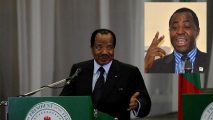
The “marriage” was guaranteed by a Federal Constitution that was ostensibly meant to preserve and protect the minority Anglophones and their colonial heritage. But in 1972 then-President Ahmadou Ahidjo organized a referendum that dissolved the federation in favor of a united republic, thereby removing the protections Anglophones enjoyed. “That marked the start of the ‘Anglophone Problem’,” said Professor Verkijika Fanso of the University of Yaoundé (Seen here on photo with CAMCORDNEWS Chairman) He said the absence of protective guarantees meant that “the values that English-speaking Cameroonians brought into the union were eroded.” Fanso said the minority Anglophones have seen their educational and legal systems systematically chipped away by the Francophone majority. 
This has recently led to popular uprisings in the two English-speaking regions. The uprisings were initially sparked by disgruntled lawyers and teachers protesting the use of French in courts using the Anglo-Saxon common law tradition (practiced in the English parts of the country) and in Anglophone schools, and it soon boiled over to the general public, with many Anglophones calling for outright secession. Bishops of the Ecclesiastical Province of Bamenda (their jurisdiction is mostly in the English-speaking parts of Cameroon) have said the problem is a result of the government’s inflexibility.
In a strongly-worded letter addressed to the President of the Republic in December, the Bamenda bishops said that the Anglophone Problem was a result of “the failure of successive governments of Cameroon, since 1961, to respect and implement the articles of the Constitution that uphold and safeguard what British Southern Cameroons brought along to the Union in 1961.” They also condemned what they called “the deliberate and systematic erosion of the West Cameroon cultural identity which the 1961 Constitution sought to preserve and protect by providing for a bi-cultural federation.
In attempts to resolve the crisis, President Paul Biya has set up a Commission for the Promotion of Bilingualism and Multiculturalism. The text creating the Commission states that the Commission shall “be responsible for submitting reports and recommendations on issues relating to the protection of bilingualism and multiculturalism to the President of the Republic and the government, monitoring the implementation of constitutional provisions establishing English and French as two official languages of equal status …, preparing and submitting to the President of the Republic draft instruments on bilingualism and multiculturalism and togetherness, receiving petitions against discriminations arising from non-compliance with the constitutional provisions on bilingualism, multiculturalism, and reporting … to the President of the Republic.”
But the Catholic bishops have dismissed the commission as a missed opportunity. “Why Common Law lawyers were striking is that their legal system was being eroded. It is the same thing with teachers, who saw the Anglo-Saxon educational system they inherited from Britain being eroded. So, the problem is not a problem of multi-cultures, because Cameroonians in their cultural and linguistic diversity have always lived together,” said Archbishop Cornelius Fontem Esua of Bamenda.
In their December letter, the bishops said: “Anglophone Cameroonians are slowly being asphyxiated as every element of their culture is systematically targeted and absorbed into the Francophone Cameroon culture and way of doing things. These include the language, the educational system, the system of administration and governance, the legal system, and a transparent democratic process where elected leaders are answerable to the electorate who put them there in the first place.”
The bishops are now calling for genuine dialogue between the government and Anglophone Cameroonians as the only way forward. But the call comes at a time when thousands of Anglophone Cameroonians are already calling for a return to a federal system of government, or even secession.
Culled from Cruxnow.com














26, July 2017
Cameroon’s forest people pay price for country’s hydropower ambitions 0
Sitting in front of his mud house in Pangar, a forest village in Cameroon’s East region, Mokuine Anatole sharpens his machete in the early morning sunlight, ready for a day’s hunting. But the planned expedition won’t take place on the land around his village, as it used to. Just 2km away, the formerly fresh air smells of gasoline, and the silence of the surrounding forest is broken by the honking and rumbling of cars and bulldozers.
The forest along the confluence of the Lom and Pangar rivers is being cleared to prepare the second phase of construction of the Lom Pangar dam, a government hydropower project that will produce 30 megawatts (MW) of electricity upon completion.
As a result, Anatole now must venture about 25km (15 miles) away from home to hunt. He and other members of similar forest communities complain that their needs are being disregarded as Cameroon’s government pushes to bring electricity to more of the country. Environmentalists are sounding alarms too.
“This hydro-dam project has made life perilous for us,” Anatole told Thomson Reuters Foundation. “The first phase of the project has brought human encroachment, destroyed our forest land and is scaring away all the animals. We are obliged to go farming and hunting far away, where we can find something to eat.”
Cameroon’s government is touting the construction of three new dams along the Sanaga River and its tributaries as a way to increase hydro-electric generation as part of the country’s ambitious plans to become an emerging economy by 2035.
The river is the country’s primary water source and already has two dams downstream from the new sites. “These (new) dams will be the biggest (electricity) generation asset of Cameroon by 2024, providing a very positive impact on Cameroon’s energy system,” said Louis Paul Motaze, the country’s minister for the economy, planning and regional development.
He spoke in Yaounde earlier this month at the signing of a financing agreement with the African Development Bank for the Nachtigal hydro dam. With the country’s economy forecast to grow by at least 5 percent annually between 2015 and 2018, Cameroon’s government says the hydro projects will ramp up power production to 3,000 MW by 2030, from a current level of 1,200 MW.
But environmental experts say the plans threaten the biodiversity of the river basin and its surrounding rich forest, as well as the survival of indigenous communities that rely on natural resources. “If all these projects take place, you would have a good chunk of the forest and wildlife in the Congo Basin disappearing,” said Manfred Epanda, the African Wildlife Foundation’s Cameroon coordinator.
In Dengdeng, another village in the East region, farmer Gregore Nvogo vented his anger at the news of the construction of more dams along the Sanaga River. “We will continue to lose our forest, our land, and our fishing opportunities,” he said. “The Lom Pangar dam has virtually submerged our forest and land for agriculture, pushing us to cultivate far away.”
Nvogo said that villagers can no longer find animals to hunt nearby, nor fish close to the village. “Where do we go now?” he asked. The farmers’ worries highlight the growing anger among forest communities at large-scale development projects that displace villagers and cause hardship.
Protests by forest communities opposed to the development of infrastructure in forest areas are likely to become more common as demand for land grows, experts say. “We have observed a surge in investment activities in forest areas with the increased presence of Chinese and other foreign business operators in Cameroon, and this is disturbing because the rights of these forest communities are constantly violated, leading to clashes,” says Bernard Njonga, coordinator of Support Service for Local Development Initiatives (SAILD), a Cameroon-based non-governmental organisation.
Activists worry that the embezzlement of funds that occurred in the first phase of the Lom Pangar project, detailed in a report published by the National Anti-Corruption Commission in 2012, will persist as more dams are built, potentially depriving communities affected by dam construction of the compensation they may be due.
Local community leaders say that it is difficult for them to monitor the projects’ impact on the forest and the indigenous population because they are not included in discussions about those issues. “Forest that used to serve as an important safety net for the poor rural community is no longer under our control,” said Paul Gbalene, the traditional chief of Djoameodjoh, one of the forest communities in the East affected by the dam projects.
However, government and development partners say that all the rights of the affected communities in the hydro dam projects will be respected. “We are conscious of the socio-economic and environment responsibilities, and the government is doing everything to address these,” economy minister Motaze said at a ceremony earlier this month to mark the beginning of construction of the second phase of the Lom Pangar dam.
Speaking at the same event, Akinwumi Adesina, president of the African Development Bank, said Cameroon was rich in energy potential which could not only help those living near the dams but also accelerate regional economic integration.
The Lom Pangar plant, being built by a Chinese company, will provide electricity to about 150,000 people living near the dam, according to Theodore Nsangou, general manager of the Electricity Development Corporation, a state-run utility. The government says the Nachtigal dam, to be constructed on the Sanaga River 65km (40 miles) from the capital, Yaoundé, will produce 420 MW of electricity, enough to satisfy a third of Cameroon’s energy needs.
However, environmentalists say it is unwise to concentrate a series of dams along the river. The 263 MW Edea and 396 MW Song Loulou dams, downstream from the newly announced projects, currently generate 95 percent of Cameroon’s electricity.
Augustine Njamnshi, of the Cameroon chapter of the Pan African Climate Justice Alliance, said that increasing Cameroon’s dependence on hydroelectric power will put the country at risk of economic breakdown if drought hits the river basin in the future.
“This will be tantamount to an economic suicide leap,” Njamnshi said. He recalled the social unrest in February 2008 triggered by persistent blackouts that provoked a wave of strikes across the country. The government said that the resulting riots led to more 17 deaths.
Njamnshi said the government would be better advised to pursue a wider range of renewable energy sources. “With an abundance of sunlight, Cameroon just needs the political will to turn its energy deficiency into energy surplus, accessible not only to the remote parts of the country but also to neighbouring countries,” he said.
Culled from DNAIndia.com