23, June 2023
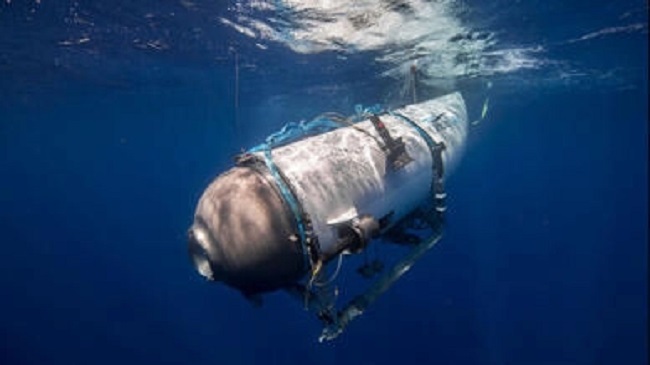
Titan craft suffered a catastrophic implosion, killing all five aboard 0
A U.S. Navy acoustic system detected an ‘anomaly’ Sunday that was likely the Titan’s fatal implosion, according to a senior military official.
The Navy went back and analyzed its acoustic data after the Titan submersible was reported missing Sunday. Coast Guard officials on Thursday announced that the craft suffered a catastrophic implosion, killing all five aboard.
That anomaly was “consistent with an implosion or explosion in the general vicinity of where the TITAN submersible was operating when communications were lost,” according to the senior Navy official.
The official spoke on condition of anonymity to discuss a sensitive acoustic detection system.
The Navy passed on the information to the Coast Guard, which continued its search.
The Wall Street Journal on Thursday first reported the Navy’s involvement.
A submersible carrying five people to the Titanic imploded near the site of the shipwreck and killed everyone on board, authorities said Thursday, bringing a tragic end to a saga that included an urgent around-the-clock search and a worldwide vigil for the missing vessel.
Coast Guard officials said during a news conference that they’ve notified the families of the crew of the Titan, which had been missing since Sunday.
The sliver of hope that remained for finding the five men alive was wiped away early Thursday, when the submersible’s 96-hour supply of oxygen was expected to run out and the Coast Guard announced that debris had been found roughly 1,600 feet (488 meters) from the Titanic in North Atlantic waters.
“This was a catastrophic implosion of the vessel,” said Rear Adm. John Mauger, of the First Coast Guard District.
OceanGate Expeditions, the company that owned and operated the submersible, said in a statement that all five people in the vessel, including CEO and pilot Stockton Rush, “have sadly been lost.”
The others on board were: two members of a prominent Pakistani family, Shahzada Dawood and his son Suleman Dawood; British adventurer Hamish Harding; and Titanic expert Paul-Henri Nargeolet.
“These men were true explorers who shared a distinct spirit of adventure, and a deep passion for exploring and protecting the world’s oceans,” OceanGate said in a statement. “We grieve the loss of life and joy they brought to everyone they knew.”
OceanGate has been chronicling the Titanic’s decay and the underwater ecosystem around it via yearly voyages since 2021.
Rescuers rushed ships, planes and other equipment to the site of the disappearance.
Authorities were hoping underwater sounds detected Tuesday and Wednesday might help narrow their search, whose coverage area had been expanded to thousands of miles — twice the size of Connecticut and in waters 2 1/2 miles (4 kilometers) deep.
But the Coast Guard indicated Thursday that the sounds were likely generated by something other than the Titan.
“There doesn’t appear to be any connection between the noises and the location (of the debris) on the seafloor,” Mauger said.
Mauger said it was too soon to say whether the implosion happened at the time of the submersible’s last communication on Sunday. But it was not detected by sonar buoys used by search crews, he said, which suggests it happened before they arrived several days ago.
“We had listening devices in the water throughout and did not hear any signs of catastrophic failure from those,” he said.
The Coast Guard will continue searching near the Titanic for more clues about what happened to the Titan. Efforts to recover the submersible and the remains of the five men who died will also continue, Mauger said.
The White House thanked the U.S. Coast Guard, along with Canadian, British and French partners who helped in the search and rescue efforts.
“Our hearts go out to the families and loved ones of those who lost their lives on the Titan. They have been through a harrowing ordeal over the past few days, and we are keeping them in our thoughts and prayers,” the statement said.
The Titan launched at 6 a.m. Sunday and was reported overdue Sunday afternoon about 435 miles (700 kilometers) south of St. John’s, Newfoundland, as it was on its way to where the Titanic sank more than a century ago. By Thursday, when the oxygen supply was expected to run out, there was little hope of finding the crew alive.
Broadcasters around the world started newscasts at the critical hour Thursday with news of the submersible. The Saudi-owned satellite channel Al Arabiya showed a clock on air counting down to their estimate of when the air could potentially run out.
‘Technology can fail’
At least 46 people successfully traveled on OceanGate’s submersible to the Titanic wreck site in 2021 and 2022, according to letters the company filed with a U.S. District Court in Norfolk, Virginia, that oversees matters involving the Titanic shipwreck. But questions about the submersible’s safety were raised by former passengers.
One of the company’s first customers likened a dive he made to the site two years ago to a suicide mission.
“Imagine a metal tube a few meters long with a sheet of metal for a floor. You can’t stand. You can’t kneel. Everyone is sitting close to or on top of each other,” said Arthur Loibl, a retired businessman and adventurer from Germany. “You can’t be claustrophobic.”
During the 2 1/2-hour descent and ascent, the lights were turned off to conserve energy, he said, with the only illumination coming from a fluorescent glow stick.
The dive was repeatedly delayed to fix a problem with the battery and the balancing weights. In total, the voyage took 10 1/2 hours.
The submersible had seven backup systems to return to the surface, including sandbags and lead pipes that drop off and an inflatable balloon.
Nicolai Roterman, a deep-sea ecologist and lecturer in marine biology at the University of Portsmouth, England, said the disappearance of the Titan highlights the dangers and unknowns of deep-sea tourism.
“Even the most reliable technology can fail, and therefore accidents will happen. With the growth in deep-sea tourism, we must expect more incidents like this.”
Source: AP

























23, June 2023
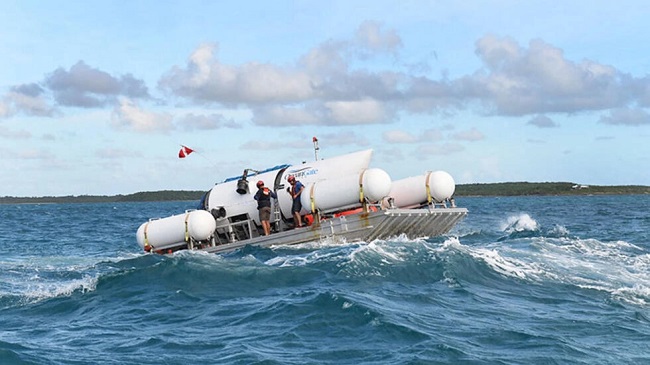
Titanic sub crew: Who were the five people on board the vessel 0
The submersible that went missing during a tourist expedition to the Titanic imploded near the wreckage, killing all five people on board, the US Coast Guard said Thursday, bringing a grim end to a massive international search for the vessel.
Among those on board the vessel was the tour operator’s boss, a French submarine operator known as “Mr Titanic”, a British aviation tycoon and a wealthy Pakistani businessman and his son.
Stockton Rush
Stockton Rush was the chief executive of OceanGate Expeditions, a company based in Washington state which operates the tourist dives and was founded in 2009.
According to his company website, Rush began his career in 1981 as the youngest jet transport rated pilot in the world, aged 19.
In 1984, Rush became a flight test engineer on the F-15 fighter jet program for the McDonnell Douglas company.
But over the last two decades, he threw himself into several ocean-related tech ventures including Seattle’s BlueView Technologies, which makes small, high-frequency sonar systems.
After a long period when trips were postponed after Rush failed to get the proper permits for the project’s support vessel, OceanGate Expeditions started taking paying customers to the Titanic’s wreck in 2021.
Paul-Henri Nargeolet
Nicknamed “Mr Titanic”, French submarine operator Paul-Henri Nargeolet was one of the vessel’s crew.
The 77-year-old, who served in the French navy for 25 years, has dived all over the world and spoken openly about the risks of his exploits in the most inaccessible waters of the world’s oceans.
Connecticut-based Nargeolet had already undertaken more than 30 dives to explore the Titanic and had supervised the recovery of around 5,500 objects, including a fragment weighing 20 tonnes that is displayed in Los Angeles.
His research produced a 2022 book where he questioned the findings of British and American enquiries into the 1912 disaster, arguing that five smaller holes were to blame rather than a 100-metre gash that followed Titanic’s collision with an iceberg.
Hamish Harding
Harding, 58, was a British aviation tycoon with three Guinness World Records and had a history of thrill-seeking adventures.
A year ago, he became a space tourist through Amazon founder Jeff Bezos’s Blue Origin company.
He founded Action Aviation, a company that buys and sells aircraft with offices in Dubai and London’s Stansted airport, with UK media reporting that the UAE-based businessman is a billionaire.
He was based in the Indian city of Bengaluru for five years, as managing director of a logistics company, before establishing Action Aviation in 2004.
His Guinness records are for longest duration and distance traversed at full ocean depth by a crewed vessel, and the fastest circumnavigation via both poles by plane.
Shahzada and Suleman Dawood
Prominent Pakistani businessman Shahzada Dawood, 48, was the vice chairman of Karachi-headquartered conglomerate Engro.
His son Suleman, 19, was a university student, and both had British citizenship.
A statement by the family-run holding group Dawood Hercules described Shahzada as a “loving father” to two children with a keen interest in “photography, especially wildlife photography, and exploring different natural habitats”.
Engro had an array of investments in energy, agriculture, petrochemicals and telecommunications. At the end of 2022, the firm announced revenue of 350 billion rupees ($1.2 billion).
Shahzada’s father Hussain Dawood is regularly listed among Pakistan’s richest men by the domestic press.
Shahzada’s profile on Engro’s website said he also serves as a trustee on the board of The Dawood Foundation – a high-profile family education charity founded in 1960.
He was educated in the United States and Britain, the profile said.
Source: AFP