22, October 2020
Nigeria: Protests escalate after deadly crackdown by security forces 0
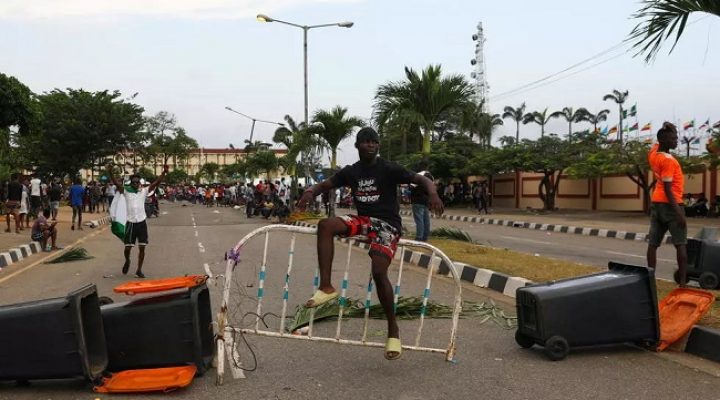
Buildings were torched in Nigeria’s biggest city Lagos on Wednesday as authorities shut down the economic hub, after the shooting of peaceful protesters by security forces caused international outrage.
At least 12 people were killed by the Nigerian army and police in two locations in Lagos on Tuesday in a deadly crackdown on demonstrations, Amnesty International said.
Peaceful protesters had gathered despite a curfew imposed to end spiralling protests over police brutality and deep-rooted social grievances.
“Evidence gathered from eyewitnesses, video footage and hospital reports confirm that between 6:45pm (1745 GMT) and 9:00pm (2000 GMT) on Tuesday 20 October, the Nigerian military opened fire on thousands of people,” Amnesty said in a statement.
The Lagos governor at first insisted no fatalities had been recorded but later said the authorities were investigating the death of one person resulting from “blunt force trauma to the head”.
He said at least 25 people were wounded.
Demonstrator Paul Sunday who was at the scene told AFP that the men who shot at the crowd were wearing masks and had army uniforms.
“They attacked us from back and front,” he said. “They came around 7pm when everywhere is dark.”
Pictures and videos showing scenes of chaos in the aftermath of the shooting were widely shared on social media.
The shooting drew international condemnation, with the UN High Commissioner for Human Rights Michelle Bachelet saying reports suggested it could have been premeditated.
“There is little doubt that this was a case of excessive use of force, resulting in unlawful killings with live ammunition, by Nigerian armed forces,” she said.
“Reports that CCTV cameras and lighting were deliberately disabled prior to the shooting are even more disturbing as, if confirmed, they suggest this deplorable attack on peaceful protestors was premeditated, planned and coordinated.”
Human Rights Watch corroborated reports that the Nigerian army had opened fire on the crowd in “a shooting spree”.
“The authorities should immediately withdraw the military from the streets,” said Anietie Ewang, a Nigeria researcher with the rights group.
The Nigerian army did not respond to AFP’s requests for comment but on Twitter it called reports of soldiers firing on protesters “fake news”.
The west African ECOWAS bloc appealed to the Nigerian government, its youth and civil society “to urgently pursue dialogue for an early and amicable resolution of this social unrest and maintain the Nigerian image as a bastion of law and order.”
Nana Akufo-Addo, chairman of ECOWAS and president of neighbouring Ghana, said in a statement that he had spoken with Nigerian President Muhammadu Buhari, who had “begun the processes that will lead to reform”.
‘Inferno’
The centre of Lagos, a sprawling city that is home to 20 million people, was largely deserted and shops were closed on Wednesday under a curfew.
An AFP journalist said several buildings were burnt around the area of the shooting and remnants of the violence—broken glass, torn banners—could be seen.
A few people were drifting around, but protest hotspot Lekki Toll Gate had emptied out, only graffiti denouncing police violence and bad governance remaining.
A dozen soldiers and heavily armed police officers patrolled nearby.
In another district a bus station was set ablaze and there were sporadic clashes between bottle-throwing youths and police, who occasionally fired into the air.
A TV station linked to one of the ruling party’s most powerful politicians was also torched.
Concerned by the escalating violence reported on Wednesday in a string of cities including Lagos, the International Committee for the Red Cross called for restraint.
“It is of paramount importance that first responders and ambulances are respected by all, so they can reach injured people safely,” said Eloi Fillion, head of the ICRC delegation in Nigeria.
In a television broadcast, Lagos state governor Babajide Sanwo-Olu ordered all “state activities” to be halted across the city for three days.
He said he had asked for a probe into “the rules of engagement employed by the men of the Nigerian army that were deployed” at the scene during the shooting on Tuesday.
“Soldiers clearly had one intention – to kill without consequences,” said Osai Ojigho, Country Director of Amnesty International Nigeria.
‘Indefinite curfew’
At least 56 people have died across the country since the protests began on October 8, with about 38 killed on Tuesday alone, according to Amnesty.
President Buhari was yet to directly address Tuesday’s incident but in a statement on the protests the presidency said he had appealed for “understanding and calm across the nation”.
A coalition of civil society organisations in Nigeria said on Wednesday that they were “deeply shocked by the killing of peaceful protesters”.
“The attempt to fight for justice over police brutality has again revealed the brutal nature of the Nigerian state,” it said in a statement.
According to the group, “not less than 40 Nigerians have lost their lives as a result of violent attempts to crack down or disrupt the ongoing protests against police brutality.”
Nigeria, where the median age is 18, is a tinderbox of profound economic and social grievances.
British Foreign Secretary Dominic Raab said on Wednesday he was “deeply concerned” by violence in Nigeria.
“The Nigerian government must urgently investigate reports of brutality at the hands of the security forces and hold those responsible to account,” he said in a statement.
Since Tuesday, Rihanna, Beyonce, Nicki Minaj, Ugandan pop star-turned politician Bobi Wine and Manchester United striker Odion Ighalo added their names to a list of celebrities who have supported the protesters.
Source: AFP
















22, October 2020
Spain becomes first EU nation to reach 1 million Covid-19 cases 0
Spain has become the first European Union nation to surpass a million coronavirus infections, official data showed Wednesday. The Mediterranean country doubled its tally in just six weeks despite the government’s fresh restrictions on public life to curb the spread of the disease.
The country recorded 16,973 confirmed cases of Covid-19 over the past 24 hours, the health ministry announced Wednesday, taking the total to 1,005,295 since its first case was diagnosed on January 31 on the remote island of La Gomera, in the Canary Islands.
Of this number, 34,366 people have died, after 156 more deaths were recorded in the previous 24 hours.
After slowing to a trickle in the wake of Spain’s strict March to June lockdown, the infection rate accelerated to frequently exceed 10,000 cases a day from late August, and hit a new peak of more than 16,000 last week.
Hurried lockdown exit
A hurried exit from confinement before tracing systems were in place let transmission get out of hand faster than in other countries, said Dr. Rafael Bengoa, co-founder of Bilbao’s Institute for Health and Strategy.
Spain, which is home to around 47 million people, is only the sixth country in the world to cross this grim milestone after the United States, India, Brazil, Russia and Argentina, according to an AFP tally based on official figures.
The new wave of contagion has been less deadly than in late March and April and the height of the health crisis, when fatalities routinely exceeded 800 per day, as the median age of new infections has dropped.
But with healthcare workers warning the spike could once again overwhelm hospitals, health minister Salvador Illa said Tuesday the government is considering several new measures, including night-time curfews such as those recently put in place in France and Belgium.
“We are facing very tough weeks ahead, winter is coming, the second wave is no longer a threat, it is a reality across Europe,” he told a news conference, adding the government was “open to everything” to contain the virus.
‘Political weapon’
The health ministry is set to meet Thursday with representatives from Spain’s powerful regional governments, who are in charge of healthcare, to update the country’s plan to respond to the pandemic.
Spain was one of the worst-affected countries when the coronavirus struck Europe early this year before one of the world’s most stringent lockdowns helped reduce the outbreak’s spread.
But infections have surged since the lockdown measures were fully removed at the end of June, with the rise blamed on the rapid return of nightlife and a lack of an efficient system to track and trace infections.
Messy disagreements between the central and regional governments, and between political parties, have also hampered the response, experts say. “The pandemic has been used as a political weapon to fight and argue with your adversaries instead of trying to find a middle ground and the best solution for everyone,” Salvador Macip, an expert in health sciences at Catalonia’s Open University who has written a book called “The Great Modern Plagues”, told AFP.
Fresh restrictions in Madrid, Catalonia, La Rioja and Navarre
As infections have picked up, Spanish regional authorities started imposing fresh restrictions.
While daily deaths have been hovering around 100 – a far cry from the peak of nearly 900 registered in late March – nationwide hospital admissions have jumped 20 percent in two weeks and 70 percent in the north-eastern region of Catalonia. That may potentially force some Barcelona hospitals to suspend non-urgent procedures
Madrid and several satellite cities have since early October been under a partial lockdown, while Catalonia has imposed a 15-day shutdown of all bars and restaurants.
The tiny wine-producing region of La Rioja joined nearby Navarre in announcing a blanket ban for all non-essential travel to and from the area.
Angela Hernandez Puente, a doctor and the deputy secretary of Madrid’s Amtys medical association, said the situation was very worrying, but not comparable with the overwhelming pressure the health system came under in March when intensive care units were full and staff lacked personal protective equipment.
‘Tired and angry health staff’
But she said the gains of Spain’s tough lockdown were wasted due a lack of preparation for a second wave of infections, citing as an example the failure to hire more doctors for public primary care centres, the first line of defence against the virus as they handle testing and tracing potential cases as well as treating the sick.
“It’s as if they thought that since infections lowered over the summer, ‘That’s it, it’s over’, when in fact it was the moment to prepare,” Hernandez Puente told AFP.
“Health care staff are tired and angry, many doctors feel that more should have been done in June, July and August to not let the public health system become overburdened as it is now,” she added.
(FRANCE 24 with AFP & REUTERS)