
3, September 2019
Cameroon’s back-to-school crisis: Stay home or risk being shot 0
The lessons at Seraphine Akwa’s house were supposed to be secret. She had been teaching at a primary school in Bamenda, in anglophone Cameroon, but repeated threats had forced the headmaster to shut the school’s doors.
The threats were from the “Amba boys”, separatists who have been fighting a two-year battle with Cameroon’s francophone government to break off and form their own state, Ambazonia. They enforced a school boycott to protest against educational injustices against English-speakers.
Thousands of schools were closed. Many were burned and now lie in ruins or are being swallowed up in weeds. Teachers have left the anglophone regions in droves.
Cameroon’s government launched a back-to-school campaign over the summer, but ongoing gun battles mean that any children walking to school at the start of term this week run the risk of being shot, and there is no clear end to the conflict in sight.
Akwa was struggling to make ends meet, so when several parents approached her, anxious for their children to receive an education, she agreed to take seven private pupils in secret.
This had been going on for several months when one Saturday, five Amba boys came to her house. Akwa was cleaning vegetables, and as soon as she saw them, she stopped what she was doing.
“They said they had been told that I continued to teach children at home. I lied that they were my neighbours’ children,” she said. “One of them asked me to shut up. He was the youngest of them all. He said I should stop it immediately, because they have declared no school in Ambaland. I was afraid. My neighbours were watching from afar. I apologised to the Amba boys and they left.”
Schoolchildren’s studies are collateral damage in many conflicts, but in anglophone Cameroon, education was a major trigger for the crisis, and schools and those teachers still trying to work are themselves a target.
Only 100 schools of 6,000 remain open, according to the Centre for Human Rights and Democracy in Africa – the other 5,900 have been closed down. Unicef said 80% of schools were shut, 74 destroyed and 600,000 children affected by the school ban. The head of basic education for the north-west said school attendance had gone down from 422,000 in 2017 to 5,500 children today.
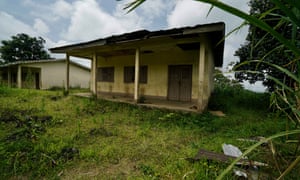
Government officials have put the number of closed schools at around 3,000 and said around 200 had been burned. The government claims it was separatists that torched the schools, but the separatists say military forces destroyed many of them when they found they were being used as rebel bases.
After the Amba boys left, Akwa immediately cancelled all her classes and left Bamenda, ending up in Logbessou, a neighbourhood of Douala. She found work, but struggles to make enough to live in Cameroon’s biggest city. She cannot grow beans and corn there as she did in her garden at home, so she has to buy them.
Sometimes she thinks about the pupils she left behind – like Noela, who was in primary school when the crisis began, and should have been well into secondary by now. She is not going to school. “Her mother told her to learn a trade,” Akwa said.
The consequence of so many girls being out of school is that the rate of teenage pregnancy has shot up, community leaders say.
Many of the older boys whose studies were abruptly stopped began driving motorbikes to make a living. When the government banned motorbikes in much of the north-west region for several months, residents of the city of Kumbo say, many then joined the separatists.
Fifteen-year-old George, whose name has been changed, said he had not been recruited by separatists because they valued physical strength and he was small for his age. He still wears his old blue and white school pullover to keep warm but has not been to school since 2016, instead spending his days hunting animals to sell and learning how to farm.
“I want to learn. I want to be educated, because I want to help myself in future,” he said. But if school does not resume this year, he could be well into adulthood by the time he has caught up on the lost years.
Whether they should support the back-to-school campaign has split anglophone separatists and protest leaders. A local chief was kidnapped last month as he oversaw the clean-up of one high school, according to the Cameroonian journalist Mimi Mefo.
Others who spearheaded the schools boycott now advocate its end, saying the long break in education has further marginalised the anglophone regions.
“The protest was to improve what we had, not to destroy the little we had,” said Mancho Bibixy, one of the most prominent protest leaders.
The headteacher of one primary school in Kumbo is thinking about reopening in September, but is caught between the demands of the government and separatists’ threats.
“We had meetings [with the government] and we were told that schools must resume this year,” said the headteacher, who asked not to be named. “Parents want their children to stay in school but the [Amba] boys have been threatening. If security is ensured, many parents will send their children.”
Security is by no means ensured, many residents of the anglophone regions say.
“No action is being taken to really prove they want children to go back to school. There’s no preparation,” said one community leader in Kumbo, who requested anonymity so he would not be targeted for speaking out. “If Unicef and other bodies could call for a ceasefire, school could resume, no problem.”
He has been holding a few conflict-specific lessons, training children to drop to the ground when they hear gunshots, and not to see joining the Amba boys as an attractive prospect.
One head teacher has tried everything to keep her school open, but parents in Kumbo have been keeping their children home because they are worried that they will get caught in one of the gun battles between the military and rebel fighters.
“We were able to register some 43 pupils last year at the beginning of the school year but some of them stopped coming. So we finally closed the school again,” she said.
Struggling even before the crisis, many teachers now cannot make ends meet. The Kumbo headteacher even offered lessons in the holidays – mainly to try to supplement her teachers’ dwindling incomes – but worried parents forbade their children from attending, and none showed up.
Others sent their children to Douala and Yaoundé, Cameroon’s two major cities.
“Even if we start this year, where would we take children from?” she asked. “They are all gone.”
Source: Guardian














3, September 2019
Grave Questions About Fairness of Trial: Ambazonia Leaders Appeal Conviction 0
Ten leaders of the separatist Ambazonia Interim Government in Cameroon lodged an appeal on August 26, 2019, against their August 20 convictions and life sentences by a military court following a trial that raises serious concerns of due process and violations of fair-trial rights.
Although the trial, on charges including terrorism, rebellion, and secession, commenced in December 2018, all the alleged evidence against the men was only presented to the defense in court during a single 17-hour overnight hearing that started on August 19. The court admitted thousands of pages of statements and documents as evidence against the accused and over 1,000 items of forensic evidence, such as guns, spears, and laptops, that defense lawyers told Human Rights Watch they did not know about and were unable to examine, discuss with their clients, or effectively challenge.
“It appears that the military court handed down a hasty verdict and sentence without giving the accused any meaningful opportunity to defend themselves,” said Lewis Mudge, Central Africa director at Human Rights Watch. “This process has been plagued by pretrial abuses and serious allegations of fair-trial breaches that warrant independent and impartial judicial review, which we hope will happen under appeal.”
The trial, which was conducted in French without adequate translation though the defendants were entitled to a trial in English, their mother tongue and an official language in Cameroon, took place after serious violations of the defendants’ rights in detention. Defense lawyers accused the judges of bias and withdrew from the proceedings after the main military judge threatened them with arrest for raising objections.
Sisiku Ayuk Tabe, head of what is known as the “Ambazonia government,” and nine other leaders had been arrested in January 2018 in Nigeria’s capital, Abuja, and forcibly returned to Cameroon, in an extrajudicial transfer that was denounced by the United Nations Refugee Agency as violating the fundamental principle of non-refoulement – the practice of not forcing refugees or asylum seekers back to a country where they risk persecution, torture, or other cruel, inhuman, or degrading treatment. The forced return of the 10 leaders was also declared illegal by a Nigerian court in March 2019. The men were then held in incommunicado detention at the State Defense Secretariat detention facility (Secrétariat d’État à la défense, SED) for six months, during which they had no access to their lawyers and families. Human Rights Watch has documented that torture and other abuses are endemic at the SED.
Fru John Nsoh, lead counsel for the separatist leaders, told Human Rights Watch that while the trial of his clients started in December 2018, all hearings prior to August 19 focused on peripheral procedural matters. He said that defense lawyers had no prior knowledge of the evidence presented to the court by the prosecution, and were not given any chance to view, comment, or object to the evidence, nor were they permitted to cross examine the four witnesses called by the prosecution.
The men were also tried before a military tribunal, despite international standards deeming the trial of civilians in military courts, in principle, to be incompatible with the right to a fair trial. Cameroon has been condemned by the UN Human Rights Committee for prosecuting civilians before military tribunals. The African Commission on Human and Peoples’ Rights has also repeatedly reinforced that under regional human rights standards, including the African Charter on Human and Peoples’ Rights, the trial of civilians in military courts is prohibited without exception, and that the only purpose of military courts should “be to determine offences of a purely military nature committed by military personnel.”
The crisis unfolding in Cameroon’s Anglophone regions broke out around October 2016, when students, teachers, and lawyers from the region took to the streets to demand greater respect for their rights. In response, security forces unlawfully killed and arbitrarily arrested peaceful protesters, escalating the crisis. Since then, numerous separatist groups have emerged, taking up arms and calling for the independence of the North-West and South-West regions, which they call “Ambazonia.”
Armed separatists have committed numerous abuses against civilians, including kidnappings for ransom, torture, and unlawful killings. They have also attacked dozens of school buildings and occupied them. They have also enforced a boycott of schools, disrupting the education of thousands of children since 2017. Human Rights Watch cannot comment on the credibility of the charges brought against the men in connection with any crimes committed by armed separatists.
The Cameroon military court also ordered the 10 men to pay fines totalling 262 billion CFA francs (US$442,000) for civil damages and court costs.
“To conduct a trial with these kinds of due process violations is no way to uphold rule of law and human rights in the midst of an escalating crisis in the Anglophone regions of Cameroon,” Mudge said. “The Cameroonian authorities should focus on addressing the legitimate grievances of its Anglophone population and make sure that members of the security forces who are responsible for abuses are held accountable.”
Source: Human Rights Watch